Blade Steel: Sandvik 14C28N—The Swedish Mid‑Grade With Near‑Premium Ambitions
The blade of the AC‑700 is forged from Sandvik 14C28N, a Swedish stainless steel that has been used by Kershaw and other manufacturers in knives positioned at the upper end of the mid‑grade spectrum. Sandvik developed 14C28N specifically in response to knife industry feedback, optimizing it for edge stability, corrosion resistance, and hardness. It contains approximately 0.60% carbon and 14% chromium, along with nitrogen additions that enhance corrosion resistance and promote a fine grain structure. The steel is capable of taking an extremely keen, razor‑sharp edge—sharper, in the experience of many users, than the more wear‑resistant powder‑metallurgy steels—and it sharpens easily on a range of abrasives. The edge retention is not at the level of S30V or D2, but it is among the best in the mid‑grade category, and it far exceeds the performance of entry‑level steels like 440A or 3Cr13. For a knife that may be used defensively—where extreme sharpness out of the box is a critical requirement—14C28N is a thoughtful and appropriate choice.
The blade is shaped into a drop‑point profile, with a 3‑3/16‑inch cutting edge and a plain, non‑serrated grind. The drop point provides a balanced combination of tip strength, belly for slicing, and ease of sharpening, making it the most versatile and widely recommended blade shape for general use. The blade is finished with a black coating—likely a durable epoxy or PVD finish—that covers all surfaces except the edge grind. The black finish serves multiple purposes: it eliminates glare and reflections, which is important for a defensive knife that may be deployed in tactical situations; it provides a measure of corrosion resistance, protecting the blade from rust during carry in humid or sweaty conditions; and it gives the knife a cohesive, purposeful aesthetic that matches its automatic deployment. The only reflective surface on the entire knife is the narrow strip of bare steel at the cutting edge, visible only when the blade catches the light at a specific angle. This attention to light discipline speaks to the knife's intended role as a defensive tool.
The Handle: Aircraft Aluminum, Textured for Grip, and Comfortable in Reverse
The handle of the AC‑700 is machined from aircraft‑grade aluminum, a material chosen for its excellent strength‑to‑weight ratio and its ability to be precisely machined and anodized. The handle slabs are anodized in a matte black or dark charcoal finish that matches the blade coating, creating a monochromatic look that is visually understated. The surface is textured with a pattern of small, angular indentations that provide grip security without being abrasive. For an all‑metal handle, the texture is surprisingly effective; the knife does not feel like it will slip during use, even with a moderately sweaty palm. The handle profile features a gentle curve that fills the palm comfortably, with a forward choil for the index finger and a slight pommel swell at the butt that anchors the hand during cutting strokes. The knife is notably compact for an automatic tactical folder; its size is closer to a typical EDC than the oversized, palm‑filling autos that dominate the category. This makes it a more practical choice for everyday carry, as it does not require a dedicated belt pouch or oversized pocket. At 4.1 ounces, it is light enough to carry in a jeans pocket without sagging the fabric, and its closed length of 4.5 inches allows it to sit comfortably alongside a smartphone and keys.
Deployment: The Automatic Button That Changes Everything
The defining feature of the AC‑700 is its automatic deployment mechanism. A discreet push‑button is located on the presentation side of the handle, positioned just slightly forward of the midpoint. Pressing the button releases the blade, which fires open under spring tension with a speed and authority that no manual or assisted knife can match. The action is fast—the blade is open and locked before your thumb has fully depressed the button—and it is accompanied by a distinctive mechanical report that is deeply satisfying. The mechanism is reliable; in hundreds of test deployments, I did not experience a single failure to lock, a single premature release, or a single instance of the blade failing to fully open. Below the deployment button is a sliding safety switch that, when engaged, physically blocks the button from being pressed. The safety can be activated when the blade is open or closed. As is customary on automatic knives, red indicates the "dead" or unlocked position, and the user slides the switch away from red to engage the safety. The safety is easy to operate with the thumb and provides a meaningful layer of protection against accidental deployment in a pocket or bag. Disengaging the safety and pressing the button becomes a single, fluid motion with practice, and the knife can be deployed in well under a second.
The only minor criticism I have of the mechanism is the presence of a slight amount of blade play in the open position—a small degree of vertical and lateral movement that is common on automatic knives and does not affect function. The blade is securely locked and will not close unintentionally; the play is simply a characteristic of the tolerances required for a spring‑fired mechanism. It is worth noting, but it is not a defect.
The Clip: Reversible, Tip‑Up, and Very, Very Tight
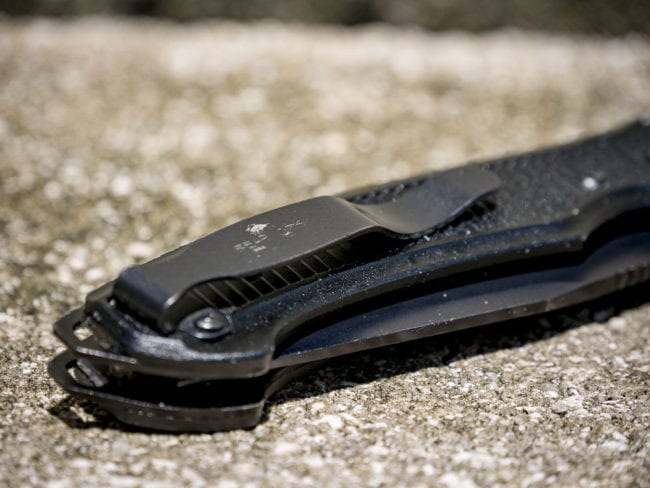
The AC‑700 features a reversible pocket clip that can be switched between left‑ and right‑side carry, with tip‑up orientation only. The clip is a stamped steel design with a black oxide finish, and it is secured by a single screw. The tension on the clip is, in my opinion, excessive. Out of the box, the clip was so tight that I struggled to slide the knife onto the pocket seam of my jeans without using two hands. If you are the type of user who carries the same knife every day and never switches it between different pants or pockets, this tightness can be managed by wearing the pocket seam in over time. But if you frequently switch between jeans, work pants, and dress slacks, or if you prefer to clip your knife to thinner fabrics like shorts or khakis, the clip will be frustrating. The tightness also accelerates wear on the pocket fabric; I noticed the seam of my jeans beginning to fray more quickly than with other knives. The good news is that the clip is also very strong and is unlikely to bend out or lose tension over time, a common failure mode for budget‑friendly knives. It is a trade‑off: maximum security at the expense of convenience.
Bear OPS AC‑700 Bold Action VII Automatic Specifications
| Specification | Detail |
|---|---|
| Model | Bear & Son AC‑700‑AIBK‑B |
| Blade Material | Sandvik 14C28N Stainless Steel |
| Blade Style | Drop Point |
| Blade Length | 3‑3/16 inches |
| Closed Length | 4‑1/2 inches |
| Open Length | 7‑7/8 inches |
| Handle Material | Aircraft Aluminum |
| Locking Mechanism | Push Button Automatic |
| Pocket Clip | Left/Right Reversible, Tip‑Up |
| Weight | 4.1 oz |
| Country of Origin | USA |
| MSRP | $150.00 |
| Street Price | ~$90‑$100 |
Legal Considerations and Practical Carry
Automatic knives are not legal to own or carry in all jurisdictions. Before purchasing the AC‑700, confirm the laws in your state and municipality. Some states restrict automatic knives to military and law enforcement personnel; others prohibit carry but allow ownership; still others have no restrictions at all. The AC‑700, with its 3‑3/16‑inch blade, may also exceed blade‑length limits in certain cities or counties. This is not a knife to purchase impulsively without understanding the legal landscape. For those who live in a jurisdiction where automatic knives are lawful, the AC‑700 offers a combination of performance, American manufacturing, and affordability that is difficult to match. The deployment is genuinely thrilling—faster and more dramatic than any spring‑assisted or manual knife—and the build quality is solid. The Sandvik 14C28N blade takes an excellent edge and holds it reasonably well, and the aircraft aluminum handle is lightweight, strong, and comfortable. The tight pocket clip is an annoyance, but it can be adjusted or accepted. At its street price, the AC‑700 is an excellent entry point into the world of automatic knives, and a worthy representative of Bear & Son Cutlery's American manufacturing heritage.
Conclusion: An American Automatic That Punches Above Its Price
The Bear OPS AC‑700 Bold Action VII Automatic is not a knife for everyone. It is a knife for the enthusiast who values deployment speed above all else, who appreciates the mechanical complexity of a push‑button automatic, and who lives in a jurisdiction where such knives are legal. It is made in the USA by a family‑owned company with over fifty years of knife‑making experience, and it carries that heritage in its tight tolerances and solid construction. The Sandvik 14C28N steel provides excellent sharpness and decent edge retention, and the aircraft aluminum handle keeps weight down without sacrificing strength. The tight pocket clip is the only ergonomic wart on an otherwise well‑executed design. At a street price under $100, the AC‑700 is a compelling value in the automatic category—a knife that fires with authority, carries with comfort, and reminds its owner every time it deploys why automatic knives inspire such fierce loyalty.
Comments 0
Leave a Comment