The Hardware: Extruded Aluminum, Slide‑Out Lumen Maintenance Trays, and an Occupancy Sensor
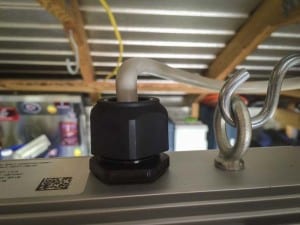
The Garage Light is a rectangular fixture, 23.1 inches long, 9.2 inches wide, and 4.6 inches thick, housed in a heavy‑duty extruded aluminum frame with an anodized finish. The aluminum extrusion serves a dual purpose: it is the structural chassis of the light, and it is the heat sink that dissipates the waste heat generated by the LEDs. The back of the light—the entire surface that faces away from the illuminated area—is a continuous field of aluminum fins, designed to maximize surface area for convective cooling. The quality of the extrusion and the machining is immediately apparent when you handle the light. It is heavy—16 pounds for a fixture that is less than two feet long—and the weight is a direct consequence of the amount of aluminum used. This is not a stamped‑steel fluorescent housing with a thin coat of paint. This is a substantial, industrial‑grade piece of equipment that feels like it belongs in a factory or a machine shop. The LEDs themselves are arranged in two rows, protected behind what Big Ass calls Lumen Maintenance Trays, or LMTs. These are clear, polycarbonate shields that slide into grooves in the aluminum housing, covering the LED strips. The LMTs serve three functions. First, they protect the LEDs from dust, insects, moisture, and physical impact. Second, they diffuse the light, softening the harsh point‑source glare of the individual LED chips and creating a smooth, even wash of illumination. Third, and most importantly, they can be removed for cleaning. If dust, dead bugs, or other debris accumulate inside the fixture—an inevitability in a garage or workshop environment—you simply slide the LMTs out, wash them with soap and water, dry them, and slide them back in. The LEDs themselves remain untouched and protected. This is a feature that addresses a real, practical problem with many LED fixtures: the gradual accumulation of grime that dims the light and cannot be cleaned without risking damage to the electronics. The Garage Light solves this problem with elegant simplicity. The standard LMT is a Diffused type, which produces a 112‑degree beam spread. The wide beam angle is ideal for general area illumination—it floods the room with light, minimizing shadows and creating a comfortable, uniform brightness. Big Ass also offers, on their larger commercial fixtures, a range of other LMT options for different beam patterns, but the Garage Light comes only with the Diffused LMT. The light is designed to be hung from the ceiling using the integrated eyebolts at each end. It comes with steel S‑hooks and additional eyebolts for attaching to chains or steel cable. Installation is straightforward: attach the chains or cables to the ceiling structure, hook the S‑hooks through the eyebolts, and plug in the 10‑foot power cord. The light can also be ordered with optional wall and column mounts for applications where ceiling hanging is not feasible. One of the most appealing optional features is the occupancy sensor, which can be added to the light for approximately $40. The sensor, housed in a dome‑protected module on the bottom face of the fixture, detects motion and ambient light levels, automatically turning the light on when someone enters the space and off after a set period of inactivity. The sensor has two trim pots that allow the user to adjust the sensitivity to ambient light (so the light will not turn on during the day if the space is already bright enough) and the shut‑off delay (adjustable from 30 seconds to 30 minutes). For a small workshop, a shed, or a garage where the light is frequently needed for short periods, the occupancy sensor is a transformative convenience. You walk in, and the light turns on. You walk out, and it turns off. No fumbling for a switch in the dark, no forgetting to turn off the light and wasting electricity. There is a brief warm‑up period—about a minute—when the sensor is first powered on, during which it calibrates itself. After that, the sensor operates essentially flawlessly. I installed the Garage Light with the occupancy sensor in my shed, and every single time I walked through the door, the light came on instantly. It is the most convenient feature in a light that I can think of, and for the spaces where it is appropriate—a single‑light installation in a small room—it is well worth the additional cost.
Light Output and Quality: 13,000 Lumens, 5,000K, and the Fluorescent Comparison
The raw numbers tell an impressive story. The Garage Light produces 13,000 lumens—equivalent to the output of a 250‑watt metal halide high bay or roughly 4.5 standard four‑foot T8 fluorescent fixtures. It achieves this output while consuming only 122 watts of power, for an efficacy of approximately 114 lumens per watt. By comparison, a typical four‑bulb T8 fluorescent fixture produces about 11,200 lumens while consuming 128 watts—slightly less light for slightly more power, and with a lamp life of only 25,000 hours compared to the Garage Light's 150,000‑hour rating. The color temperature is 5,000 Kelvin—a crisp, neutral white that closely approximates the color of midday sunlight and that renders colors accurately. It is slightly yellower than the 6,500K "daylight" color temperature that some LED products use, and that is a good thing for a workspace. The 5,000K light is bright and clear without being harsh or clinical, and it creates a comfortable, natural‑feeling illumination that is easy on the eyes even after hours of exposure. The 112‑degree beam spread, combined with the diffusing LMT, produces a remarkably even wash of light. There are no hot spots directly under the fixture, no dark zones between fixtures, and no harsh shadows. The light simply fills the room, creating a bright, uniform, shadow‑free environment that is ideal for detailed work. In my 12‑by‑14‑foot shed, a single Garage Light replaced a two‑bulb T8 fluorescent fixture and provided more than twice the light output in less than half the physical space. The difference was dramatic and immediate—the shed went from a dim, slightly yellow workspace to a brilliantly lit, neutral‑white environment that made every task easier. In a larger 2,000‑square‑foot steel building, a single Garage Light installed in a corner provided enough illumination for the fabrication and project‑build area directly beneath it, though additional lights would be needed to illuminate the entire space uniformly for general use. The light is designed primarily for single‑fixture installations in garages, sheds, workshops, and similar spaces up to about 400 square feet, where a single unit can provide all the ambient light needed. For larger spaces, multiple fixtures can be installed, and the 112‑degree beam spread allows them to be spaced relatively far apart while still providing even coverage.
The Longevity Promise: 150,000 Hours and the Death of the Fluorescent Tube
The most compelling argument for investing in the Big Ass Garage Light, particularly for a professional or a serious hobbyist who uses their workspace regularly, is the longevity of the LED light source. Big Ass rates the LEDs for an L70 lifespan exceeding 150,000 hours at an ambient temperature of 25 degrees Celsius (77 degrees Fahrenheit). The L70 rating means that after 150,000 hours of continuous operation—that is over 17 years of 24/7 use, or over 51 years of 8‑hour‑per‑day use—the LEDs will still produce at least 70% of their initial light output. The light will not have failed; it will simply have gradually dimmed to the point where replacement might be considered, though 70% of 13,000 lumens—9,100 lumens—is still a very bright light by any standard. The significance of this lifespan figure becomes clear when compared to the alternatives. A fluorescent T8 tube is typically rated for 25,000 hours—less than one‑sixth of the Garage Light's lifespan. In practice, fluorescent tubes rarely achieve their rated life in a garage or workshop environment, where temperature swings, vibration, and frequent on‑off cycling take a toll on the filaments and the ballast. The fluorescent fixtures themselves degrade over time, with reflectors becoming dull, sockets becoming loose, and ballasts failing. The Garage Light, by contrast, has no filaments to burn out, no gas to leak, no ballast to fail, and no sockets to corrode. It is a solid‑state device with no consumable components except the LEDs themselves, and those LEDs are rated to last longer than most people will own their homes. The energy savings, while significant, are almost a secondary benefit when compared to the elimination of maintenance. Over the life of the fixture, the owner of a Garage Light will never purchase a replacement bulb, never climb a ladder to wrestle a flickering tube out of a sticky socket, never dispose of a mercury‑containing fluorescent lamp, and never replace a failed ballast. The light is installed once, and it works, essentially forever. The 7‑year complete fixture warranty, which covers the power supply and all components, provides additional peace of mind. If anything fails within the first 7 years, Big Ass will repair or replace the light at no cost. After 7 years, the LEDs themselves are still covered for the remainder of their 150,000‑hour rated life.
Big Ass Garage Light Specifications
| Specification | Detail |
|---|---|
| Model | BAL‑SHL1‑13050104100900 |
| Dimensions | 23.1″ × 9.2″ × 4.6″ (59 × 23 × 12 cm) |
| Color Temperature | 5,000 K |
| Lumen Output | 13,000 lm |
| Wattage | 122 W |
| Efficacy | 114 lumens/watt |
| L70 Lifespan | 150,000 hours (at 25°C / 77°F) |
| Lumen Maintenance Tray | Diffuse Only (112° beam spread) |
| Cord Length | 10 ft (3 m) with plug |
| Weight | 16 lbs (7.3 kg) |
| Warranty | 7‑year complete fixture warranty |
| Price | $399 (plus $40 for occupancy sensor option) |
Conclusion: The Last Garage Light You Will Ever Need to Buy
The Big Ass Garage Light is not a casual purchase. At $399, it costs as much as eight cheap fluorescent shop lights, and for someone who only occasionally uses their garage or workshop, that kind of investment is difficult to justify. But for the professional mechanic, the dedicated woodworker, the serious hobbyist, or anyone who spends significant time working in their garage or shop and who values good lighting, the Garage Light is a genuinely transformative upgrade. The quality of the light—the brightness, the evenness, the color accuracy—is immediately apparent the first time you turn it on. The build quality—the extruded aluminum chassis, the slide‑out LMTs, the industrial‑grade hardware—inspires confidence that the light will still be performing flawlessly decades from now. The occupancy sensor option adds a layer of convenience that, once experienced, is very hard to live without. And the 150,000‑hour LED lifespan, combined with the 7‑year comprehensive warranty, essentially eliminates the maintenance and replacement cycle that has defined fluorescent lighting for as long as it has existed. The Garage Light is not merely a good light. It is, for the spaces it is designed for, the last light you will ever need to buy. And that, in a world of disposable products and planned obsolescence, is a genuinely rare and valuable thing.
Comments 0
Leave a Comment