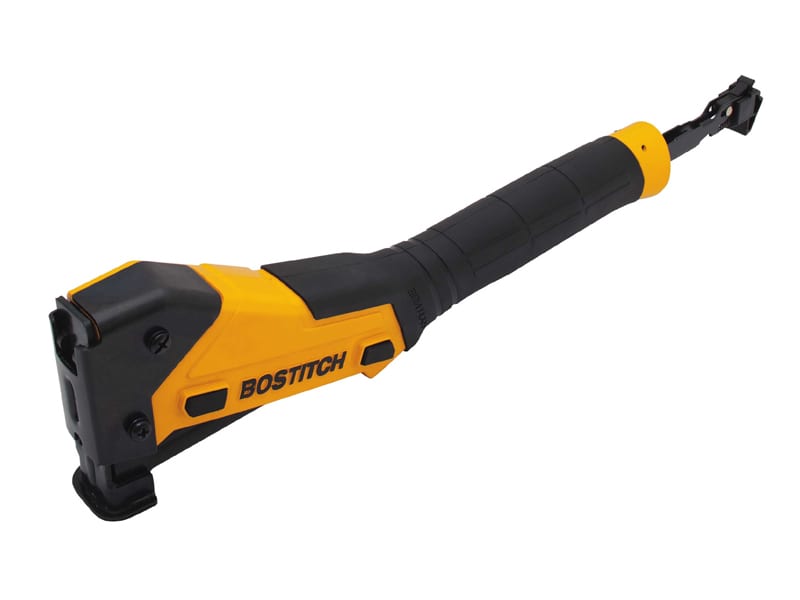
The Physics of Vibration: Why It Matters, and How Bostitch Addressed It
To understand why the Bostitch Anti‑Vibe Hammer Tacker is a meaningful improvement over a standard hammer tacker, it is necessary to understand, at least in broad terms, what vibration does to the human body. When a tool strikes a surface, the kinetic energy of the tool is converted into several forms: some of it does useful work, driving the staple into the material; some of it is dissipated as sound; and some of it reflects back through the tool as vibration. That vibration travels through the tool's structure and into the user's hand, where it is absorbed by the soft tissues—the skin, the muscles, the tendons—and transmitted to the bones and joints. The body can tolerate a certain amount of vibration without harm, but repeated exposure, day after day, year after year, can cause damage. The small blood vessels in the fingers can constrict, reducing circulation and leading to the numbness and blanching known as vibration white finger, or hand‑arm vibration syndrome (HAVS). The tendons and ligaments can become inflamed, leading to chronic pain and reduced grip strength. The joints can develop arthritis at an accelerated rate. These conditions are not dramatic—no one is rushed to the emergency room with a hammer tacker injury—but they are cumulative, progressive, and largely irreversible. The Occupational Safety and Health Administration (OSHA) and its international equivalents recognize vibration as a workplace hazard, and they set exposure limits that employers are required to observe. But the most effective mitigation is to reduce the vibration at its source—to build the tool in such a way that less vibrational energy reaches the user's hand. The Bostitch Anti‑Vibe Hammer Tacker does this with two design modifications. The first is the multi‑layer grip. The handle of the hammer tacker is not a simple piece of molded plastic or rubber. It is a composite of multiple layers, each with different mechanical properties, designed to absorb and dissipate shock. The outer layer, which contacts the user's hand, is a soft, compliant material that deforms slightly under pressure and provides a comfortable, non‑slip surface. Beneath that, a firmer layer provides structural support and additional damping. Together, the layers act as a mechanical filter, reducing the amplitude of the vibration that reaches the hand. The second modification is the die‑cast aluminum housing. Aluminum, as a material, has a natural ability to damp vibration—it is one of the reasons that aluminum engine blocks and cylinder heads are quieter and smoother than their cast‑iron counterparts. By making the body of the hammer tacker from die‑cast aluminum rather than stamped steel, Bostitch created a tool that is both lighter and less resonant. The aluminum housing absorbs vibrational energy and converts it into a very small amount of heat, rather than transmitting it efficiently to the handle. The result, according to Bostitch, is a 16 percent longer service life compared to Arrow's HTX50, a figure that encompasses both the tool's durability and the user's ability to work longer without fatigue. A 16 percent improvement may not sound dramatic, but over the course of a career—hundreds of thousands of swings, millions of staples—it represents a significant reduction in the cumulative vibrational dose absorbed by the user's hand and arm. For the professional roofer, insulation installer, or house wrap contractor, that reduction could mean the difference between a long, healthy career and an early forced retirement due to hand and wrist problems.
The Anti‑Jam Mechanism: Bostitch's Solution to the Most Frustrating Moment in Hammer Tacking
The second major feature of the Bostitch Anti‑Vibe Hammer Tacker is the AntiJam loading mechanism, a redesign of the staple feed system that aims to eliminate the staple jam—the infuriating moment when a staple becomes lodged in the firing channel, the tool refuses to fire, and the user must stop work, open the magazine, extract the mangled staple, reload, and resume. For a professional who is working on a production schedule—a roofer trying to dry in a house before the afternoon thunderstorms, an insulation crew working against the clock to get a building ready for drywall—every jam is a small crisis. It costs time directly, through the seconds or minutes required to clear it, and it costs time indirectly, by breaking the rhythm of the work and forcing the user to refocus after the interruption. The Bostitch AntiJam mechanism addresses this problem in two ways. First, it uses a redesigned staple pusher that flexes under load. When a staple misfires—when it is not fully driven or when it becomes misaligned in the firing channel—the flexing pusher absorbs the energy of the misfire and prevents the staple from becoming permanently lodged. The pusher acts as a sort of mechanical shock absorber, allowing the misfired staple to clear itself without jamming. This self‑clearing action reduces the frequency of jams significantly, because many potential jams are resolved before they require user intervention. Second, when a jam does occur—and no system can eliminate jams entirely—the loading mechanism is designed to make clearing the jam easier and faster. The bottom‑load magazine opens with a simple one‑handed operation, allowing the user to access the firing channel and remove the obstruction without tools and without the risk of losing or damaging the staple pusher. The magazine is designed so that the pusher cannot be accidentally dislodged during loading, a common problem with lesser hammer tackers where an over‑enthusiastic tug on the magazine door can send the pusher flying across the room. The combination of the self‑clearing pusher and the easy‑access magazine design means that the Bostitch Anti‑Vibe requires less downtime for jam clearing over the course of a workday—a small improvement that, like the vibration reduction, compounds into a meaningful productivity gain over weeks and months of use.
Other Features: Slip‑Resistant Bumpers, Low Activation Force, and Lightweight Aluminum
The Bostitch Anti‑Vibe Hammer Tacker incorporates several additional features that enhance its usability and durability. The rubber bumpers on the base of the tool are designed not merely to protect the tool when it is set down but to prevent it from sliding when placed on an inclined surface. A roofer working on a pitched roof, an insulation installer working on a sloped attic floor, or a house wrap contractor working on scaffolding often needs to set the hammer tacker down momentarily while adjusting material or reaching for another tool. A tacker that slides off the roof and clatters to the ground is an annoyance, a safety hazard, and, if it falls far enough, a trip to the tool store for a replacement. The slip‑resistant bumpers significantly reduce the likelihood of this scenario. The activation force—the amount of downward pressure required to fire a staple—has been reduced compared to previous Bostitch models. This lower activation force means that the user does not need to swing the tool as hard to drive a staple, which reduces both the impact shock to the hand and the effort required per swing. Over hundreds of swings, that reduction in effort translates into less fatigue. The die‑cast aluminum housing, in addition to its vibration‑damping properties, provides durability while keeping the overall weight of the tool manageable. A hammer tacker must be heavy enough to drive a staple with authority—a tool that is too light requires the user to swing harder, which defeats the purpose—but not so heavy that it becomes a burden to carry and swing all day. The Bostitch Anti‑Vibe strikes a reasonable balance at just over 2 pounds, with enough mass to drive 1/2‑inch heavy‑duty staples into roofing felt, house wrap, insulation, and similar materials without excessive effort.
Applications: Roofing, House Wrap, Insulation, and Beyond
The hammer tacker is a specialized tool, and its applications, while not numerous, are fundamental to several major trades. Roofers use hammer tackers to secure roofing felt, synthetic underlayment, and ice‑and‑water shield to the roof deck before the shingles, tiles, or metal panels are installed. The speed of a hammer tacker—a staple per swing, a swing per second, a roof dried in by mid‑morning—is essential to a trade where time is literally money and where getting the building weather‑tight before the next rainstorm is a constant concern. Insulation installers use hammer tackers to secure fiberglass batts, radiant barrier, and vapor retarder to wall studs, ceiling joists, and floor framing. The tool allows them to work quickly while keeping their hands free to position the insulation. House wrap contractors use hammer tackers to secure Tyvek, Typar, and similar moisture‑barrier membranes to the exterior sheathing of buildings. The staples must be spaced closely enough to hold the wrap securely against wind uplift but not so closely that they create unnecessary holes in the membrane. The hammer tacker's rapid‑fire capability allows the contractor to achieve the correct staple density without slowing the pace of work. Flooring installers use hammer tackers to secure underlayment, rosin paper, and lath for tile and stone installations. Furniture upholsterers use hammer tackers to stretch and secure fabric to frames. General contractors find dozens of miscellaneous uses for the tool—tacking up temporary barriers, securing protective sheeting, fastening signs and notices. The Bostitch Anti‑Vibe Hammer Tacker accepts 3/8‑inch, 5/16‑inch, and 1/2‑inch heavy‑duty staples, covering the most common staple sizes used in these applications. The bottom‑load magazine makes reloading fast, and the AntiJam mechanism keeps the tool running smoothly through the inevitable misfires that occur in production work.
Bostitch Anti‑Vibe Hammer Tacker Specifications
| Specification | Detail |
|---|---|
| Model | Bostitch BTHTHT550 |
| Staple Capacity Range | 3/8″, 5/16″, 1/2″ heavy‑duty staples |
| Overall Length | 13.25 inches |
| Housing Material | Die‑cast aluminum |
| Grip | Multi‑layer Anti‑Vibe with slip‑resistant bumpers |
| Loading | Bottom‑load with AntiJam mechanism |
| Warranty | Limited Lifetime |
| Price | $31.49 |
Who Should Buy the Bostitch Anti‑Vibe Hammer Tacker?
The Bostitch Anti‑Vibe Hammer Tacker is a professional‑grade tool aimed at the tradesperson who uses a hammer tacker as a primary fastening method. For the roofer who spends days drying in houses, the insulation installer who staples batts by the thousand, the house wrap contractor who secures thousands of square feet of membrane, the Anti‑Vibe offers a meaningful reduction in hand vibration and a corresponding reduction in long‑term injury risk. The AntiJam mechanism reduces downtime and frustration, while the slip‑resistant bumpers and low activation force make the tool easier and safer to use. At $31.49, it is priced slightly higher than a basic hammer tacker, but the additional cost is easily justified by the durability of the die‑cast aluminum housing, the effectiveness of the vibration damping, and the lifetime warranty that backs the tool. For the occasional user—the homeowner who is tackling a single roofing project, the DIYer who needs to staple house wrap on a shed—a less expensive tacker may suffice. But for the professional, the Bostitch Anti‑Vibe Hammer Tacker is not an expense; it is an investment in productivity, comfort, and the long‑term health of the hand that earns the paycheck. It is a tool that takes a category long neglected by innovation and improves it in ways that matter on the very first swing, and that continue to matter every swing thereafter.
Comments 0
Leave a Comment