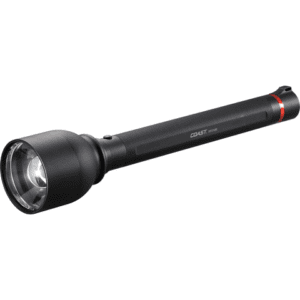
The HP314R occupies an interesting position in Coast's lineup. For years, Coast was known primarily for producing solid, reliable, mid‑range flashlights and headlamps—tools that offered excellent value and competent performance but rarely ventured into the high‑output, high‑price territory dominated by brands like LEDLenser, Fenix, and Nitecore. The HP314R, with its $499 MSRP, its 1,200‑lumen alkaline output, and its sophisticated dual‑power system, represents Coast's deliberate move into that premium space. It is a statement product, designed to compete with the best handheld searchlights on the market, and it brings to that competition a combination of features—the dual‑power flexibility, the slide‑focus optics, the USB charging output—that are genuinely distinctive. For the professional who needs a searchlight that can run for hours on easily sourced alkaline batteries, who wants the ability to focus the beam from a piercing spot to a room‑filling flood, and who appreciates the security of knowing that their flashlight can double as a backup battery for their phone, the HP314R is a compelling, if expensive, proposition. For the serious outdoor enthusiast, the hunter, the boater, the search‑and‑rescue volunteer, or anyone who ventures far from the electrical grid and needs a light that will not fail them, the HP314R warrants a close examination. It is not an impulse purchase, but then, neither is a winch, a satellite phone, or any of the other equipment that serious backcountry travelers invest in. It is a tool for people who understand that, in the dark, light is safety, light is capability, and light—bright, reliable, long‑lasting light—is worth paying for.
The Flex Charge Dual Power System: Lithium Rechargeable Meets Alkaline D‑Cells
The defining feature of the Coast HP314R is its dual‑power capability, a system that Coast calls Flex Charge. The flashlight can be powered by either the included rechargeable lithium‑ion battery pack or by four standard D‑cell alkaline batteries. The two power sources are not merely interchangeable; they each confer different performance characteristics on the light, and the user can choose between them based on the demands of the situation. The rechargeable lithium‑ion pack provides the convenience of never having to buy disposable batteries. It recharges via the Pro‑Tek charging port, located under a threaded tail cap, which accepts a standard AC adapter or can be connected to a USB power source. The pack can be charged inside the flashlight, which means the user does not need a separate battery charger—simply plug the light into a wall outlet or a USB port, and it recharges. Alternatively, the pack can be removed and charged externally, allowing the user to keep a spare pack on the charger and swap them as needed, ensuring that the flashlight is never out of commission while waiting for a recharge. The lithium pack also serves as a portable power bank. A USB output port on the pack allows the user to connect a cable and charge other devices—a smartphone, a GPS receiver, a satellite communicator—directly from the flashlight. In an emergency, when a dead phone means a lost navigation tool, a broken communication link, or an inability to call for help, this feature could be genuinely life‑saving. The trade‑off for the lithium pack's convenience is a slight reduction in peak output and beam distance. When running on the rechargeable pack, the HP314R produces 1,000 lumens on high and throws a beam 2,693 feet. These are still formidable numbers—a thousand lumens is more than enough to light up a football field, and a beam that reaches over half a mile is far beyond what most flashlights can achieve. But they are slightly lower than the numbers achieved with alkaline batteries.
The alkaline D‑cell configuration unlocks the flashlight's maximum performance. With four D‑cells installed, the HP314R produces 1,200 lumens on high—a 20% increase over the lithium pack—and throws a beam an astonishing 2,762 feet, or 842 meters. That is more than half a mile of reach. To put that in perspective, it is the length of roughly nine football fields laid end to end. The user standing at one end of a large warehouse, a long bridge, or an open field can illuminate objects at the far end with enough clarity to identify them. The D‑cell configuration also dramatically extends run time on the lowest setting. On low, with alkaline batteries, the HP314R will run for an astounding 94 hours—nearly four full days of continuous illumination at 165 lumens. On the lithium pack, the low setting produces 105 lumens and runs for 85 hours. These run times make the HP314R an excellent choice for extended power outages, for remote camps where battery changes are impractical, or for any scenario where the light must operate for days without access to electricity. The D‑cell batteries are universally available—any gas station, convenience store, supermarket, or hardware store stocks them—which means the flashlight can be resupplied almost anywhere in the world. For the professional who works in remote locations, for the disaster relief worker deployed to an area without infrastructure, or for the prepper who wants a light that can be sustained indefinitely with off‑the‑shelf batteries, the alkaline capability is a decisive advantage. The dual‑power system is not merely a convenience; it is a statement of philosophy. Coast has designed the HP314R to be useful in the broadest possible range of scenarios, constrained not by a single battery format but by the user's access to power. If you have time to recharge, use the lithium pack. If you need maximum brightness and the longest throw, load it with D‑cells. If you need to charge your phone in an emergency, the lithium pack has you covered. The flexibility is genuine, and it is the kind of thoughtful, user‑centric design that distinguishes a premium tool from a commodity one.
Pure Beam Optics and Slide Focus: From Searchlight Spot to Room‑Filling Flood
Coast's reputation rests, in no small part, on its optical systems. The company's Pure Beam Optics, which are incorporated into the HP314R, are designed to produce a beam that is free of the artifacts, hot spots, halos, and dark rings that plague lesser flashlights. The goal is a beam that is either a perfectly uniform circle of light in flood mode or a crisp, well‑defined spot with a smooth transition from the central hotspot to the surrounding spill in spot mode. The HP314R achieves this goal admirably. The X‑Rage Spot Beam, as Coast terms the maximum‑focus setting, produces a tight, penetrating shaft of light that reaches extreme distances while maintaining a useful amount of peripheral illumination. There is enough spill—the dimmer light surrounding the central hotspot—to provide peripheral awareness, which is critical for navigation and situational awareness when using the light outdoors. You can see not only the object at the center of the beam, but also the ground immediately around you, without having to sweep the light back and forth. The Broad Flood Beam, achieved by pulling the Slide Focus bezel rearward, spreads the light into a wide, even wash that is ideal for illuminating a large area at close to medium range. In flood mode, the light can illuminate an entire room, a wide section of trail, or a broad work area, with no distracting hot spot that would draw the eye to the center and leave the periphery in relative darkness. The Slide Focus mechanism is simple, robust, and effective. The bezel slides forward and backward along the body of the flashlight with a smooth, damped motion. There are no detents, no steps—the focus is continuously variable between the two extremes, allowing the user to fine‑tune the beam to the exact width required by the task at hand. The mechanism feels durable, with no wobble, no gritty drag, and no tendency to shift on its own during use. It can be operated with one hand, even when wearing gloves, and it provides a tactile satisfaction that makes adjusting the beam a pleasure rather than a chore.
The Cyclone Heat Sink: Active Thermal Management for Sustained Brightness
High‑output LED flashlights generate heat. It is an unavoidable consequence of the physics of solid‑state lighting: the LED chip converts a portion of the electrical energy it receives into visible light, and the remainder into heat. If that heat is not effectively dissipated, the LED temperature rises, and as it rises, the efficiency of the LED decreases—a phenomenon known as thermal droop. The light becomes dimmer, not because the battery is depleting, but because the LED is overheating. In extreme cases, sustained overheating can permanently damage the LED, reducing its brightness and shortening its lifespan. Coast addresses this with the Cyclone Heat Sink System, a thermal management design that pulls heat away from the LED and into the body of the flashlight, where it can be dissipated into the surrounding air. The aluminum casing of the HP314R, with its substantial mass and its finned exterior, acts as a large, passive radiator. Heat is conducted from the LED mounting board to the aluminum body through direct contact with the heat sink, and the large surface area of the body transfers that heat to the air through natural convection. The Cyclone system is designed to facilitate this heat transfer—the name presumably refers to the way the heat is "spun" or channeled away from the emitter through the internal structure of the heat sink. The practical result is that the HP314R can sustain its maximum brightness for longer periods without dimming to protect the LED. The light will still eventually reduce output if it becomes too hot—this is a safety feature, not a flaw—but the threshold at which that occurs is higher than it would be with a less sophisticated thermal design. For the user, this means more time at full brightness, less time waiting for the light to cool, and a longer overall lifespan for the LED itself. The Cyclone system, combined with the high‑quality Cree LED at the heart of the HP314R, contributes to the flashlight's overall reliability and longevity. This is a light that is engineered to perform consistently, day after day, in demanding conditions, and the attention to thermal management is one of the details that separates it from cheaper, less sophisticated alternatives.
Build Quality, Controls, and the Tactical Tail Switch
The HP314R is constructed from aluminum, with a substantial, weighty feel that communicates durability and quality. The body is finished with a dark gray anodized coating that resists scratches, corrosion, and the wear of regular handling. The machining is clean and precise, with tight tolerances and smooth threads on the tail cap and the bezel ring. The flashlight is impact‑resistant, tested to survive drops onto hard surfaces, and water‑resistant, with rubber O‑ring seals at all openings that protect the internal electronics from rain, splashes, and brief submersion. It is not a dive light—it is not rated for prolonged underwater use—but it will survive the kind of wet weather and accidental immersion that a working flashlight encounters in the real world. The control interface is straightforward, consisting of a tactical‑style rear switch and a Quick Cycle mode selector. The rear switch is a large, rubber‑covered button that is easy to locate by feel, even in the dark or when wearing gloves. A partial press of the switch activates the light momentarily—ideal for quick signaling or for checking a map without committing to full‑on illumination. A full press clicks the light on, and subsequent partial presses cycle through the available modes: High, Strobe, and Low. The Quick Cycle system allows the user to change modes without fully turning the light off and on again, which speeds up mode selection and reduces wear on the switch mechanism. The strobe mode is a defensive feature, designed to disorient an aggressor or to signal for attention in an emergency. It is not a mode that will see frequent use in professional applications, but its inclusion adds versatility. The anti‑roll tail cap is shaped with a flat edge that prevents the flashlight from rolling away when set on a sloped or uneven surface—a small but appreciated detail that has saved many a flashlight from a fall off a table or a hood.
Performance: Understanding the Alkaline vs. Lithium Trade‑Off
The HP314R's dual‑power system means that its performance specifications are not singular; they depend on which power source is installed. This is worth understanding in detail, because the differences are not trivial, and the choice of power source should be informed by the user's specific needs. With the rechargeable lithium‑ion battery pack installed, the flashlight produces 1,000 lumens on High, 105 lumens on Low, and has a strobe mode. The High‑mode beam distance is 2,693 feet (821 meters), and the Low‑mode beam distance is 810 feet (247 meters). Run times are 10 hours on High and 85 hours on Low. With four D‑cell alkaline batteries installed, the numbers shift. The High‑mode output jumps to 1,200 lumens, and the Low output increases to 165 lumens. The High‑mode beam distance extends to 2,762 feet (842 meters), and the Low‑mode beam distance reaches 1,040 feet (317 meters). Run times, however, are significantly shorter on High—just 3 hours and 15 minutes—but dramatically longer on Low, at 94 hours. These differences reflect the fundamental characteristics of the two battery chemistries. Alkaline cells can deliver a higher initial voltage and current, which drives the LED harder and produces more light, but their capacity under heavy load is limited, which shortens the High‑mode run time. Under light load, however, alkaline cells have excellent capacity, which explains the 94‑hour Low‑mode run time. The lithium‑ion pack delivers a more consistent voltage over its discharge cycle, which results in more stable output but slightly lower peak brightness, and its energy density under heavy load is superior, which explains the longer High‑mode run time. For the user, the practical implications are clear. If maximum brightness and maximum throw are the priority—for example, when conducting a long‑range search or when signaling across a vast distance—load the HP314R with D‑cells and accept the shorter run time. If sustained output over a long period is the priority—for example, when working through a night shift with access to a charger, or when using the light as an area illuminator for a campsite—use the lithium pack. The flexibility to choose between these two performance profiles is a genuine advantage, and it is one of the features that justifies the HP314R's premium price.
Coast HP314R LED Flashlight Specifications
| Specification | With Rechargeable Lithium Pack | With 4 D‑Cell Alkaline Batteries |
|---|---|---|
| High Lumens | 1,000 | 1,200 |
| Low Lumens | 105 | 165 |
| High Beam Distance | 2,693 ft / 821 m | 2,762 ft / 842 m |
| Low Beam Distance | 810 ft / 247 m | 1,040 ft / 317 m |
| High Run Time | 10 hours | 3 hours, 15 minutes |
| Low Run Time | 85 hours | 94 hours |
| Common Features: X‑Rage Spot Beam, Slide Focus, Cyclone Heat Sink, Pure Beam Optics, aluminum body, water‑resistant, impact‑resistant, USB output (lithium pack), Pro‑Tek charging port, Quick Cycle switch, anti‑roll tail cap, lifetime warranty, ANSI FL1 tested. | ||
The Value Proposition: $499 and the Cost of Serious Light
At $499, the Coast HP314R is not a casual purchase. It is priced in the same territory as premium searchlights from brands like Streamlight, Pelican, and even some entry‑level HID (high‑intensity discharge) lights. The question that any prospective buyer must answer is whether the HP314R's combination of features—dual‑power flexibility, slide‑focus optics, USB charging output, half‑mile throw—justifies that price. For the professional who needs a versatile, reliable, high‑output flashlight for daily use, the answer is yes, provided that the specific features of the HP314R align with their needs. The ability to run on both rechargeable lithium and off‑the‑shelf alkalines is genuinely rare at this output level, and it provides a degree of flexibility and resilience that single‑source flashlights cannot match. The USB output, while not a primary feature, is a valuable emergency capability that could, in a critical situation, make the difference between a dead phone and a working one. The slide‑focus optics, with their smooth, continuous adjustment, are superior to the stepped or fixed‑focus systems on many competing lights. The build quality, the thermal management, and the overall fit and finish are consistent with a premium instrument. For the casual user who needs a bright flashlight for occasional use, the HP314R is overkill. A $50 or $100 flashlight will handle those occasional tasks perfectly well. But for the user who demands the best, who ventures into environments where a flashlight is not a convenience but a necessity, who values the flexibility of dual power and the security of a built‑in backup battery, the Coast HP314R is a serious contender. It is a flashlight that asks a serious price, but it delivers serious performance in return—performance that, for the right user, will be worth every dollar.
Comments 0
Leave a Comment