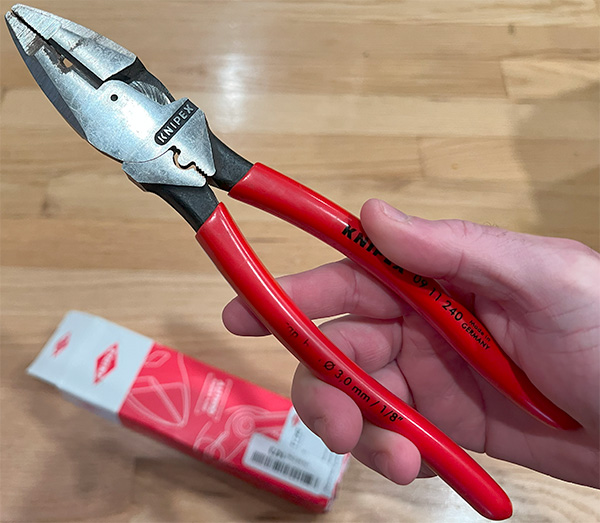
The story is a modern horror tale for tool enthusiasts : a customer, lured by an impossibly low price on their business account, received a tool that wasn't just "used"-it was catastrophically damaged, featuring a literal hole blown through the cutting induction-hardened blades. This incident has sparked a massive debate regarding Amazon’s "Reshelving" policies, the discrepancies between Personal and Business pricing, and the hidden costs of the "Free Return" culture.
"When you buy Knipex, you expect a surgical instrument for electricity. When Amazon ships you a discarded, arc-damaged piece of scrap metal instead, it’s not just a shipping error-it’s a total collapse of the retail trust-chain."
1. The Anatomy of the Incident : From "New" to "Nonsense"
The customer in question noticed a startling price discrepancy. While a standard pair of Knipex 9.5-inch NE-Style Lineman’s Pliers (95 02 240) typically retails on Amazon for $64.40, their Amazon Business portal showed a "Special Price" of just $17.62. Believing they had found the deal of a lifetime, the customer placed the order.Upon arrival, the reality was grim. The pliers were not in original packaging. More importantly, the cutting edges-designed to snip through heavy-gauge copper and ACSR-looked like they had been used to cut a live high-voltage line, resulting in a melted blowout hole in the center of the blades. The tool was functionally dead. It wasn't "Like New" or "Very Good"; it was industrial waste that had been cleaned up and put back into a shipping mailer.
2. The Amazon Business Pricing Mystery
One of the most confusing aspects of this case is the $17.62 vs. $64.40 price gap. Amazon Business accounts often receive "Quantity Discounts" or specialized "Business-Only Pricing." However, a 70% discount on a single unit of a premium German tool is a major red flag.Industry analysts suggest that Amazon’s algorithm may have automatically lowered the price of this specific SKU because it was flagged in the system as a "Returned/Refurbished" item, but the listing failed to update the condition status to "Used." This suggests a database desync :
- The Price : Reflected a damaged, returned unit.
- The Description : Remained "New" or "Professional Grade."
- The Result : A customer expecting a bargain but receiving a liability.
3. The Failure of the "Return Inspection" Protocol
How does a tool with a hole in the blade get reshelved? To understand this, we must look at the sheer scale of Amazon’s Reverse Logistics. Amazon processes millions of returns per week. In the "General Merchandise" category, low-level warehouse associates are often given less than 60 seconds to inspect a returned item before deciding its fate :- Resell as New : If the box looks okay.
- Warehouse Deal : If the box is damaged but the item "looks" fine.
- Liquidation/Trash : If it’s obviously broken.
In this case, the previous buyer likely "swapped" their old, damaged pliers for the new ones they ordered-a form of return fraud. The warehouse associate, likely untrained in tool mechanics, saw a pair of pliers that looked "shiny" enough and threw them back into the "New" bin. This lack of specialized knowledge (not knowing that a gap in the blades makes the tool useless) is the Achilles' heel of automated retail.
4. The Hidden Costs : Time, Gas, and Frustration
The customer’s ordeal didn't end with opening the box. To get their $17.62 back, they had to :* Initiate a digital return.
* Drive to a UPS Store or drop-off point.
* Wait 7–10 days for a refund to process.
When you factor in the cost of fuel and the value of a professional's time, the "deal" actually cost the customer money. This "Return Friction" is a significant burden on the consumer, essentially forcing the buyer to perform the quality control work that Amazon failed to do at the warehouse level.
Comparative Risk Analysis : Buying Tools Online
| Retailer Type | Inspection Quality | Pricing Stability | Risk of "Used-as-New" |
|---|---|---|---|
| Amazon (Direct) | Low (Automated) | Volatile (Algorithmic) | High |
| Specialized Tool Sites | High (Manual) | Stable / Premium | Near Zero |
| Local Supply House | Physical Verification | MSRP (High) | Zero |
| eBay / Marketplace | Variable (Buyer Beware) | Bargain-Heavy | Extremely High |
5. The Knipex Reputation and Brand Dilution
Knipex is a brand built on 140 years of precision. They use specialized Chrome Vanadium heavy-duty steel and vacuum-hardened cutting edges. When a customer receives a mangled Knipex tool from Amazon, it inadvertently damages the brand’s reputation. A less-informed buyer might assume "Knipex isn't as tough as they say," rather than realizing they received a piece of abused scrap metal.This incident highlights why many premium brands are becoming hesitant to sell directly through massive "everything stores." When your product is treated like a commodity-stored next to bags of dog food and phone cases-the specialized care required to handle precision engineering is lost.
6. How to Protect Yourself When Buying Online
Until Amazon addresses its quality control lapses, tool buyers must exercise extreme vigilance :* Check the "Sold By" Field : Always prioritize "Sold by Amazon" or "Sold by Knipex Tools USA." Avoid third-party sellers with "Just Launched" status.
* Scrutinize the Price : If a tool is 50% cheaper than its MSRP on other sites, it is likely a mislabeled return or a counterfeit.
* The "Out-of-Box" Inspection : Before using any tool, check for light-gap in the cutters, excessive "play" in the joint, and ensure the laser-etched markings are crisp.
* Document Everything : Take photos of the packaging and the tool immediately upon arrival if something feels "off."
7. The Future of E-Commerce Tool Sales
This Knipex incident is a wake-up call. As more professionals turn to online platforms for their primary gear, the demand for Condition Verification will increase. Amazon may eventually need to implement specialized "Pro-Tool" inspection hubs where staff are trained to identify tool-specific defects-like arc-burns on pliers or run-out on drill chucks.For now, the story of the $17.00 Knipex pliers serves as a cautionary tale : If the price looks too good to be true, you might just be paying for someone else’s garbage.
Final Verdict : A Lapse in Logistics
The customer eventually received a refund, but the damage to consumer trust remains. Amazon’s failure to inspect a high-voltage tool for safety-critical damage is a liability that transcends simple retail error. It is a reminder that in the world of professional tools, there is no substitute for a reputable supply chain.Pros of Amazon Buying :
* Speed and Convenience.
* Easy (though time-consuming) returns.
* Competitive Business pricing.
Cons of Amazon Buying :
* High risk of receiving fraudulent or damaged returns.
* Inconsistent quality control for specialized categories.
* Algorithm-driven pricing that can hide item defects.
Final Thoughts : Tools are the lifeblood of the trades. Receiving a broken tool isn't just an inconvenience; it can be a safety hazard. Retailers like Amazon must do better to ensure that the "Knipex" name remains synonymous with quality, not with the "luck of the draw" at the return warehouse.
Comments 0
Leave a Comment