The Fiberglass Handle: Why Crescent Chose It, and What It Means for the User
The handle of a hammer is not merely a stick that connects the head to the hand. It is a structural component that must withstand repeated bending and impact forces, a vibration damper that must absorb the shock of each strike without transmitting excessive vibration to the user, and an ergonomic interface that must remain comfortable and secure through hours of repetitive swinging. The choice of handle material is one of the most consequential decisions in hammer design, and it has historically divided the market into three major camps: steel, wood, and fiberglass. Each material has its partisans, and each has its trade‑offs. Steel handles are essentially indestructible. A one‑piece forged steel hammer—the classic Estwing, for example—can be dropped from a roof, run over by a truck, left in the rain, and used as a pry bar, and it will still function. The trade‑off is that steel transmits vibration directly to the user's hand, which can lead to fatigue and, over time, to repetitive stress injuries. Modern steel hammers often incorporate rubber or Santoprene grips that mitigate vibration somewhat, but they cannot match the damping performance of a material that is inherently less rigid. Wood handles, traditionally made from hickory, are excellent vibration dampers. The natural grain structure of wood absorbs and scatters impact energy, producing a soft, comfortable feel at the handle. Wood is also relatively light, which contributes to a fast swing speed. The trade‑off is durability. A wooden handle can break if the user over‑strikes—hitting the workpiece with the handle rather than the head, a common mistake among novices—or if the hammer is used for excessive prying. A broken wooden handle can be replaced, but the replacement process requires tools and time that are not always available on a job site. Fiberglass handles occupy a middle ground between steel and wood. They are significantly better vibration dampers than steel, though not quite as good as hickory. They are far more durable than wood—fiberglass is essentially immune to the breakage that plagues wooden handles—though they can still be damaged by severe over‑strikes or by exposure to extreme heat. Fiberglass is lightweight, corrosion‑proof, and can be molded into complex ergonomic shapes that would be difficult or impossible to achieve with wood. It is also significantly less expensive than premium steel or titanium, which makes it a popular choice for hammers in the budget and mid‑range price brackets. The Crescent Fiberglass Rip Claw Hammers use a solid fiberglass core—not a hollow tube, not a foam‑filled shell, but a dense, solid piece of fiberglass that runs the full length of the handle. The core is encased in a nylon jacket that protects the fiberglass from abrasion and impact, improves grip, and prevents the user from coming into direct contact with the fiberglass fibers, which can cause skin irritation. The nylon jacket is molded with a textured surface that provides a secure, non‑slip grip, even when the handle is damp with sweat or rain. At the butt end of the handle, the nylon jacket flares outward into a pronounced "flared foot" that serves two purposes. First, it prevents the hand from slipping off the end of the handle during a powerful swing—a particularly important safety feature when working with a smooth‑grip material like nylon. Second, it provides a leverage point for the pinky and ring finger, allowing the user to generate more head speed with less wrist effort. The flare is a feature that is more commonly found on premium hammers, and its inclusion on a $13–$16 tool is noteworthy.
Permabond Construction: The Epoxy That Keeps the Head Attached
The junction between the head and the handle is the most critical structural point on any hammer. If the head separates from the handle during a swing, the result is at minimum a dangerous projectile and at worst a serious injury to the user or to someone nearby. A hammer with a loose head is also inefficient; the energy of the swing is partly absorbed by the movement between the head and the handle, reducing the force delivered to the nail. Traditional wooden‑handle hammers secure the head with a wedge driven into the top of the handle, which expands the wood fibers against the inside of the eye and creates a mechanical lock. This system works, but it can loosen over time as the wood dries and shrinks, and the wedge may need to be re‑driven or replaced periodically. Fiberglass and steel handles typically rely on epoxy to bond the head to the handle, with additional mechanical features—such as ribs, grooves, or flares on the handle end—that interlock with the inside of the eye. The quality of this bond depends on the epoxy formulation, the surface preparation of the handle and the eye, and the curing process. Crescent uses a Permabond construction technique on its Fiberglass Rip Claw Hammers. The term "Permabond" refers to a permanent adhesive bond—not a specific brand name, but a method of assembly that is designed to create a connection that will not loosen, separate, or degrade over the life of the tool. The epoxy is formulated to bond strongly to both the fiberglass handle and the lacquered steel head, and the handle end is shaped to interlock mechanically with the inside of the eye, providing a secondary locking mechanism that supplements the adhesive bond. The result is a hammer that should remain securely assembled through years of heavy use, without the need for periodic tightening or re‑wedging. The lacquered finish on the head serves both an aesthetic and a protective function: it prevents rust and corrosion, and it creates a smooth, uniform surface that bonds well with the epoxy. The head itself is a forged steel rip claw design, with a polished striking face, poll (the flat surface opposite the striking face, used for tapping and positioning), and cheek pads (the sides of the head, which are often used for striking in tight spaces where a full swing is not possible). The forged finish is left with a dark, matte texture on the non‑polished surfaces, creating a visual contrast that is attractive and that helps to distinguish the polished functional areas from the unpolished body. The claw is a rip style, meaning the tines are straight rather than curved, which is the preferred configuration for framing and rough carpentry because it provides better leverage for prying and nail extraction. Curved claws, by contrast, are more common on finish hammers and are optimized for nail pulling rather than prying. The rip claw on the Crescent hammer is sharp and well‑shaped, with a V‑shaped notch that securely grips nail heads for extraction. The claw is not intended for heavy‑duty prying—no hammer claw is, despite what some users subject them to—but for the nail‑pulling and light prying tasks that are part of the daily work of a carpenter, it is more than adequate.
The Magnetic Nail Starter: A Pro‑Level Feature, With a Quirk
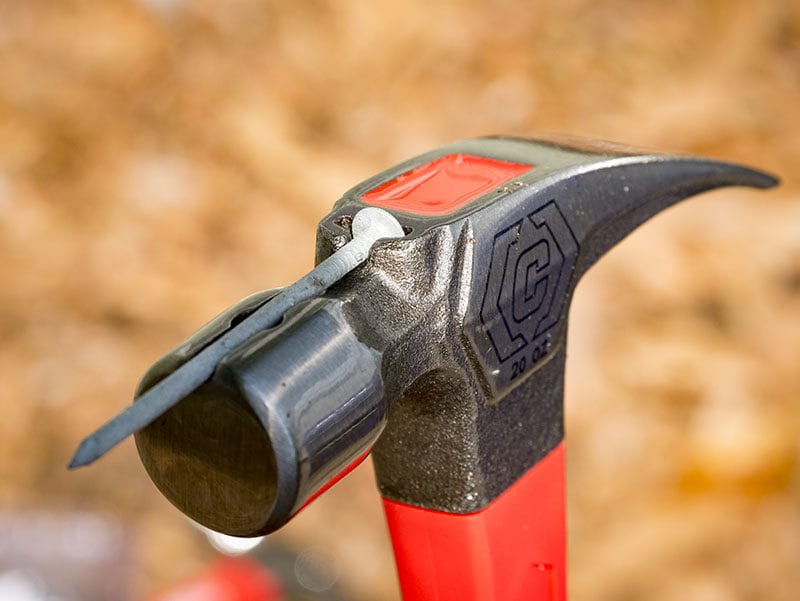
One of the most convenient features of the Crescent Fiberglass Rip Claw Hammers is the magnetic nail starter, a feature that has become essentially standard on professional‑grade hammers but is still not universal on budget models. The nail starter is a small, recessed magnet set into the top of the hammer head, just behind the striking face. Its purpose is to hold a nail in position for one‑handed starting—a critical capability when the user is working overhead, in tight spaces, or anywhere that their free hand cannot reach the nail. To use it, the user places the head of a nail against the magnet, which holds the nail securely with the point facing forward, aligned with the direction of the swing. The user then positions the nail against the workpiece and strikes it with the hammer, driving the point into the wood. Once the nail is started, the user releases it from the magnet and continues driving it with the striking face. The Crescent hammer's magnetic nail starter works well, but it differs from the nail starters on some other hammers in a subtle but significant way: the nail must be set into a dedicated holder, rather than simply butted up against the magnet. This means that the user must place the nail into the holder with a bit more precision than on some competing designs, where the magnet is simply a flat surface and the nail can be placed against it in any orientation. The Crescent design provides a more secure hold—the nail is fully captured by the holder and cannot shift or fall out, even if the hammer is inverted—but it also requires a slightly different technique. On a conventional magnetic nail starter, the user typically strikes the nail once to set it into the wood, then pulls the hammer back and away from the nail, releasing it from the magnet in the process. On the Crescent, because the nail is set into a holder rather than simply held against a magnet, the user may need to pull back toward themselves after that first strike, lifting the hammer off the nail rather than simply sliding it away. This is a small adjustment—a matter of muscle memory that is developed after a few dozen nails—but it is worth noting for professionals who are accustomed to a different nail starter design. The magnetic force is adequate to hold a 16d nail in any orientation, including overhead, and the holder is positioned so that the nail aligns naturally with the center of the striking face, ensuring that the first strike is clean and accurate. Once the initial learning curve is overcome, the Crescent nail starter functions as well as any on the market.
Handle Length, Weight, and the Framing Hammer Paradox
The Crescent Fiberglass Rip Claw Hammers are available in two sizes: a 16‑ounce model and a 20‑ounce model. The 16‑ounce version has a handle length of 13.1 inches, while the 20‑ounce version extends to 13.2 inches. These are standard lengths for general‑purpose claw hammers, but they are on the shorter side for a dedicated framing hammer. A typical framing hammer—the kind used by professional framers who drive 16d nails all day—has a handle length of 16 to 18 inches and a head weight of 22 to 28 ounces. The longer handle provides more leverage, allowing the user to generate higher head speed with the same arm motion, and the heavier head provides more driving power per strike. The Crescent hammers, with their shorter handles and lighter heads, are better suited to general carpentry—a mix of driving, prying, tapping, and positioning—than to production framing. They will frame a wall, certainly, but they are not optimized for the task in the way that a longer, heavier hammer would be. This is not a criticism; it is a clarification of the tool's intended role. The 16‑ounce model, in particular, is a comfortable, versatile weight for the kind of all‑around use that a carpenter, electrician, or general contractor encounters daily: driving small nails for trim and fixtures, tapping components into alignment, extracting bent nails, and performing the thousand small percussive tasks that do not require the brute force of a framing hammer. The 20‑ounce model provides a bit more driving authority while remaining maneuverable and comfortable for extended use. For the professional who carries a dedicated framing hammer for rough work and a lighter hammer for everything else, the 20‑ounce Crescent is a strong candidate for the "everything else" role. For the DIYer or the homeowner, either weight will handle virtually any task that arises around the house, from hanging pictures to repairing a fence to assembling a deck.
Vibration Damping, Fiberglass Fatigue, and the Long‑Term Outlook
One of the primary advantages of a fiberglass handle over a steel handle is vibration damping. The composite nature of fiberglass—glass fibers embedded in a resin matrix—allows the material to absorb and dissipate vibrational energy far more effectively than a homogeneous metal. The individual glass fibers can move ever so slightly relative to one another within the resin matrix, creating internal friction that converts vibrational energy into a tiny amount of heat. This process, known as viscoelastic damping, is the same principle that makes laminated fiberglass springs popular in trailers and heavy trucks: they provide a smoother ride because they damp vibration better than steel leaf springs. For a hammer user, the practical result is that a fiberglass handle feels "softer" on impact than a steel handle of the same weight and length. The sting that accompanies a poorly struck blow is reduced, and the cumulative fatigue that builds up over a day of swinging is lessened. The Crescent Fiberglass Rip Claw Hammers deliver on this promise. In side‑by‑side comparison with a steel‑handled hammer of similar weight, the Crescent produced noticeably less high‑frequency vibration, particularly on off‑center strikes—the glancing blows that send the most shock through the handle. The nylon jacket over the fiberglass core provides additional damping, acting as a secondary viscoelastic layer that further isolates the user's hand from the impact.
The trade‑off for the improved vibration damping of fiberglass is that the material is not as resistant to extreme abuse as steel. A fiberglass handle can be damaged by severe over‑strikes—blows where the handle, rather than the head, strikes the workpiece—particularly if the over‑strike occurs near the head, where the handle is subjected to the highest bending stresses. A fiberglass handle can also be damaged by exposure to extreme heat (such as being left too close to a fire or a torch) or by prolonged exposure to strong solvents. Under normal use—driving nails, pulling nails, light prying—a fiberglass handle will last for many years. Under abuse, it may eventually fail. The Crescent hammers are backed by a limited lifetime warranty, which covers defects in materials and workmanship but does not cover abuse or normal wear and tear. This is standard for the industry. For the professional who treats their tools with reasonable care, the Crescent hammer should provide a long and trouble‑free service life. For the user who is particularly hard on tools—who regularly over‑strikes, who uses their hammer as a heavy‑duty pry bar, who leaves their tools exposed to the elements—a steel‑handled hammer may be the more durable choice, though it will come at the cost of increased vibration and weight.
Price, Value, and the Competitive Landscape
At $12.97 for the 16‑ounce model and $15.97 for the 20‑ounce model, the Crescent Fiberglass Rip Claw Hammers are positioned at the very affordable end of the professional hammer market. They are significantly less expensive than premium titanium hammers, which can run from $70 to over $200. They are less expensive than most high‑end steel hammers, such as the Estwing or Vaughan models that populate many professional tool belts. They are even less expensive than many wooden‑handle hammers from reputable brands. At this price point, the Crescent hammers are competing primarily with the house brands of major home centers—the Husky, Kobalt, and similar lines—and with the entry‑level offerings from established hammer manufacturers. In this competitive set, the Crescent hammers distinguish themselves with their Permabond construction, their flared‑foot handle design, their magnetic nail starter, and their forged‑finish head with polished functional surfaces. The fiberglass handle is a solid, middle‑of‑the‑road choice that provides good vibration damping and durability, and the overall fit and finish of the tool is consistent with what one would expect from a brand with Crescent's history. For the apprentice electrician or plumber who needs a reliable general‑purpose hammer but does not want to spend a significant portion of their first paycheck on a premium tool, the Crescent is an excellent choice. For the homeowner who wants a hammer that will handle projects around the house and will not let them down when they need it, the Crescent provides professional features at a consumer price. For the contractor who needs to equip a crew with hammers that will be lost, loaned, and occasionally abused, the Crescent offers a combination of quality and affordability that makes it a sensible bulk purchase. There is no milled face option available—a feature that some framing carpenters prefer because the textured surface grips nail heads and reduces glancing blows—but the polished face on the Crescent hammers is perfectly serviceable for the vast majority of users. The hammer is available at Home Depot and through online retailers, making it easy to acquire regardless of location.
Crescent Fiberglass Rip Claw Hammers Specifications
| Specification | 16‑Ounce Model (11419C) | 20‑Ounce Model (11418C) |
|---|---|---|
| Head Weight | 16 ounces | 20 ounces |
| Handle Length | 13.1 inches | 13.2 inches |
| Handle Material | Solid fiberglass core with nylon jacket | Solid fiberglass core with nylon jacket |
| Head Material | Forged steel, lacquered finish | Forged steel, lacquered finish |
| Face Style | Polished smooth | Polished smooth |
| Claw Style | Rip (straight) | Rip (straight) |
| Nail Starter | Magnetic, recessed holder | Magnetic, recessed holder |
| Handle Features | Flared foot, non‑slip nylon grip | Flared foot, non‑slip nylon grip |
| Assembly | Permabond epoxy with mechanical interlock | Permabond epoxy with mechanical interlock |
| Warranty | Limited Lifetime | Limited Lifetime |
| Price | $12.97 | $15.97 |
Conclusion: A Hammer That Punches Well Above Its Price Point
The Crescent Fiberglass Rip Claw Hammers are not the most innovative, the lightest, the most powerful, or the most prestigious hammers on the market. They are, instead, something arguably more important for the majority of users: they are hammers that get the fundamentals right at a price that almost anyone can afford. The fiberglass handle provides good vibration damping and excellent durability for its cost. The Permabond assembly, with its combination of epoxy bonding and mechanical interlock, ensures that the head will remain securely attached through years of use. The flared foot, the magnetic nail starter, the polished functional surfaces, and the forged‑finish head are features that are typically found on hammers costing significantly more. The 16‑ounce and 20‑ounce weights, combined with the 13‑inch handle lengths, create tools that are balanced, comfortable, and versatile—not specialized framing hammers, but excellent general‑purpose hammers that can handle a wide variety of tasks. For the apprentice, the homeowner, the budget‑conscious professional, or the contractor who needs to equip a crew without breaking the bank, the Crescent Fiberglass Rip Claw Hammers represent exceptional value. They are tools that will serve faithfully for years, and when they finally need to be replaced—after a career's worth of nails driven and pulled—the cost of replacement will be so modest as to be almost an afterthought. That is the definition of a good investment, and it is why these hammers, for all their lack of glamour, deserve a place in the tool bags of anyone who works with their hands.
Comments 0
Leave a Comment