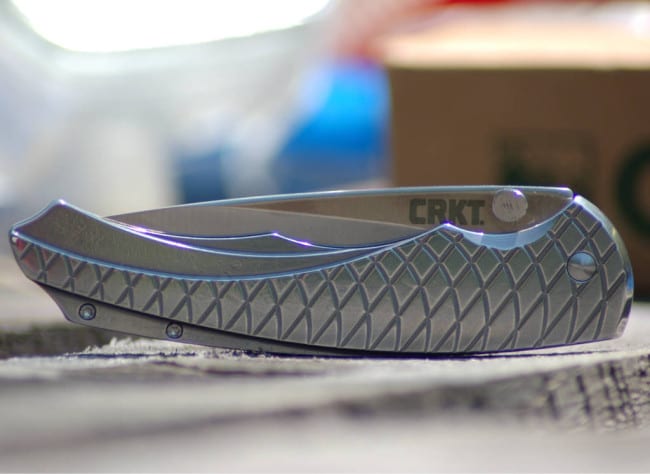
The Blade: 1.4116 Stainless, Hollow Grind, Drop Point
The Cobia's blade is forged from 1.4116 stainless steel, a German‑origin alloy that is essentially the European equivalent of the steels used in mid‑range kitchen knives. It is a workhorse steel—not exotic, not boasting sky‑high Rockwell numbers, but tough, corrosion‑resistant, and easy to sharpen. The blade hardness is rated at 55‑57 HRC, which is on the softer side by modern EDC standards. This means the edge will not hold for weeks of hard use without attention, but it also means the blade is exceptionally resistant to chipping and very easy to touch up. A few passes on a ceramic rod or a strop, and the edge is back to shaving sharpness. The steel's corrosion resistance is particularly relevant for a knife named after a saltwater fish; while no knife should be carried in a saltwater environment without diligent maintenance, the Cobia's blade will withstand humidity and incidental moisture better than many higher‑carbon steels.
The blade geometry is a drop point with a hollow grind, a combination that provides an excellent balance of tip strength and slicing efficiency. The hollow grind removes material from the blade flats, creating a thinner cross‑section behind the edge that slices with noticeably less resistance than a flat‑ground blade of comparable thickness. The tip is fine enough for detail work but backed by enough steel to resist snapping under lateral pressure. The blade deploys via CRKT's Outburst spring‑assisted mechanism, actuated by dual thumb studs. The action is crisp and snappy—not quite as fast as some of the higher‑end assisted openers on the market, but reliable and satisfying. The thumb studs are positioned well and are easy to engage.
Handle: 420J2 Stainless, Fish‑Scale Texture, and a One‑Sided Grip Story
The handle is where the Cobia truly distinguishes itself. Both scales are made from 420J2 stainless steel, a material commonly used for knife handles due to its good corrosion resistance and ability to be formed into complex shapes. One side of the handle—the presentation side, when the knife is clipped in the pocket—features a smooth, satin‑finished surface that is elegant and understated. The opposite side—the side that faces the pocket and also houses the frame lock—is machined with a fish‑scale pattern that gives the knife its name. The scales are overlapping, recessed ovals that catch the light and provide a minor amount of texture. They are not deeply aggressive; they will not abrade your palm or chew up your pocket. But they provide enough visual interest and tactile variation to elevate the handle beyond a simple flat slab of steel.
The frame lock is executed in the same 420J2 steel, and it engages the blade tang with a solid click. Lockup is secure, with no blade play in any direction. The lock bar is adequately thick and positioned for easy disengagement with the thumb. The pocket clip is a single‑position design, set for tip‑down carry on the right side only. This is a limitation that will frustrate left‑handed users and those who prefer tip‑up carry. The clip itself is a low‑profile design that grips the pocket securely without tearing the fabric. The knife carries well, with its 3.66‑inch closed length and 2.5‑ounce weight vanishing into the pocket of jeans or work pants.
A Gentleman's Knife, a Fisherman's Knife, or Both?
The Cobia occupies an interesting niche. With its clean lines, satin finish, and relatively small size, it works beautifully as a gentleman's EDC—a knife you can pull out in an office setting without causing alarm. The fish‑scale texture adds just enough personality to make it a conversation starter. But the knife is also genuinely capable. The blade is sharp, the lock is strong, and the hollow grind slices efficiently. It is entirely at home cutting monofilament fishing line, trimming braided rope, or cleaning a fresh‑caught fish on the dock. The 1.4116 steel, with its excellent corrosion resistance, is well‑suited to the marine environment, provided the knife is rinsed with fresh water and dried after exposure to salt. The compact size and light weight make it a natural choice for a tackle box or a boat bag. If you are an angler who appreciates good design, the Cobia is the knife you want in your pocket when you are on the water. It is not a heavy‑duty deck knife—it is too small and too refined for cutting bait or prying barnacles—but for the countless light cutting tasks that fill a day of fishing, it is an elegant, capable companion.
CRKT Cobia Specifications
| Specification | Detail |
|---|---|
| Closed Length | 3.66 inches |
| Open Length | 6.56 inches |
| Weight | 2.5 ounces |
| Blade Material | 1.4116 Stainless Steel |
| Blade Hardness | 55‑57 HRC |
| Blade Finish | Satin |
| Blade Grind | Hollow |
| Blade Style | Drop Point |
| Lock | Frame Lock |
| Carry | One‑position, tip‑down |
| MSRP | $130 |
| Street Price | ~$70‑$80 |
Conclusion: The Fish That Swims Upstream
The CRKT Cobia is not the knife you buy because you need the latest super‑steel or the fastest flipper action. It is the knife you buy because you appreciate the intersection of form and function, because you want something that looks as good on a dinner date as it does on a fishing pier, and because you recognize that the best tools often have a story behind them. The cobia fish is an unlikely delicacy; the CRKT Cobia knife is an unlikely charmer. Both reward those who take the time to discover them.
Comments 0
Leave a Comment