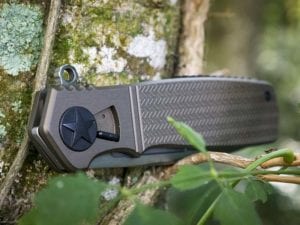
But the Homefront is more than a nostalgic exercise. Hidden beneath its classic lines is a technological breakthrough that took more than ten years to develop: CRKT's Field Strip technology. This system allows the knife to be disassembled into its three major components—two handle halves and the blade—without the use of any tools. It is the easiest knife to clean in the history of folding knives, and it addresses a problem that has plagued folder design since the first folding knife was made: how do you clean the pivot, the lock, and the internal surfaces when they become fouled with dirt, sand, blood, or pocket lint? The answer, for every other folding knife, has been "with a set of Torx drivers, patience, and a steady hand." The Homefront answers that question with two moving parts and a clever lever mechanism that can be operated by anyone, anywhere, in under thirty seconds. It is the kind of innovation that comes along once in a generation, and CRKT has wrapped it in a design that honors the past while pointing toward the future.
The AUS‑8 Blade: Drop Point, Brushed Finish, and a Bayonet‑Lug Flipper
Ken Onion selected AUS‑8 steel for the Homefront's blade, a deliberate choice that prioritizes toughness and ease of maintenance over the extreme edge retention of powder‑metallurgy steels. AUS‑8 is a Japanese stainless steel with a carbon content of approximately 0.75%, hardened here to 57‑58 HRC. It sharpens readily on a wide range of abrasives, resists corrosion adequately with minimal care, and is tough enough to survive hard use without chipping. The blade profile is a drop point with a plain edge and a pronounced belly that provides ample slicing surface. Onion incorporated one of his signature subtle curves, increasing the belly slightly as it moves away from the handle, which improves the knife's ability to make long, smooth draw cuts. A fuller—often misidentified as a "blood groove"—runs along the spine of the blade, reducing weight and adding stiffness without compromising strength. The finish is a brushed steel that looks appropriate to the era and hides scratches well. The flipper tab is styled to resemble a bayonet lug, a design element that reinforces the military‑inspired aesthetic and provides excellent purchase for the index finger during deployment. The blade deploys manually, without spring assist, via a nylon‑bushed pivot that is smooth and reliable, if not as fast as the IKBS‑bearing flippers in CRKT's higher‑end models. This is intentional; the Field Strip mechanism precludes the use of a bearing pivot, at least for now, and the manual action is entirely appropriate to the knife's character. It deploys with a deliberate, mechanical feel that suits the vintage design.
The 6061 Aluminum Handle: Green‑Brown Classic Finish, Black Hardware, and Jimping Where It Counts
The handle of the Homefront is machined from 6061 aluminum, a material that was chosen for its combination of strength, lightness, and the ability to accept a durable, military‑inspired finish. The color is a green‑ish brown that evokes the olive drab of WWII equipment without being a direct copy. The finish is matte and slightly textured, providing a reasonable grip that is enhanced by jimping along the top of the handle for the thumb and on the rear of the handle for the palm. The hardware—screws, pivot, and clip—are black, providing a visual contrast that sharpens the overall appearance. The handle is secured by a liner lock that engages the blade tang fully and releases smoothly with thumb pressure. The pocket clip is a single‑position, tip‑up design optimized for right‑hand carry. It is an ultra‑deep carry clip, meaning the knife sits very low in the pocket with almost nothing visible above the seam—a feature that enhances discretion and security. The clip is stout and well‑formed, though its single position will frustrate those who prefer tip‑down or left‑side carry. The Army star pivot cover, visible on the presentation side, is a subtle but unmistakable nod to the U.S. military, and it completes the vintage aesthetic in a way that feels earned rather than tacked on.
Field Strip Technology: How It Works, and How to Do It Right
The Field Strip mechanism is the Homefront's reason for being, and it works as follows. First, locate the lever adjacent to the Army star on the presentation side of the handle. Flip this lever outward. This releases a hex bolt that passes through the pivot and holds the knife together. Next, locate the thumb wheel that is recessed into the jimping near the rear of the handle. Turn this wheel away from the front of the knife until it is completely loose. At this point, the handle halves can be separated, and the blade can be lifted free. The knife is now in three pieces: two handle halves and the blade. Cleaning is as simple as wiping down the internal surfaces, rinsing the pivot area, and applying a small drop of lubricant if desired. Reassembly is the reverse process: place the blade between the handle halves, align the pivot, tighten the thumb wheel, and flip the lever back into its locked position. The entire disassembly and reassembly process takes less than a minute and requires no tools.
There are two critical cautions to observe. The lever and the thumb wheel must be operated in the correct order. If you attempt to force the lever without first releasing the thumb wheel, you can torque the hex bolt out of alignment, which will prevent the Field Strip mechanism from functioning properly. Also, when reassembling, it is important to pinch the front of the handle halves together at the pivot point before locking the lever back into place. If the halves are not properly aligned, the lever may bind or not fully engage. The lever should operate smoothly; if it resists, release the handle, pinch the halves together more firmly at the pivot, and try again. With these simple precautions, the Field Strip system works reliably and provides a level of maintenance accessibility that no other folding knife on the market can match.
CRKT Homefront Specifications
| Specification | Detail |
|---|---|
| Blade Material | AUS‑8 Steel |
| Hardness | 57‑58 HRC |
| Blade Length | 3.502 inches |
| Closed Length | 4.728 inches |
| Open Length | 8.313 inches |
| Blade Finish | Brushed Steel |
| Blade Style | Drop Point |
| Handle Material | 6061 Aluminum |
| Lock | Liner Lock |
| Weight | 4.8 ounces |
| Special Feature | Field Strip Technology (tool‑free disassembly) |
| MSRP | $150 |
| Street Price | ~$77 |
Conclusion: The Past and the Future, Folded Into One
The CRKT Homefront is not the prettiest knife you will ever see—not unless the classic military throwback design sparks the kind of memories that it sparks for me, in which case it is one of the most beautiful. It is a knife with a story, a knife that connects its owner to a past that is worth remembering, and it does so without resorting to cheap nostalgia or superficial styling. The Field Strip technology inside the Homefront is genuinely revolutionary, and it makes a compelling case for why a folding knife should not be a sealed, unmaintainable object. Being able to strip the knife down, clean it thoroughly, and reassemble it in under a minute transforms the owner's relationship with the tool. It is no longer something to be used until it becomes too dirty to function, then discarded or sent away for service. It is something that can be maintained indefinitely, by its owner, with no special skills or tools. CRKT has stated that the Field Strip system is just the first in a planned line of tools using this technology. If that promise is realized, and if Field Strip knives become available in a variety of blade styles, steel qualities, and handle designs—perhaps even as a customizable platform—the Homefront will be remembered as the knife that started a revolution. For now, it stands alone as a beautifully executed fusion of vintage aesthetics and cutting‑edge innovation, a knife that would make a WWII aircraft mechanic proud, and a tool that any modern knife enthusiast can appreciate.
Comments 0
Leave a Comment