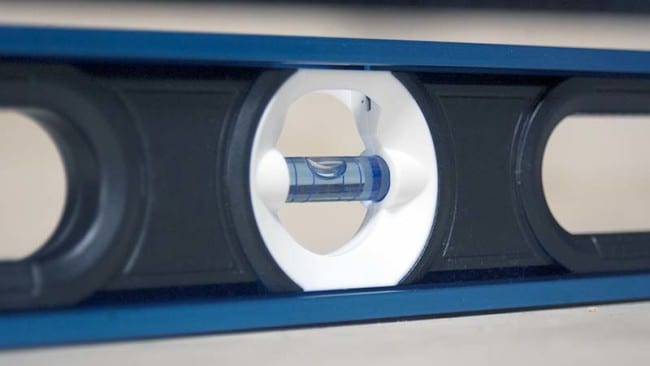
The Empire Level e55 Series is an I‑beam style level within the company’s iconic True Blue family. I may be in the minority here, but I think a little Gator orange to accent the blue would make these levels look even sharper. That said, the Wisconsin‑based company manages a very attractive, professional look without it. What really makes the e55 special, however, isn’t the color scheme—it’s the innovation Empire has poured into the True Blue vial system since its introduction in 2004, and the careful balance of accuracy, durability, weight, and price that these I‑beam levels represent. Clint, one of our editors, has been dropping subtle hints about needing a larger level for door frames and large window installations, so we brought in the 72‑inch Empire Level e55 Series I‑Beam Level. Over the past several weeks, we’ve put it through its paces on everything from framing interior walls to setting exterior door jambs. Here’s what we found, and why the e55 series might be the best value in professional‑grade levels today.
I‑Beam vs. Box Beam: Why Empire’s e55 Design Makes Sense for Long Levels
Before diving into the specifics of the e55.72, it’s worth understanding the fundamental design choice Empire made with this series. Levels for professional use generally come in two structural flavors: box beam and I‑beam. If you cut the end off a box beam level, you’d see a hollow rectangular cross‑section—essentially a box. This shape is inherently rigid and resists twisting and bending exceptionally well. Box beam levels are the heavy‑duty choice; they withstand more abuse, they’re less likely to warp, and they command a higher price. If you cut the end off an I‑beam level, the cross‑section looks exactly like the capital letter “I”. The top and bottom flanges are connected by a vertical web. I‑beam levels are lighter than box beams, typically a few dollars less expensive, and when constructed from high‑grade aluminum, they can still deliver excellent durability and accuracy.
The e55 series leans into the advantages of the I‑beam design. Empire extrudes these levels from a high‑strength aluminum alloy that keeps the frame rigid while shaving off considerable weight compared to a box beam of the same length. For a 72‑inch level, that weight savings matters. A 72‑inch box beam can feel like a piece of gym equipment when you’re holding it overhead to check a ceiling joist or carrying it across a job site. The e55.72, by contrast, is light enough to maneuver with one hand without wearing out your arm, yet it remains stiff enough to give an accurate reading across its full length. For a trim carpenter, a cabinet installer, or a framer who needs a long level but doesn’t want to wrestle with it, the I‑beam design makes a lot of sense. It’s durable enough for daily professional use without the weight penalty, and it costs significantly less than an equivalent box beam. That’s the practical calculus behind the e55 series, and it’s a formula that has kept I‑beam levels on job sites for decades.
True Blue Vial Technology: The Visibility That Changed the Level Industry
Back in 2004, Empire Level introduced the True Blue vial, and it quickly became the defining feature of the brand. Before True Blue, most spirit levels used a yellow or green liquid with black reference lines. The contrast was decent, but under certain lighting conditions—bright sun, dim basements, or the sickly yellow glow of a temporary job light—the bubble edge could blur and become difficult to read precisely. Empire’s innovation was to swap the traditional yellow liquid for a clear, bright fluid and pair it with bold blue lines and a subtle blue tint around the vial. The blue‑on‑clear color scheme created a sharper visual contrast, making the meniscus—the curved edge of the bubble—easier to see and align between the lines. It was a simple change that made a genuine difference in daily use, and it’s been copied by many manufacturers since.
The e55 series features solid block acrylic True Blue vials. Acrylic is the modern standard for professional levels because it’s far more resistant to shattering than glass, it doesn’t crack when subjected to rapid temperature changes, and it can be machined to extremely tight tolerances. The vials are permanently sealed and set into the aluminum frame, protected by the end caps and the overall structure of the level. The blue reference lines are bold and easy to pick up at a glance, and the bubble itself is crisp and well‑defined. On the 72‑inch e55.72, there are three vials: two for plumb (one at each end, allowing vertical readings in both orientations) and one for level in the center.
Adding to the visibility factor is a top‑read window on the center vial. This is a huge benefit when you’re checking the level of flooring, aligning a countertop, or doing any application where the level is positioned overhead or at waist height and you can’t easily crouch down to read it from the side. You simply glance down through the top window and see the bubble’s position. It’s a small feature that costs Empire almost nothing to include but pays out in convenience every single time you use it. For a 72‑inch level that’s often used on the floor or low to the ground, the top‑read window is practically essential.
Accuracy: 0.0005 Inches Per Inch, and How to Field‑Check It in Under Five Minutes
Empire Level e55 Series I‑Beam Levels are accurate to 0.0005 inches per inch—the same specification shared by Empire’s premium e75 and e95 series, and the same standard upheld by top‑tier competitors like Stabila and Milwaukee’s Redstick. That’s 5/10,000ths of an inch of potential deviation for every inch of length. Over the 72‑inch span of the e55.72, the maximum possible error from end to end when the level is showing a perfectly level surface is 0.036 inches—just over 1/32nd of an inch. If you’re keeping score at home in metric, that’s less than a millimeter over six feet. For framing walls, setting door jambs, installing windows, or checking floor flatness, that tolerance is so tight that no human installer could detect the error without a precision instrument. It’s more than sufficient for every trade except perhaps the most demanding machine‑setup or scientific applications.
But a level’s accuracy out of the box is only half the story. Levels get knocked, bumped, dropped, and generally abused throughout their working lives. The e55 series is no exception—especially the longer models, which seem to attract accidental kicks and ladder strikes like a magnet. The good news is that checking a level’s accuracy in the field is fast and requires no special tools. Here’s the simple procedure we use, and that every Pro should know:
Place the level on a reasonably flat surface. Mark the position of both ends. Carefully observe where the bubble sits in the center vial—even if it’s not perfectly level, note exactly where the meniscus is relative to the lines. Now, rotate the level 180 degrees, lining the ends back up with your marks. Look at the bubble again. If the meniscus is in the exact same position relative to the lines (even if off‑center), the level is perfectly calibrated. If the bubble reads differently, the level has drifted and needs adjustment or replacement. Use the same technique against a vertical wall to check the accuracy of the plumb vials. This entire process takes less than five minutes, and it gives you absolute confidence that your level is telling the truth before you frame an entire wall or set an expensive window. We performed this test on the e55.72 right out of the box, and after several weeks of use, and the bubble returned to precisely the same position every time. Empire’s factory calibration is clearly consistent.
Durability and Construction: Lightweight Aluminum, Protective End Caps, and a Limited Lifetime Warranty
The e55 series is built around an extruded aluminum frame. Aluminum is both strong and lightweight, and when properly alloyed and extruded into an I‑beam profile, it delivers an impressive stiffness‑to‑weight ratio. The frame is anodized to resist corrosion, which is important for carpenters and masons who work with damp materials or in humid climates. The surface is smooth, making it easy to wipe off mortar, drywall mud, or sawdust at the end of the day.
Protective rubber end caps cover both ends of the level, absorbing the shock from drops and bumps that would otherwise transmit directly to the frame and vials. End strikes are one of the most common ways a level loses accuracy; the e55’s end caps are designed to take those hits and keep the frame true. The caps are not removable on the e55 series (unlike some of Empire’s higher‑end e95 models), but they are durable and well‑fitted. For most Pros, replaceable end caps are a nice‑to‑have, not a necessity, and the e55’s caps should last the life of the level under normal use.
The acrylic vials are another key component of the level’s durability. Glass vials, which were standard on professional levels for decades, can crack or shatter from a sharp impact or a sudden temperature change. Acrylic is far more resilient; it can take a drop that would destroy a glass vial, and it won’t spontaneously fracture when moving from a freezing truck bed to a heated interior. Empire seals the vials permanently, so the liquid won’t leak or evaporate over time. The True Blue fluid itself is a custom formulation that resists fading, clouding, or separating, maintaining the crisp blue contrast for years.
Empire backs the e55 series with a limited lifetime warranty on the frame and vials. This covers manufacturing defects, not abuse, but it’s a strong statement of confidence from a company that has been making levels for over a century. If a vial ever loses its calibration due to a manufacturing defect, Empire will repair or replace the level. It’s a warranty that matches what you’d get from premium competitors at higher price points.
Weight and Handling: Six Feet of Aluminum That Won’t Wear Out Your Arm
One of the standout characteristics of the e55.72 is its weight—or more accurately, its lack of it. A 72‑inch box beam level from a premium manufacturer can easily weigh 5 to 7 pounds. The e55.72, thanks to its I‑beam construction, comes in noticeably lighter. For a professional who uses a long level for extended periods—checking floor flatness across a large room, installing a series of interior doors, or setting a long run of base cabinets—that weight savings translates directly into less arm and shoulder fatigue. By the end of the day, you feel the difference.
The level’s balance is also well‑considered. The handhold cutouts are positioned at natural gripping points, and the I‑beam shape provides a comfortable purchase for your fingers. You can carry it one‑handed at your side without the level tipping or swinging awkwardly. When you need to hold it overhead to check a ceiling joist or the top of a window opening, the reduced weight means you can maintain a steady position for longer without your arm shaking and introducing user error. For contractors who are already dealing with the physical toll of the trades—back strain, shoulder issues, carpal tunnel—a lighter level is not a luxury; it’s a tool that helps preserve your body for the long haul.
Available Sizes and Options: From 24 Inches to Magnetic 76‑Inch Models
While we focused our testing on the 72‑inch e55.72, Empire offers the e55 I‑Beam series in a range of sizes to cover virtually every layout task. The lineup includes 24‑inch, 48‑inch, 72‑inch, and 76‑inch lengths. The 24‑inch model ($18.99) is ideal for cabinet jambs, window stools, and tight spaces where a larger level won’t fit. The 48‑inch ($26.99) is the standard all‑purpose size for door frames, base cabinet runs, and general framing. The 72‑inch ($49.99) is the long span specialist, perfect for large windows, exterior doors, floor leveling, and concrete form checks. The 76‑inch version is available in a magnetic configuration for those who frequently work around steel studs, metal door frames, or iron beams.
The magnetic models in the e55 series feature rare‑earth magnets embedded in the base, providing a strong grip on ferrous metal surfaces. For metal stud framers, ironworkers, and electricians mounting panels on steel enclosures, the magnetic option is well worth the small additional cost. The non‑magnetic models are lighter and less expensive, making them the better choice for carpenters and masons who work primarily with wood and masonry. Empire has designed the line so that you can mix and match based on your specific needs—a 48‑inch magnetic for steel stud work and a 72‑inch non‑magnetic for wood framing, for example.
Empire Level e55 Series Specifications (All Available Models)
| Model | Length | Magnetic | Vials | Accuracy | Price (Approx.) |
|---|---|---|---|---|---|
| e55.24 | 24 inches | No | 2 plumb, 1 level | 0.0005 in/in | $18.99 |
| e55.48 | 48 inches | No | 2 plumb, 1 level | 0.0005 in/in | $26.99 |
| e55.72 | 72 inches | No | 2 plumb, 1 level | 0.0005 in/in | $49.99 |
| e55.24M | 24 inches | Yes (rare earth) | 2 plumb, 1 level | 0.0005 in/in | Contact Retailer |
| e55.48M | 48 inches | Yes (rare earth) | 2 plumb, 1 level | 0.0005 in/in | Contact Retailer |
| e55.76M | 76 inches | Yes (rare earth) | 2 plumb, 1 level | 0.0005 in/in | Contact Retailer |
Accuracy, Durability, Visibility, and Now “Lightweight” and “American‑Made”
Accurate, durable, and visible—the e55 series delivers on all three of the essential level characteristics. But we can add two more words to the accolades: lightweight and American‑made. The I‑beam design keeps the weight down without sacrificing the stiffness necessary to give an accurate reading across six feet. And for Pros who care about where their tools come from—and the jobs they support—Empire Level manufactures the e55 series in the United States. That domestic production means tighter quality control, shorter supply chains, and the knowledge that you’re keeping American workers employed while getting your hands on an outstanding product. In an era when many tool brands have moved production overseas, Made in the USA is a badge of honor that Empire wears proudly, and it’s one that resonates with many professional tradespeople.
The environmental footprint of buying an American‑made level is also smaller, thanks to reduced shipping distances and U.S. manufacturing standards that tend to be more stringent than those in many offshore locations. For the contractor trying to build a sustainable business, these factors can tip the scales toward a domestic brand like Empire.
When an I‑Beam Level Might Not Be the Best Choice
For all its strengths, the e55 series is not the ideal level for every single application. The I‑beam design, while lightweight and stiff, is not as resistant to twisting or denting as a full box beam profile. If your work involves extreme abuse—for example, using the level as a straightedge to cut drywall, as a makeshift pry bar (we’ve all seen it), or as something to bang against heavy steel forms—a box beam level like Empire’s own e75 or e95 series, or the Milwaukee Redstick, will offer greater structural integrity. The e55 is a precision layout tool, not a beater. Treat it with the respect any level deserves—don’t use it as a hammer, don’t leave it in the mud, don’t run it over with the skid steer—and it will provide years of accurate service.
The non‑magnetic models are also not suitable for working on steel studs or metal door frames without a helper to hold the level. If your work regularly involves ferrous metal surfaces, the magnetic e55 variants are a must‑have. They cost a bit more, but the hands‑free convenience and the security of knowing the level won’t slide off and hit the deck are well worth the premium.
How the e55.72 Fits Into a Complete Level Collection
For the professional who wants a coherent set of levels that share the same vial technology and build quality, the e55 series provides a sensible ladder. Start with a 24‑inch for tight spaces and cabinet jambs. Add a 48‑inch for door frames, base cabinets, and general framing. Then bring in the 72‑inch for large windows, exterior doors, long wall runs, and floor flatness checks. For steel stud work, substitute the magnetic versions at the lengths you need. Because all e55 levels use the same True Blue vials, the learning curve is zero—once you’re accustomed to reading the blue‑on‑clear bubble on one length, you can read it on all of them. There’s no mental recalibration when you switch tools, no subtle color shifts between models. The consistency is a productivity advantage that adds up over days and weeks of layout.
At the current pricing, you can assemble a complete set of three non‑magnetic e55 levels (24, 48, and 72 inches) for under $100. Compare that to the cost of a single 78‑inch premium box beam level, which can run north of $200, and the value proposition of the e55 series becomes immediate and powerful. For an apprentice just building a tool collection, or a seasoned Pro outfitting a second trailer, that kind of value is hard to argue with.
Final Thoughts: The e55 Series Is Proof That You Don’t Have to Spend a Fortune to Get a Professional‑Grade Level
The Empire Level e55 Series I‑Beam Level, particularly in the 72‑inch length we tested, is a tool that quietly overdelivers. It’s accurate enough for the most demanding framing and finish work. Its True Blue vials are genuinely easier to read than traditional yellow‑and‑black designs, and the top‑read window is a practical feature you’ll use constantly. It’s light enough to carry all day without fatigue, durable enough to survive the bumps and drops that are part of construction life, and priced so affordably that you won’t feel a sting if it eventually needs to be replaced after years of hard service.
It’s not the flashiest level on the market—there are no LEDs, no digital readouts, no Bluetooth connectivity, and that’s exactly the point. This is a straightforward, well‑made spirit level that does its job without fuss, without batteries, and without excuses. It embodies the same principle that has kept bubble levels relevant for over a century: when you have a reliable bubble suspended in a durable, accurately machined frame, you have everything you need to build plumb, level, and true. Everything else is just marketing.
Comments 0
Leave a Comment