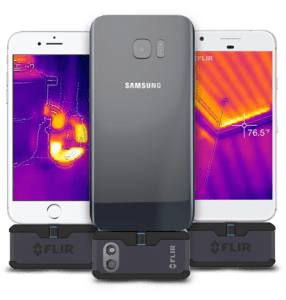
The FLIR One Pro is not the first thermal camera attachment for smartphones, nor is it the first product in the FLIR One line. It builds on several generations of development, and it incorporates technologies and design features that have migrated downward from FLIR's professional‑grade thermal imaging cameras. The heart of the device is the Lepton microcamera core, a thermal imaging sensor that FLIR developed specifically to be small enough, light enough, and power‑efficient enough to be integrated into a smartphone accessory. The Lepton core in the FLIR One Pro has a resolution of 160 by 120 pixels—a significant step up from the 80 by 60 resolution of the standard FLIR One, and a figure that begins to approach the resolution of entry‑level professional thermal cameras. Each of those 19,200 pixels is an individual, calibrated thermal sensor, capable of measuring the infrared radiation emitted by an object and converting that measurement into a temperature value. The result is a thermal image that is detailed enough to identify individual components on a circuit board, to trace the path of a hot water pipe behind a wall, to see the thermal signature of a person or an animal in complete darkness, or to locate the exact spot where a window seal has failed and cold air is leaking into a room. The Lepton core is paired with a standard visible‑light camera, and it is the combination of these two sensors that enables the FLIR One Pro's most impressive feature: MSX, or Multi‑Spectral Dynamic Imaging. MSX is a patented image processing technique that extracts the edges and fine details from the visible‑light image and superimposes them onto the thermal image. The result is a hybrid picture that has the thermal information of the infrared sensor—the colors that represent temperature differences—but the sharp, recognizable outlines of the visible‑light photograph. Without MSX, a thermal image can be difficult to interpret: a blurry blob of red and blue that might be a window, a door, or a piece of furniture. With MSX, the thermal image gains context. You can see that the hot spot is on a specific circuit breaker, that the cold area corresponds to a particular window frame, that the warm trail along the floor is the path of a hot water pipe. The visible‑light camera provides the detail that the thermal sensor lacks, and the combination of the two creates an image that is both informative and easy to understand.
VividIR and Advanced Image Processing: Sharper, Clearer, and More Useful
The FLIR One Pro introduces VividIR, an upgraded image processing system that goes beyond the standard MSX implementation to produce images that are noticeably sharper, clearer, and more detailed. VividIR works by capturing multiple frames of thermal data and combining them into a single, enhanced image—a technique similar to the HDR (High Dynamic Range) processing used in modern smartphone photography. By merging multiple frames, VividIR reduces noise, enhances contrast, and brings out fine details that would be lost in a single‑frame capture. The result is a thermal image that has a level of clarity that was previously only achievable with much more expensive, dedicated thermal cameras. For the professional who uses thermal imaging to diagnose problems, the improved image quality translates directly into faster, more accurate diagnoses. An electrician scanning a panel for a loose connection can see the subtle temperature rise of a high‑resistance joint before it becomes a fire hazard. An HVAC technician checking a duct system for leaks can see the faint thermal signature of escaping air that would be invisible with a lower‑resolution imager. A home inspector looking for moisture intrusion can spot the telltale cool spot on a ceiling that indicates a roof leak, even before the water damage becomes visible to the naked eye. The VividIR processing also improves the quality of the spot temperature measurements that the FLIR One Pro provides. Multiple spot temperatures can be placed on the image, measuring the temperature at specific points with an accuracy that is sufficient for most diagnostic work. The user can tap on any area of the image to read the temperature at that point, and the spots can be repositioned or removed as needed.
The FLIR Tools App and One‑Touch Reporting
The FLIR One Pro is fully integrated with the FLIR Tools app, a free application available for iOS and Android that serves as the control interface for the camera and as a platform for analyzing, organizing, and sharing thermal images. The app provides a live view of the thermal image on the phone's screen, with the ability to switch between the standard thermal palette, the MSX overlay, and the visible‑light image. The user can capture still images or record video, and all captures are stored within the app for later review. The reporting capability is what transforms the FLIR One Pro from a curiosity into a professional tool. With a single tap, the user can generate a report that includes the thermal image, the visible‑light image, the spot temperature measurements, and any notes that have been added. The report can be saved as a PDF, emailed to a client or a supervisor, or uploaded to cloud storage for archiving. This one‑touch reporting capability streamlines the documentation process that is an essential part of professional inspection and diagnostic work. Instead of transferring images to a computer, opening a report template, manually inserting images and typing notes, the entire process is handled on the phone in seconds. The FLIR Tools app also provides a range of analysis functions, including the ability to adjust the temperature scale, to change the color palette, and to add additional measurement tools such as rectangular areas or circles. The app is designed to be intuitive and easy to use, reflecting FLIR's understanding that thermal imaging is a tool that professionals use to do a job, not a hobby that they pursue for its own sake. The learning curve is gentle, and a new user can be capturing useful thermal images within minutes of installing the app and attaching the FLIR One Pro.
The OneFit Adjustable Connector and Ruggedized Design
One of the persistent frustrations of smartphone accessories is the compatibility problem. Phone cases come in a bewildering variety of thicknesses and designs, and a connector that is designed to plug directly into a bare phone may not fit through the opening in a protective case. The FLIR One Pro addresses this with the OneFit adjustable connector, a mechanism that allows the user to extend the USB‑C or Lightning connector by up to 4 millimeters to accommodate the thickness of a phone case. The adjustment is made via a small dial on the back of the device, and it locks securely in place once set. This means that the user does not have to remove their phone from its case every time they want to use the thermal camera—a small but meaningful convenience that makes the device more likely to be used regularly. The FLIR One Pro is also built to withstand the rigors of professional use. The housing is a ruggedized, impact‑resistant polymer that protects the internal electronics from drops and bumps. The Lepton camera core is solid‑state, with no moving parts to fail under shock or vibration. The entire device is designed to be carried in a tool bag or a pocket, and to survive the kinds of accidents that happen on a job site. It is not waterproof, and it should not be submerged, but it will handle the dust, the occasional splash, and the general rough handling that a professional tool endures. The FLIR One Pro draws its power from its own internal battery—it does not drain the phone's battery—which is a critical design choice. A thermal camera that drew power from the phone would quickly deplete the phone's charge, potentially leaving the user without a working phone at the end of a long day of inspections. The internal battery is recharged via a micro‑USB port on the device itself, and a full charge provides approximately one hour of continuous use—enough for dozens of inspections if the camera is used in short bursts, as it typically is.
Who Should Buy the FLIR One Pro?
The FLIR One Pro occupies a unique position in the thermal imaging market. It is significantly more capable than the standard FLIR One, with four times the thermal resolution, the VividIR image processing system, and the OneFit adjustable connector. It is also significantly less expensive than a dedicated, handheld professional thermal camera such as the FLIR Exx series, which can cost several thousand dollars. For the professional who needs thermal imaging as part of their diagnostic toolkit—the electrician, the HVAC technician, the home inspector, the building contractor—the FLIR One Pro provides a level of performance that is entirely adequate for most applications, at a price that is within reach. It is also an excellent choice for the serious DIYer or the homeowner who wants to understand their house better: to find the air leaks, to check the insulation, to verify that the radiant floor heating is working correctly, to see if the refrigerator is running too warm. The FLIR One Pro makes thermal imaging accessible to a much wider audience than ever before, and it does so without compromising on the quality of the technology. The MSX overlay, the VividIR processing, the spot temperature measurements, and the one‑touch reporting are features that were until recently reserved for expensive professional equipment. The fact that they are now available in a $400 smartphone attachment is a testament to the speed at which thermal imaging technology has advanced, and to FLIR's commitment to making that technology available to the people who need it. The FLIR One Pro is not a toy. It is a serious diagnostic tool that happens to be small enough to fit in a pocket, affordable enough to be within reach of a wide range of professionals, and easy enough to use that it will actually be used—not left on a shelf gathering dust because it is too complicated or too cumbersome to deploy. For anyone who has ever wondered what the world looks like in thermal infrared, or who has a professional need to see the invisible signatures of heat and cold, the FLIR One Pro is a revelation.
Comments 0
Leave a Comment