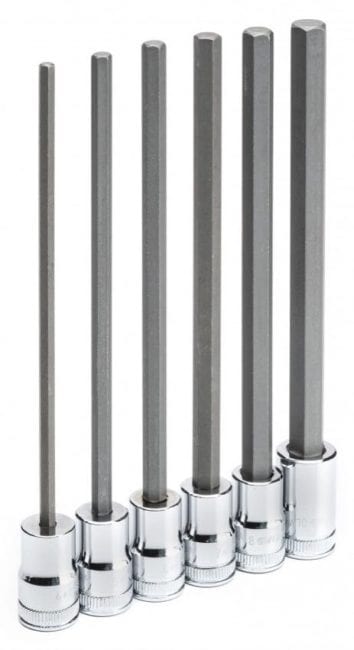
The new line from Gearwrench is comprehensive, spanning 61 total products—57 open stock options and four sets—across 3/8‑inch and 1/2‑inch drive sizes, in both SAE and metric. It includes mid‑length hex sockets, which extend the reach by roughly 50 percent over a standard hex bit socket, and long‑length hex sockets, which double or triple the reach, enabling access to fasteners that are buried deep inside housings, behind obstructions, or positioned in the kind of awkward, blind locations that seem to populate every modern engine bay, hydraulic system, and industrial machine. The bits are forged from S2 tool steel, a material that has become the benchmark for high‑performance hex bits, and the sockets are heat‑treated and finished with Gearwrench's full‑polish chrome. The ends of the bits are chamfered, a geometric detail that reduces the risk of stripping and makes it easier to engage the fastener in low‑visibility situations. The SAE and metric sizes are visually differentiated—double line markings for SAE, knurled lines for metric—so that the technician can distinguish between the two systems at a glance, without squinting at tiny size stamps.
The Geometry of Reach: Why Longer Bits Exist—and Why They Are Hard to Make
A standard hex bit socket is a straightforward tool: a short length of hexagonal steel, ground to precisely controlled dimensions, press‑fitted or forged into a socket base. The bit extends perhaps three‑quarters of an inch beyond the socket face, enough to engage the head of a cap screw that is flush with the surrounding surface or recessed by a modest amount. For the vast majority of fasteners, this is sufficient. But when the fastener is recessed by several inches—as is the case with the header bolts on a V8 engine, the manifold bolts on a turbocharged diesel, or the internal fasteners on a hydraulic valve body—a standard hex bit socket cannot reach. The bit simply is not long enough. The fastener head sits at the bottom of a well, and the socket body cannot enter the well because it is too wide. The solution is a longer bit, but making a longer bit introduces significant engineering challenges. The longer the bit, the more it behaves like a torsion spring under load. When torque is applied to the drive end of the bit, the entire length of the bit twists slightly before the force reaches the fastener end. This twisting, called wind‑up, is not merely a theoretical concern. If the bit twists too much, the applied torque at the drive end does not accurately correspond to the torque at the fastener end. The user may feel like they are tightening the bolt to a specific value, when in reality the bolt is seeing significantly less torque because the bit has absorbed a portion of the energy. In a high‑precision assembly environment—cylinder head bolts, bearing cap bolts, any fastener that requires a specific torque value—this discrepancy can lead to under‑torqued fasteners and the subsequent failures that cascade from them. Additionally, a longer bit is subject to greater bending stress if the socket is not perfectly aligned with the fastener axis, a situation that occurs frequently when working in tight quarters. A bit that bends under load can snap, or it can cam out of the fastener head, damaging both the tool and the workpiece.
Gearwrench addresses these challenges with its choice of material: S2 tool steel. S2 is a shock‑resistant, high‑alloy steel that was originally developed for applications like chisels, punches, and impact tools—tools that must withstand repeated high‑stress impacts without chipping or breaking. Its composition includes silicon, molybdenum, and chromium, which work together to provide a combination of hardness, toughness, and wear resistance that is superior to the chrome‑vanadium (Cr‑V) steel commonly used for hex bits. S2 resists the twisting and bending that plague longer bits. It maintains its dimensional stability under high torque, transmitting the user's input force to the fastener with minimal wind‑up. It resists the shock loads that occur when an impact wrench is used to break loose a stubborn fastener, and it resists the wear that gradually rounds off the hex corners on a lesser bit. For the professional technician who uses hex bit sockets as a primary tool—the automotive mechanic who works on European vehicles where hex fasteners are ubiquitous, the industrial maintenance technician who services hydraulic pumps and valve bodies, the aviation mechanic who assembles and disassembles components held together by recessed hex bolts—S2 steel is not a luxury. It is a requirement for a tool that will perform reliably over a career.
The Chamfered Edge: A Small Geometry Change With Big Consequences
The end of each Gearwrench hex bit is chamfered—cut at a slight angle around the perimeter of the hex—rather than being ground dead‑flat. This chamfer serves two functions. First, it acts as a lead‑in, guiding the bit into the fastener head when the alignment is not perfect. In the blind, obstructed locations where long‑length hex bit sockets are used, the technician often cannot see the fastener head directly. They must locate it by feel, sliding the bit along the surrounding surface until it drops into the hex recess. A chamfered edge greatly increases the probability that the bit will engage the recess on the first attempt, rather than hanging up on the edge and requiring multiple probing attempts. In a production environment where time is measured in tenths of an hour, the seconds saved on each fastener engagement accumulate into meaningful productivity gains over the course of a workday. Second, the chamfer reduces the stress concentration at the very tip of the bit. A sharp, dead‑flat corner is a stress riser—a location where microscopic cracks can initiate when the bit is loaded, eventually leading to chipping or breakage. By removing that sharp corner, the chamfer distributes the load more evenly across the tip of the bit, extending its service life and reducing the likelihood of catastrophic failure. It is a subtle detail, invisible to the casual user, but it represents the kind of engineering optimization that distinguishes a professional‑grade tool from a commodity product.
The Socket Base: Heat‑Treated, Full‑Polish Chrome, and ASME Proof Torque
The bit is only half of the tool. The socket base into which the bit is mounted must be equally robust, because it is the interface between the bit and the drive tool—the ratchet, breaker bar, or impact wrench that applies the torque. Gearwrench constructs the socket base from heat‑treated alloy steel, hardened to a level that exceeds the ASME proof torque requirements for sockets in its class. Proof torque is a standardized test in which the socket is subjected to a torque well above its rated capacity, and it must survive without cracking, deforming, or failing to engage the drive tool. Gearwrench's socket bases exceed these requirements, providing a margin of safety that is reassuring when the user is leaning into a breaker bar with most of their body weight, trying to break loose a fastener that has been in place for a decade. The full‑polish chrome finish on the socket base is not merely cosmetic. It provides a smooth, non‑porous surface that resists rust and corrosion, cleans easily with a shop rag, and slides smoothly into and out of tight spaces without snagging. The chrome also provides high visibility; a bright, reflective socket is easier to locate in a crowded toolbox or in the shadows of an engine bay than a dark, non‑reflective one. The size of each socket is hard‑stamped into the base in large, legible numerals, a marking method that outlasts laser etching and remains readable after years of hard use. The SAE sizes are marked with double lines, and the metric sizes are marked with knurled lines—a visual coding system that allows the technician to distinguish between the two measurement systems without stopping to read the numbers. For the professional who works on both domestic and import vehicles, mixing SAE and metric fasteners throughout the day, this visual differentiation saves time and reduces the frustration of grabbing the wrong socket.
Applications: Header Bolts, Intake Manifolds, and the Hidden Fasteners of the Mechanical World
The long‑length and mid‑length hex bit sockets from Gearwrench were designed with specific applications in mind, and they excel in precisely those environments. The automotive technician working on performance exhaust headers—a job that is notorious for its inaccessible fasteners—will find the long‑length hex bit sockets invaluable. Header bolts are recessed into deep flanges, surrounded by primary tubes that limit the approach angle, and often require a hex bit rather than a conventional socket because the bolt head is too small or too recessed for a socket to fit. The Gearwrench long‑length hex bit socket slides past the tubes, engages the recessed hex head, and allows the technician to torque the bolt to spec without resorting to a cut‑down hex key and an open‑end wrench that can only turn the bolt a fraction of a rotation at a time. The industrial maintenance technician who services hydraulic pumps and valves encounters similar challenges. Fasteners on these components are often deeply recessed, and the surrounding castings, hoses, and fittings limit tool access. The mid‑length hex bit sockets provide enough reach to access these fasteners without the excessive length that might cause clearance issues with adjacent components. The aviation mechanic, working in the cramped nacelles and wing structures of an aircraft, finds that the long‑length sockets enable access to fasteners that would otherwise require the removal of surrounding panels, a time‑consuming and invasive process. In every case, the Gearwrench hex bit sockets replace a collection of workarounds—cut‑down keys, stacked adapters, universal joints—with a single, purpose‑built tool that transmits torque more efficiently, lasts longer, and reduces the time required for each fastening operation.
Gearwrench Long Length Hex Bit Sockets: Key Features
- S2 tool steel bits for exceptional toughness, shock resistance, and dimensional stability under high torque.
- Chamfered hex bit ends for easier engagement in blind, hard‑to‑see locations and reduced stress concentration at the tip.
- Heat‑treated socket base with full‑polish chrome finish for corrosion resistance, easy cleaning, and high visibility.
- Large, hard‑stamped size markings and visual differentiation between SAE (double line) and metric (knurled line).
- Exceeds ASME proof torque requirements for safety and durability in high‑stress applications.
- Available in 3/8‑inch and 1/2‑inch drive sizes, covering a broad range of fastener sizes and torque requirements.
- Mid‑length and long‑length options to accommodate different reach requirements, from moderately recessed to deeply buried fasteners.
- 57 open stock options and four sets providing comprehensive coverage of SAE and metric hex sizes.
Pricing and the Value Proposition
The Gearwrench long length hex bit socket set is priced at approximately $60.18, while the mid‑length hex socket set comes in at around $33.59. Individual open‑stock pieces are available for technicians who need to replace a lost socket or who want to supplement an existing set with specific sizes. At these price points, the Gearwrench hex bit sockets occupy the middle tier of the professional tool market—more expensive than budget import sets, but significantly less expensive than the tool‑truck brands that dominate the automotive service industry. The value proposition is straightforward: a technician could spend twice as much for a set of Snap‑on or Matco long‑length hex bit sockets, or they could pay half as much for an import set that uses lower‑grade steel and lacks the chamfered edges, the visual size differentiation, and the ASME‑exceeding proof torque rating. The Gearwrench set represents the point on the price‑performance curve where the incremental cost of moving to a premium brand no longer justifies the incremental improvement in performance for all but the most demanding production environments. For the independent shop owner, the dealership technician, the industrial maintenance crew, or the serious enthusiast who values quality tools but does not have an unlimited budget, the Gearwrench hex bit sockets are a rational, defensible choice. They will perform alongside the tool‑truck brands for years, and if one does eventually wear out or break, replacing it is a matter of ordering a single socket online rather than waiting for the tool truck to arrive and paying a premium for the convenience of immediate replacement.
Gearwrench Long Length Hex Bit Sockets Specifications
| Specification | Detail |
|---|---|
| Bit Material | S2 tool steel |
| Socket Finish | Full‑polish chrome |
| Bit End | Chamfered |
| Drive Sizes | 3/8‑inch, 1/2‑inch |
| Measurement Systems | SAE (double line marked) and Metric (knurled line marked) |
| Total Products | 61 (57 open stock, 4 sets) |
| Proof Torque | Exceeds ASME requirements |
| Long‑Length Set Price | $60.18 |
| Mid‑Length Set Price | $33.59 |
Conclusion: The Right Tool for the Fasteners That Hide
Gearwrench has built its reputation on delivering professional‑grade tools at prices that do not require a tool‑truck credit account, and the Long Length and Mid‑Length Hex Bit Sockets are faithful to that tradition. They address a specific, pervasive problem—the recessed hex fastener—with a solution that is more elegant, more durable, and more efficient than the workarounds that have been the default answer for generations. The S2 steel bits, the chamfered ends, the visual SAE‑metric differentiation, and the heat‑treated chrome‑finished socket bases are not marketing bullet points. They are the tangible evidence of an engineering team that understands what happens when a technician tries to break loose a corroded header bolt with a cut‑down hex key and a prayer. The available lengths—mid and long—cover the full range of reach requirements that a professional encounters, and the open‑stock availability means that a lost or damaged socket can be replaced individually. At the published prices, these sets represent a genuine value in a market where long‑length hex bit sockets have historically commanded a premium. For the professional technician who has ever stared at a recessed fastener and muttered something under their breath about the engineer who designed it, the Gearwrench Long Length Hex Bit Sockets are the answer to an unspoken prayer. They will not make the fasteners any easier to reach, but they will make reaching them a matter of routine rather than a battle of improvisation.
Comments 0
Leave a Comment