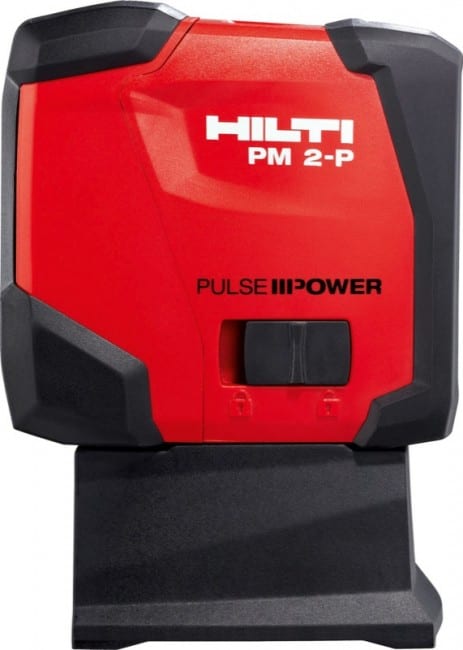
The Hilti PM 2‑L Line Laser and Hilti PM 2‑P Plumb Laser are pocket‑sized layout tools that slide into a tool pouch, clip onto a metal stud, and project crisp, bright lines across a room without demanding a tripod, a helper, or a learning curve. They use what Hilti calls “Always on Pulse Power” technology, a feature that maximizes beam visibility and battery efficiency while making the lasers compatible with a detector for outdoor use. The PM 2‑L throws a horizontal and a vertical line with a wide fan angle, perfect for everything from leveling a drop ceiling grid to setting a junction box at the correct height. The PM 2‑P is a dedicated plumb laser with integrated magnets that snap onto drywall track, steel columns, or door frames, letting you transfer a point from the floor to the ceiling with a single, perfectly vertical beam. Both are wrapped in generous amounts of rubber overmold, designed to survive the kind of falls that happen when you’re balancing on a ladder in a mechanical room. And because Hilti now publishes its prices, you can see exactly what these tools cost before you ever speak to a sales rep. That alone is almost as revolutionary as the lasers themselves.
Always on Pulse Power : The Technology That Makes a Pocket Laser Act Like a Big Tool
The phrase “Always on Pulse Power” sounds like something from a sci‑fi movie, but in the context of construction lasers, it describes a specific and genuinely useful capability. Traditional line lasers emit a continuous wave of light-a steady, unchanging beam that’s visible indoors but washes out completely in daylight beyond a few feet. Pulsed lasers, by contrast, flash on and off at a frequency that’s invisible to the naked eye but detectable by a laser receiver. This allows you to use the laser outdoors, at long range, with a detector that picks up the pulsing signal even when the beam itself is invisible against the sun. The tradeoff, historically, has been that pulsed lasers are larger, drain batteries faster, and cost more. Hilti’s Always on Pulse Power technology bridges that gap. The PM 2‑L and PM 2‑P emit a continuous beam for indoor visibility, but they also pulse at a frequency compatible with Hilti’s laser detectors. You can use the same tiny pocket laser to align a drop ceiling indoors and to check a footing excavation outdoors-switch on the detector, and the tool’s range extends dramatically.
This dual‑mode capability is significant because it eliminates the need to own two lasers : a small cross‑line for interior finish work and a larger rotary or line laser with detector compatibility for exterior layout. For the electrician who spends the morning setting box heights in a dim parking garage and the afternoon checking the level of a conduit trench in full sun, one pocket‑sized tool now covers both tasks. The pulse rate is optimized to conserve battery life; Hilti claims extended runtime on standard alkaline batteries, and the auto‑shutoff feature prevents the laser from draining its cells if left on accidentally. The Always on Pulse name, while marketing‑friendly, accurately describes the experience : you don’t have to switch the laser into a special “pulse mode” or remember a button sequence. It’s always pulsing, always ready for a detector, always delivering the beam characteristics you need regardless of the environment.
Hilti PM 2‑L Line Laser : Horizontal, Vertical, and a Fan Angle That Floods the Room
The PM 2‑L is the cross‑line laser of the pair, designed for tasks that require both a level horizontal line and a plumb vertical line, projected simultaneously or independently. The laser aperture sits behind a protective glass window, and the lines are bright, crisp, and well‑defined-Hilti doesn’t specify the diode color in the press materials, but based on the tool’s pocket‑sized class and the emphasis on indoor use, it’s likely a red beam with enhanced optics to maximize visibility. The fan angle-the arc over which the line is projected-is exceptionally wide, covering nearly 180 degrees. This means you can place the laser in the corner of a room and the horizontal line will wrap around both adjacent walls, eliminating the need to reposition the tool for every wall. For a drywall finisher checking screw patterns, a cabinet installer leveling a run of uppers, or an electrician aligning a row of receptacles, that wide fan angle translates directly into fewer setups and faster work.
The PM 2‑L is self‑leveling, with a pendulum that locks into place within a range of about ±4 degrees. A blinking laser line indicates when the tool is beyond its self‑leveling range, preventing the user from inadvertently working with an out‑of‑level reference. The locking mechanism engages automatically when the laser is powered off, protecting the pendulum during transport. The housing is a compact rectangle, roughly the size of a deck of cards, with a flat base that sits securely on a ladder rung, a pipe, or a piece of lumber. The overmold rubber wraps the corners and edges, absorbing impact from drops. A 1/4‑inch threaded insert on the bottom accepts a tripod or a Hilti magnetic bracket, expanding mounting options. Controls are minimal : a single button toggles between horizontal line, vertical line, and both lines simultaneously. There’s no screen, no Bluetooth, no app-just a tool that does its primary job with as little friction as possible.
Hilti PM 2‑P Plumb Laser : Transferring Points from Floor to Ceiling in One Motion
The PM 2‑P laser is more specialized. It doesn’t project a line; it projects a single, perfectly vertical plumb point upward and downward from the tool’s aperture. This is the laser you reach for when you need to transfer a layout mark from the floor to the ceiling, align a window opening from the sill to the header, or ensure a steel column is vertically true from base to cap. The integrated magnets-powerful rare‑earth discs embedded in the back of the housing-allow the laser to cling to drywall track, metal door frames, steel I‑beams, and any ferrous surface. You mark a point on the floor, place the PM 2‑P over that mark (assisted by the laser’s downward beam), and the upward beam instantly shows you where the corresponding point lands on the ceiling or the bottom of the deck above. No plumb bob, no string, no helper holding a level.
The magnets are strong enough to hold the laser securely even when the surface is vertical. You can slap the PM 2‑P onto a metal stud and it stays put while you walk away to mark the floor or ceiling point. The rubber overmold on the back provides friction on non‑magnetic surfaces, though the tool is clearly designed with metal framing in mind. The laser is also self‑leveling within a similar range to the PM 2‑L, and the pendulum lock protects it during transport. The single‑button operation toggles the laser on and off, and the housing is nearly identical in footprint to the PM 2‑L, making the two tools a natural pair to carry together. An electrician running conduit might use the PM 2‑L to level a horizontal run and the PM 2‑P to transfer the knockout location from the panel to the ceiling above, all within a single workday and without swapping brackets or batteries.
Build Quality and Durability : Hilti’s Signature Over‑Mold Armor
Hilti’s reputation for durability is not a marketing invention. The company’s tools are designed to survive on commercial construction sites where a tool might be left in the rain, dropped from a scissor lift, or buried in drywall dust. The PM 2‑L and PM 2‑P both carry that DNA. The housing is a rigid, impact‑resistant composite, but the real protection comes from the thick rubber overmold that wraps the entire tool. This overmold serves three purposes : it absorbs shock when the laser hits the ground, it provides a non‑slip grip that stays secure even with damp or gloved hands, and it seals the internal components against dust and light moisture. Hilti rates the lasers at IP54, meaning they are protected against dust that could interfere with the optics and against splashing water from any direction. They won’t survive submersion, but a sudden rain shower, a splash from a wet concrete pour, or the condensation in a cold mechanical room won’t kill them.
The laser apertures are recessed behind hardened glass windows that resist scratching. The pendulum mechanism is a proven Hilti design that has been field‑tested in thousands of their larger rotary and line lasers. The buttons are sealed and have a positive, tactile click. The battery compartment is closed with a gasketed cover, and the lasers run on widely available AA batteries-a deliberate choice that keeps operating costs low and ensures you can find replacements anywhere, from a supply house to a gas station. The overall feel is one of density and solidity; these are small tools, but they don’t feel fragile. They feel like miniature versions of Hilti’s larger layout instruments, and that’s exactly what they are.
The Hilti Website Revamp : Why Transparent Pricing Changes the Game
For years, the barrier to entry into the Hilti ecosystem wasn’t just the cost of the tools-it was the opacity of that cost. You couldn’t browse Hilti’s website, compare prices, and make a purchasing decision. You had to engage with a sales representative, sit through a consultation, and receive a quote that often included service contracts, fleet management, and other bundled services. This model worked well for large commercial contractors who already had Hilti reps on speed dial, but it alienated the independent tradesperson, the small remodeler, and the electrician who just wanted a really good laser without a relationship commitment. Hilti’s redesigned website changes that completely. Every product now displays a retail price. You can add items to a cart, check out, and have them shipped directly to your door, just like any other online tool purchase. The laser product pages include detailed specifications, compatibility information, and instructional videos. The mystique is gone; the tools have to stand on their own merits against a transparently priced market. And that’s a good thing for everyone.
The PM 2‑L and PM 2‑P are among the first new products to debut on this redesigned site, and their pricing positions them as premium compact lasers, but not extravagantly so. They compete with the Bosch GLL series, the DeWalt cross‑line lasers, and the Milwaukee M12 laser line, but with the added credibility of Hilti’s commercial‑grade durability and the Always on Pulse Power feature that many competitors in this size class lack. The transparent pricing also makes it easier to compare total cost of ownership. You can see the price of a replacement detector, a magnetic bracket, or a service plan, and decide whether those add‑ons make sense for your business. This level of openness is a cultural shift for Hilti, and it makes the brand accessible to a much wider audience.
Specifications and Comparison Table
| Specification | Hilti PM 2‑L | Hilti PM 2‑P |
|---|---|---|
| Function | Cross‑line laser (horizontal and vertical) | Plumb point laser (up and down) |
| Laser Type | Red diode, Class 2 | Red diode, Class 2 |
| Fan Angle (Horizontal) | ~180° | N/A (point beam) |
| Pulse Power | Always on; detector‑compatible | Always on; detector‑compatible |
| Self‑Leveling Range | ±4° | ±4° |
| Accuracy | ±1/8 inch at 30 feet (±3 mm at 10 m) | ±1/8 inch at 30 feet (±3 mm at 10 m) |
| Magnets | No (optional bracket available) | Yes, integrated rare‑earth magnets |
| IP Rating | IP54 | IP54 |
| Power | 2 × AA batteries | 2 × AA batteries |
| Runtime (approx.) | 15 hours (all lines on) | 20 hours |
| Thread Mount | 1/4‑inch tripod thread | 1/4‑inch tripod thread |
| Weight | ~0.6 lbs | ~0.5 lbs |
| Dimensions | ~4.5 × 3 × 1.5 inches | ~4.5 × 3 × 1.5 inches |
| Price | See Hilti website | See Hilti website |
Real‑World Applications : Where the PM 2‑L and PM 2‑P Excel
Electrical Work: The PM 2‑L’s horizontal line is ideal for setting junction boxes at consistent heights around a room. The wide fan angle covers an entire space from a single corner placement. The PM 2‑P’s plumb point transfers the panel knockout location from the floor to the ceiling grid for conduit penetrations. The magnets hold fast to metal studs and enclosures. Both tools fit in a tool pouch, meaning the electrician always has them on hand for quick layout adjustments.
Drywall and Ceiling Grid Installation: Running a horizontal laser line around a room at grid height is the standard method for drop ceiling installation. The PM 2‑L’s wide fan angle and pulse capability mean the same laser can be used indoors for grid layout and outdoors with a detector for leveling a perimeter track on a new commercial shell. The compact size is a benefit in tight areas between the grid and the slab above.
Window and Door Alignment: The PM 2‑P is a revelation for installing windows and doors in steel‑framed commercial buildings. Attach it to the metal header track at the top of the rough opening, and the downward beam shows exactly where the center of the window should align on the sill. Attach it to the sill and the upward beam checks the header. No string, no level, no helper squinting at a bubble. The magnets hold securely through vibration from adjacent work.
Concrete Formwork and Footings: With the Always on Pulse Power, the PM 2‑L can be used outdoors with a detector to level form boards, check footing elevations, and align anchor bolts. While it lacks the range of a full‑size rotary laser, for residential and light commercial projects with a compact footprint, it’s a surprisingly capable tool that eliminates the need to rent or buy a larger laser for small‑scale concrete work.
Steel Erection and Metal Framing: The PM 2‑P’s magnets are its superpower on a steel job site. Stick it to a column and you can instantly plumb the member, or transfer a reference point from the base to the connection plate above. The tool’s small size means it won’t interfere with bolts, clips, or other connections. Ironworkers and metal stud framers will find the speed and convenience transformative compared to a traditional plumb bob and string.
Hilti’s Ecosystem : Accessories, Detectors, and the Lifetime Service Agreement
Hilti doesn’t just sell a laser; they sell an ecosystem that includes brackets, detectors, tripods, and a service agreement that covers calibration and repairs. The PM 2‑L and PM 2‑P are compatible with Hilti’s laser detectors, which are sold separately. The puck‑style detector mounts to a grade rod or a story pole and emits an audible tone when it reads the laser line. For outdoor use, this is essential; without a detector, the laser beam is invisible beyond a few feet in sunlight. Hilti’s detectors are ruggedized, with large LED displays and a memory function that remembers the last on‑grade setting.
Mounting options include a magnetic bracket that fits the PM 2‑L (adding magnetic capability to the line laser) and a multi‑purpose clamp that attaches to pipes, studs, and edges. These accessories are not inexpensive-Hilti accessory pricing reflects the brand’s commercial market position-but they are designed to the same standard of durability as the lasers themselves. The tripod‑thread insert is a standard 1/4‑inch, so you can use any camera tripod or construction tripod with the appropriate adapter, not just Hilti’s proprietary stands.
The Hilti Lifetime Service agreement, available for an additional fee, covers wear and tear, calibration, and repairs for the life of the tool. For a professional who relies on laser accuracy daily, this can be a worthwhile investment, turning the laser from a depreciating asset into a long‑term fixture of the tool fleet. The transparent pricing on the website now makes it easy to see exactly what the service plan costs, so you can factor it into the purchase decision up front, rather than negotiating with a rep.
What to Consider Before Buying : Limitations of Pocket‑Sized Lasers
While the PM 2‑L and PM 2‑P are exceptional at what they do, they are not full‑size rotary lasers, and they come with inherent limitations that buyers should understand. The beam is red, not green. Red diodes are less expensive and use less power, but under bright indoor lighting or at longer distances, a green beam is significantly more visible to the naked eye. Hilti’s optics maximize the red beam’s brightness, but if your primary use case is large, brightly‑lit open spaces without a detector, a green laser may serve you better.
The PM 2‑L projects lines; it does not project points except at the intersection of its cross. For tasks requiring multiple plumb points or a 90‑degree layout, you may need a laser with additional diodes or a rotary function. The self‑leveling range of ±4 degrees means you can’t place the laser on a severely sloped surface and expect it to work-it will flash a warning and refuse to project a line. This is standard for the class, but it requires a reasonably level setup surface or a tripod with adjustable legs.
The PM 2‑P’s magnets are for ferrous metal only. If you work primarily with wood framing, the plumb laser will need a separate mounting solution (a clamp, a tripod, or careful balancing). The magnets add a bit of weight, but it’s negligible. More importantly, the PM 2‑P does not project a horizontal line-it’s a single‑purpose tool. You’ll likely want to pair it with the PM 2‑L or another cross‑line laser for complete layout capability. Hilti is counting on the convenience of the dual‑tool kit; separately, each laser is a specialist, together they form a comprehensive layout system.
Conclusion : Small Lasers, Big Impact, and a New Way to Buy from Hilti
The Hilti PM 2‑L Line Laser and PM 2‑P Plumb Laser are not the most technologically advanced lasers Hilti makes, nor are they the most powerful. But they might be the most practical. Their pocket‑sized form factor means they’re always within reach, not buried in a case on the truck. The Always on Pulse Power technology extends their usefulness from the basement to the rooftop, letting one compact tool cover indoor visibility and outdoor detector‑based range. The build quality, with its thick rubber overmold and sealed construction, is pure Hilti-these tools feel like they were made to be used, not babied. And the redesigned Hilti website, with its transparent pricing and online purchasing, makes acquiring them as straightforward as any other tool purchase.
For the electrician finishing a hotel floor and needing a reliable cross‑line laser that can also check the parking garage trench outside, the PM 2‑L is an elegant solution. For the drywall framer, the steel erector, or the window installer who needs to transfer a point from the bottom to the top of an opening in seconds, the PM 2‑P’s magnets and dual plumb beams are a genuine workflow accelerator. For the general contractor who’s been put off by Hilti’s old sales process, the new website removes the final barrier to entry.
These lasers are the beginning of a more accessible Hilti-one that understands that transparency, simplicity, and tools that just work are the currency of the modern tradesperson. They’re tools that fit in your pocket, but more importantly, they fit in your daily workflow without demanding a learning curve or a credit check. At whatever price Hilti is asking on its new transparent website, they’re worth a look. Because when a pocket‑sized laser can do the work of two larger tools, and survive the drop that would kill a cheaper one, it stops being a luxury and starts being a necessity.
Comments 0
Leave a Comment