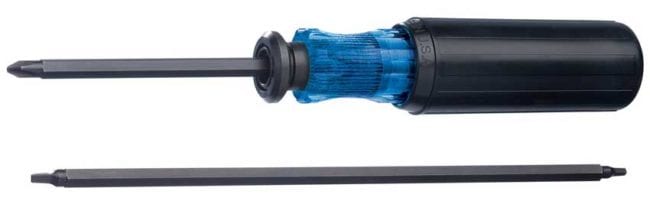
At its core, the Ideal Extendable Screwdriver is a study in deliberate minimalism. The tool consists of a single handle, a collet‑type locking collar, and two removable, double‑ended bits. Each bit is nine inches long—longer than most fixed‑shaft screwdrivers—and carries a different tip on each end. The first bit provides a #2 Phillips on one side and a 1/4‑inch slotted on the other. These are the two most commonly encountered fasteners in electrical work, and their inclusion on a single bit means that the vast majority of screws an electrician touches in a day—panel cover screws, terminal block screws, conduit clamp screws, receptacle and switch screws—can be addressed without changing bits. The second bit provides a #1 square drive on one end and a #2 square drive on the other. Square drive, also known as Robertson, is ubiquitous in Canadian electrical work and increasingly common in the United States on electrical boxes, certain commercial fixtures, and HVAC equipment. The inclusion of these bits means the driver covers the four most common fastener types an electrician encounters, all with two bits that are easy to swap and impossible to lose because they are either in the driver or in the handle. There is no bit storage compartment to break open, no tiny collet to unscrew, no collection of loose bits rattling around in the bottom of a tool bag. The bits are the shank. When you are not using one, it is stored in the handle. When you need the other, you pull the current bit out, flip the stored bit to the desired tip, and insert it. The process is fast, intuitive, and secure.
The Adjustable Shaft: How It Works, and Why It Changes the Workflow
The defining feature of the Ideal Extendable Screwdriver is the adjustable shaft length. The handle incorporates a spring‑loaded collet mechanism that grips the bit shank. To extend the reach, you push down on the collet collar, which releases its grip on the bit. You then slide the bit outward to the desired length, anywhere between its fully retracted position and its maximum extension, and release the collar. The collet snaps back into place and locks the bit with a grip that is, for all practical purposes, indistinguishable from a fixed‑shaft driver. There is no perceptible play, no tendency for the bit to slide back into the handle under load, no feeling that the tool is anything other than a solid, one‑piece screwdriver. To shorten the reach, you push the collar out again and slide the bit inward, then release. The mechanism is simple enough to be operated one‑handed once you have learned the motion, and it can be adjusted in seconds between fasteners. The range of adjustment is continuous, not stepped, so you can set the shaft to exactly the length that the workspace demands. If a screw is recessed 5.3 inches behind a panel, you can set the bit to extend 5.3 inches. If the next screw is flush with the panel face, you can retract the bit to its shortest position and use the driver like a stubby. The tool adapts to the work, rather than the user adapting their body position to the limitations of a fixed tool. In the hands of a professional electrician working on motor control panels—the kind used to drive large pumps in water treatment plants, manufacturing facilities, and commercial buildings—the adjustable shaft reveals its full utility. These panels are deep, often exceeding twelve inches from face to back. Components are mounted at various depths within the enclosure: contactors near the front, thermal overload relays in the middle, terminal blocks at the rear, power supplies and heat sinks bolted to the back panel. A fixed‑length screwdriver that reaches the bottom of the panel is too long to maneuver between components near the front. A short screwdriver that works at the front runs out of reach at the back. The electrician must carry multiple drivers or constantly swap between them. With the Ideal Extendable Screwdriver, a single tool handles all of these positions. Extend it fully to reach the recessed terminals at the back of the panel. Retract it halfway to navigate between the densely packed components in the middle. Retract it fully to work on the front‑mounted breakers and switches. The time saved by not swapping tools, combined with the reduced weight and bulk on the tool belt, makes a meaningful difference over the course of a shift. We observed one of our resident electricians using the driver to secure wires in terminal blocks, to tighten heat sinks and power supplies to the rear of cabinets, and to fasten components to Square D breaker panels. In every configuration, the tool performed like a dedicated, fixed‑length driver. The collet held firm. The bit did not slip. The handle provided adequate torque without discomfort. The only limitation encountered was the maximum reach: with the bit fully extended, the shaft length is approximately 7 inches, and with the tip itself adding another inch of reach, the total effective length is around 7.5 inches. For panels deeper than that, a longer dedicated driver is still necessary, but for the vast majority of electrical enclosures, 7.5 inches of reach is more than sufficient.
The Two Double‑Ended Bits: Simple, Robust, and Always Onboard
Ideal's decision to use two double‑ended bits rather than a collection of single‑ended bits is a deliberate choice that prioritizes simplicity and durability. Each bit is machined from hardened steel and finished with a black oxide coating that resists corrosion and provides a subtle friction that helps the bit grip the screw head. The #2 Phillips tip is the workhorse—the tip that will see the most use in any electrician's hand—and it is properly profiled to engage Phillips screws without camming out under torque. The 1/4‑inch slotted tip on the opposite end of the same bit is equally well‑profiled, with a flat, even grind that fits the slot of a standard electrical screw snugly. The square drive bits, #1 and #2, share the second double‑ended shaft. The #2 is the standard size for most electrical boxes and many commercial fixtures; the #1 handles the smaller square‑drive screws found on some control components and Canadian‑spec devices. The bits are standard 1/4‑inch hex shank, which means they can be used in any impact driver or bit holder if the user prefers powered fastening for production work. But the Ideal Extendable Screwdriver is designed to be the primary tool—the one you reach for when you need to feel the screw seat, when you need to control the torque precisely to avoid stripping a thread or crushing a delicate component. The black oxide finish on the bits, combined with the hollow‑ground tips, provides a secure grip on the fastener and minimizes the tendency to slip, a critical safety feature when working near live electrical components where an uncontrolled slip could have serious consequences. The storage of the unused bit is elegantly solved. When one double‑ended bit is installed in the driver, the other bit is stored inside the handle, fully enclosed and protected from the elements. To swap bits, you simply pull the installed bit out, extract the stored bit from the handle, flip it to the desired tip orientation, and insert it. There is no need to carry a separate bit holder, no risk of dropping a tiny bit into a dark, inaccessible corner, no interruption to the workflow while you search for the right tip. The bits are retained by friction and by the same collet mechanism that secures them during use. The retention is strong enough that the stored bit will not fall out if the handle is inverted or shaken, but the bit releases easily when you intentionally pull it. The entire bit‑swapping process takes less than ten seconds and can be performed with one hand if necessary. For the electrician who alternates between Phillips and slotted screws throughout the day, the ability to switch tips instantly, without leaving the work area, is a genuine productivity enhancement.
The Grip: Comfortable, But With a Wrinkle
Ideal finishes the Extendable Screwdriver with a thick, overmolded rubber grip that covers the majority of the handle. The rubber is contoured with shallow grooves that provide a natural resting place for the fingers, and it is thick enough to absorb vibration and provide a comfortable platform for the palm. However, the rubber surface is slightly slicker than some competitors—not dangerously so, but noticeably less tacky than the iconic Klein cushion grip or the Sanoprene overmolds found on some premium European drivers. In dry conditions, the grip provides adequate control. In damp, sweaty, or oily conditions, the user will need to maintain a conscious, deliberate grip. The handle does incorporate a rotating collar at the top, just below the collet, that allows the user to hold the shaft steady with one hand while turning the handle with the other. This is a useful feature for driving long screws or for situations where precise control of the bit tip is critical. The rotating collar is smooth, well‑fitted, and does not feel like it will loosen or develop play over time. The butt of the handle features Ideal's branding and the tool's patent number, but it does not feature the kind of tip‑identification markings that some competing drivers use to help the user quickly identify the tool when it is stored handle‑up in a pouch. This is a minor oversight, but for the electrician who carries multiple drivers, the ability to glance down at the butt of the handle and see that it is the adjustable driver—rather than the 12‑in‑1 or the dedicated Phillips—would be a welcome addition. The overall diameter of the handle is larger than that of a fixed‑blade screwdriver, a necessary consequence of the internal collet mechanism and the bit storage compartment. For users with average to large hands, the diameter is comfortable and provides a commanding grip. For users with very small hands, the diameter may feel slightly oversized, particularly during delicate, fingertip‑controlled work. The handle length is sufficient to provide a full four‑finger grip for most users, and the weight of the tool—approximately 7 ounces according to our measurements—feels balanced and substantial without being burdensome. The tether hole at the end of the handle is a thoughtful inclusion for professionals who work at height and need to secure their tools to a lanyard, a requirement that is becoming increasingly common under updated OSHA regulations.
Made in the USA: A Selling Point That Speaks to Quality
One of the distinguishing characteristics of the Ideal Extendable Screwdriver is that it is manufactured in the United States from domestically sourced materials. This is not a tool that was assembled in the US from imported components or a tool that was designed in the US and manufactured offshore. It is a fully American‑made product, built by American workers in an American factory. For many professionals, this is a meaningful distinction. It speaks to the quality of the materials, the control of the manufacturing process, and the support of domestic industry. But it also has practical implications for the end user. A tool manufactured in the US is subject to American labor and environmental standards, which are generally more stringent than those in many offshore manufacturing locations. The steel used in the bits is American‑sourced, heat‑treated, and finished. The plastic and rubber used in the handle are American‑sourced and molded. The collet mechanism is machined and assembled by American hands. The result is a tool that feels like it was built to last, not built to a price point. Ideal backs the driver with a standard warranty, and the company's history of producing professional‑grade electrical tools suggests that warranty claims will be rare. The Made in the USA stamp on the handle is more than a patriotic emblem; it is a statement about the quality and durability of the tool.
Field Performance: From the Shop to the Motor Control Center
We tested the Ideal Extendable Screwdriver in two distinct environments: the Pro Tool Reviews shop, where it was used for general maintenance and assembly tasks, and a working motor control panel facility, where a professional electrician put it through its paces on the kinds of deep, component‑dense enclosures that define industrial electrical work. In the shop, the driver handled everything from securing terminal blocks to fastening power supplies and heat sinks to the rear of cabinets. The adjustable shaft proved its worth repeatedly, allowing us to switch between a stubby configuration for close‑quarters work and an extended configuration for reaching deeply recessed fasteners without changing tools. The #2 Phillips tip engaged screws positively and did not cam out under reasonable torque. The 1/4‑inch slotted tip fit the standard flat‑head screws on older equipment without the side‑to‑side play that plagues poorly‑ground slotted bits. The square drive bits saw less use, simply because square‑drive fasteners are less common in the environments where we tested, but when they were needed, they performed flawlessly. In the motor control panel facility, the electrician who used the driver was initially skeptical. He had a set of fixed‑length Klein drivers that he had been using for years, and he was not convinced that an adjustable driver could match their feel and reliability. After a day of using the Ideal Extendable Screwdriver—extending it to reach deeply recessed terminals, retracting it to work on front‑mounted breakers, swapping between the Phillips and slotted bits as the fasteners demanded—he was converted. He noted that the collet held the bit securely at every extended position, that the driver never slipped or collapsed back into the handle, and that the grip, while slightly slicker than his Kliens, was comfortable enough for all‑day use. The time savings were significant: instead of swapping between three or four fixed drivers as the work moved between different depths in the panel, he simply adjusted the shaft and continued working. The space savings on his tool belt were equally significant: one driver replaced three. He did note that the maximum reach of the Ideal driver was slightly less than his longest dedicated screwdriver, which meant that for the very deepest recesses—beyond about 7.5 inches—he still needed a dedicated tool. But those situations were rare, and for the overwhelming majority of fasteners, the Ideal Extendable Screwdriver was more than capable.
Ideal Extendable Screwdriver Specifications
| Specification | Detail |
|---|---|
| Model | Ideal 35‑947 |
| Included Bits | #2 Phillips / 1/4' Slotted; #1 / #2 Square Drive |
| Bit Length | 9 inches each |
| Shaft Length Range | ~3.5 inches (retracted) to ~7.5 inches (extended) |
| Handle Type | Overmolded rubber grip with rotating collar |
| Made in the USA | Yes |
| Price | $18.53 (retail) |
Conclusion: A Single Driver That Replaces a Pouch Full of Fixed Tools
The Ideal Extendable Screwdriver is not the first adjustable‑length screwdriver on the market, but it is one of the most thoughtfully executed. The combination of a continuously adjustable shaft, two double‑ended bits that cover the four most common fastener types, a secure collet‑locking mechanism, and a comfortable (if slightly slick) handle make it a compelling upgrade for any professional who currently carries multiple fixed‑length drivers. The Made in the USA pedigree, with domestically sourced materials and manufacturing, adds a layer of quality assurance that is difficult to quantify but easy to feel when the tool is in your hand. The price—under $20—is competitive with similar products from Klein and other premium brands, and in some cases slightly lower. For the electrician working in deep control panels, the HVAC technician reaching into air handlers, or any professional who needs to adapt their screwdriver reach to the demands of the workspace rather than the limitations of the tool, the Ideal Extendable Screwdriver is an easy recommendation. It will not replace every screwdriver in the bag—there will always be a place for a dedicated stubby, a precision driver, and a heavy‑duty demolition driver—but it will replace the half‑dozen mid‑reach drivers that occupy the most space and contribute the most weight. That is a meaningful step toward a lighter, leaner, more efficient tool pouch, and it is a step worth taking.
Comments 0
Leave a Comment