The Battery: Sixteen Lithium‑Ion Cells, 180 Watt‑Hours, and the Math of Portable Power
The heart of the iMuto S5 is its battery array: sixteen individual 3.6‑volt lithium‑ion cells, wired in a series‑parallel configuration to deliver a total capacity of 50 amp‑hours at a nominal voltage of approximately 10.8 to 14.4 volts, depending on the state of charge. The total energy stored is 180 watt‑hours—a figure that, for the uninitiated, can be difficult to visualize but which provides a useful benchmark for what the device can and cannot power. A watt‑hour is the energy consumed by a device that draws one watt of power for one hour. A typical smartphone battery has a capacity of roughly 10 to 15 watt‑hours, which means the iMuto S5 can recharge a smartphone approximately 12 to 18 times before it needs to be recharged itself. A modern ultrabook laptop draws perhaps 30 to 45 watts in normal use, which means the S5 can power it for roughly four to six hours. A CPAP machine, depending on the model and the pressure settings, might draw 30 to 60 watts, giving a run time of three to six hours—sufficient for a full night of sleep, provided the humidifier and heated hose are not in use. A small LED television, a portable fan, a set of camera battery chargers, a drone battery charger, a cordless tool battery charger—all of these fall within the S5's capabilities, and each one draws from the finite reservoir of 180 watt‑hours until the battery is depleted.
The battery is managed by an onboard BMS—a Battery Management System—that performs the critical functions of monitoring the voltage, current, and temperature of each cell, balancing the charge across the array to maximize both performance and longevity, and protecting the cells from overcharging, over‑discharging, short circuits, and thermal runaway. A BMS is a non‑negotiable requirement for any lithium‑ion battery pack that is intended to be used by consumers, because lithium‑ion cells, for all their advantages in energy density and cycle life, are chemically volatile. A cell that is overcharged, discharged too deeply, or subjected to a short circuit can heat up rapidly, vent flammable electrolyte gases, and, in the worst case, catch fire. The BMS is the silent guardian that prevents these scenarios, and its presence in the iMuto S5 is a mark of a product that has been designed with safety as a priority.
Charging Options: Wall, Car, USB‑C, and Solar
One of the most compelling features of the iMuto S5 is the variety of ways in which it can be recharged. The most straightforward method is the included 20‑volt, 2‑amp DC power adapter, which plugs into a standard wall outlet and replenishes the battery in roughly five to seven hours. The second method is the included 12‑to‑24‑volt vehicle DC charging cable, which allows the S5 to be recharged from a car, truck, boat, or RV cigarette lighter socket while driving. The third method—and the one that points toward the future of portable power—is the USB‑C Power Delivery 2.0 port. This port is bidirectional: it can deliver up to 60 watts of power to a connected device, such as a modern laptop that charges over USB‑C, and it can also receive up to 60 watts of power from a compatible USB‑C charger. If the user has a USB‑C charger that can deliver 60 watts—the kind that ships with a high‑end laptop or a fast‑charging smartphone—that charger can be used to replenish the iMuto S5, eliminating the need to carry a separate power brick. The fourth method is solar. The iMuto S5 is compatible with solar panels that output between 36 and 60 watts, connected via the DC input port. With a compatible panel in full sun, the S5 can be recharged in roughly six to eight hours—a full day of good sunlight. The ability to recharge the S5 from the sun transforms it from a simple battery pack into a self‑sustaining power system. A camper, a hiker, an overland traveler, or a disaster survivor can set up a solar panel, connect it to the S5, and, over the course of a day, harvest enough energy from the sun to power their essential electronics through the night and into the next day. The solar input is regulated by the S5's onboard charge controller, which ensures that the battery is charged at the correct voltage and current and that the solar panel does not overcharge or damage the cells.
Outputs: AC, USB, USB‑C, and DC—A Comprehensive Suite
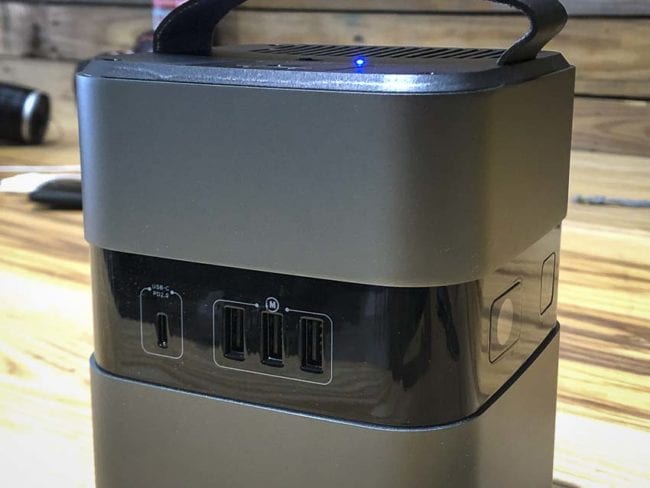
The iMuto S5 is equipped with a total of seven output ports, covering the full spectrum of connectors that modern electronics require. The 120‑volt AC outlet is a pure sine wave inverter, rated for a maximum continuous output of 260 watts, with a peak surge capacity that is somewhat higher. A pure sine wave inverter produces an AC waveform that is identical to the power supplied by the electrical grid, which is essential for sensitive electronics—medical devices, audio equipment, variable‑speed motors—that can be damaged or can malfunction when powered by the modified sine wave output of a cheaper inverter. The inclusion of a pure sine wave inverter, rather than a modified sine wave unit, is a significant differentiator that elevates the S5 above budget portable power stations. The three USB Type‑A outlets, collectively capable of delivering 40 watts, provide charging for smartphones, tablets, cameras, Bluetooth speakers, and the thousand other gadgets that have standardized on the USB connector. The USB‑C Power Delivery 2.0 port, as noted, is bidirectional and can deliver up to 60 watts—sufficient to charge a modern MacBook, a Dell XPS, a Lenovo ThinkPad, or any other laptop that supports USB‑C charging. The two DC outputs—a 20‑volt, 2‑amp "laptop" output and a 12‑volt car adapter socket—provide compatibility with older electronics that use barrel‑type DC connectors or that are designed to operate from a vehicle's electrical system. All of the outputs can be used simultaneously, provided that the total load does not exceed the inverter's maximum rating. The S5 will automatically shut down if the load exceeds its capacity, protecting both the device and the connected equipment from damage.
The LCD Display: Real‑Time Information at a Glance
The iMuto S5 features a backlit LCD display that provides the user with real‑time information about the state of the device. The display shows the remaining battery capacity as a percentage, the estimated run time at the current load, the input power (when the device is being charged), and the output power (when the device is discharging). The estimated run time is calculated dynamically, based on the current load, and it updates as the load changes. This is a genuinely useful feature that allows the user to manage their power consumption intelligently. If the display shows that the S5 has only 45 minutes of run time remaining at the current load, the user can turn off non‑essential devices, reduce the brightness of a connected light, or switch to a lower‑power charging mode to extend the run time. The display also provides status icons that indicate whether the S5 is charging, discharging, or operating on solar power, and it alerts the user to any fault conditions—overload, over‑temperature, or low battery—that require attention. The display is bright enough to be read in direct sunlight and dim enough not to be distracting in a dark tent or a bedroom.
Design, Portability, and Build Quality
The iMuto S5 is housed in a smooth, rectangular enclosure made from a durable, impact‑resistant polymer. The enclosure is finished in a matte dark gray with orange accents—a color scheme that is both professional and visually distinctive. The integrated carry handle is molded into the top of the enclosure, soft to the touch, and comfortable to hold for extended periods. The handle is not a separate, bolt‑on component; it is part of the enclosure itself, which means it cannot break off, loosen, or rattle. The overall dimensions are compact—roughly the size of a small shoebox—and the weight, at 4 pounds 13 ounces, is light enough to be carried in one hand, tossed into a backpack, or stowed in the trunk of a car without consuming excessive space. The enclosure is vented to allow heat to escape from the internal electronics, and the unit generates a modest amount of warmth during operation—noticeable but not alarming, and entirely normal for a device that is converting battery voltage to AC line voltage through an inverter.
One of the less‑advertised but highly useful features of the iMuto S5 is its ability to charge and discharge simultaneously. This is not a universal capability among portable power stations, and it adds a layer of versatility that is particularly valuable in off‑grid and emergency scenarios. The user can connect a solar panel to the S5, and while the sun is shining and the battery is charging, they can simultaneously draw power from the S5 to charge their phone, run their laptop, or power a small appliance. The solar energy that is being harvested is used first to power the connected devices, and any excess is stored in the battery for later use. This "pass‑through" charging capability means that the S5 can function as a rudimentary solar generator—a small, silent, emission‑free power plant that can operate indefinitely as long as the sun continues to shine.
Limitations: What the iMuto S5 Cannot Do
The iMuto S5 is a capable device, but it is not a miracle worker. Its 180‑watt‑hour capacity and 260‑watt maximum output place firm limits on what it can power. A full‑sized refrigerator, a microwave oven, a space heater, a power tool, a sump pump—these are all far beyond the S5's capabilities, and attempting to power them will simply cause the inverter to shut down. A CPAP machine with a heated humidifier and a heated hose may draw more power than the S5 can supply for a full night, depending on the specific model and settings. A laptop that is performing intensive tasks—video editing, 3D rendering, gaming—will drain the S5 more quickly than the estimated run time suggests. The solar charging capability, while valuable, is dependent on the availability of sunlight and on the quality of the connected solar panel. A cloudy day, a shaded campsite, or a panel that is misaligned with the sun will dramatically reduce the charging rate. The battery, like all lithium‑ion batteries, will lose capacity over time as it accumulates charge‑discharge cycles. After several hundred cycles, the usable capacity may have declined to 70 or 80 percent of its original value, and eventually the battery will need to be replaced—a task that is not user‑serviceable on the S5 and would require the device to be sent back to the manufacturer or professionally refurbished.
iMuto S5 Portable Solar Power Station Specifications
| Specification | Detail |
|---|---|
| Battery Capacity | 50 Ah / 180 Wh (16 × 3.6V Li‑ion cells) |
| AC Output | 120V AC, 260W max (pure sine wave) |
| USB Outputs | 3 × USB Type‑A (40W max total) |
| USB‑C PD 2.0 | 60W max (bidirectional—charge and discharge) |
| DC Outputs | 20V/2A laptop output; 12V car adapter socket |
| Charging Inputs | DC adapter (wall), 12‑24V vehicle cable, USB‑C PD, 36/60W solar panel |
| Display | Backlit LCD (battery %, estimated run time, input/output power) |
| BMS | Overcharge, over‑discharge, short circuit, thermal protection |
| Weight | 4 lbs 13 oz |
| Simultaneous Charge/Discharge | Yes |
| Price (Approx.) | $399 |
Who Should Buy the iMuto S5?
The iMuto S5 is ideally suited for the camper who wants to keep a phone, a tablet, a camera, and a portable fan running through a weekend in the woods; the overland traveler who needs to power a laptop and a drone charger from the back of a vehicle; the disaster prepper who wants a compact, self‑contained backup power source for essential electronics during a grid outage; the remote‑location contractor who needs to charge cordless tool batteries and run a small work light where no temporary power is available; and the CPAP user who wants the security of knowing that a power outage will not interrupt their sleep. It is not suited for the homeowner who wants to back up their refrigerator, their well pump, or their home heating system—those applications require a much larger, permanently installed generator or battery backup system. The iMuto S5 occupies a specific, well‑defined niche: it is a portable, personal power station for small electronics and low‑wattage appliances, and within that niche, it performs exceptionally well. The ability to recharge it from a solar panel, to charge and discharge simultaneously, and to power modern laptops over USB‑C makes it a versatile and forward‑looking device. The pure sine wave inverter ensures compatibility with sensitive electronics. The comprehensive protection system provides peace of mind. And the compact, lightweight, and well‑designed enclosure makes it a pleasure to own and to use.
Comments 0
Leave a Comment