Kapro, the Israeli precision instrument manufacturer that has spent decades carving out a reputation for thoughtful innovation in the spirit level market, took a hard look at the conventional box beam and decided it could be improved in three critical areas : vial visibility, plumb readability, and versatility on the jobsite. The Condor is the result. It features the company’s patented OptiVision red‑backed vials, the clever PlumbSite mirror system for top‑down plumb checks, a tri‑surface horizontal vial that wraps over the corner of the frame, gradient slope lines etched inside the vial, solid acrylic shockproof construction, and a wall‑grip texture that keeps the tool planted against vertical surfaces. And in true Kapro fashion, all of this innovation is wrapped in one of the most durable, comfortable, and aggressively orange packages you’ll find on a lumber rack.
The particular model we’re diving into is the 24‑inch Condor, a length that hits the sweet spot between a pocket torpedo and a full 48‑inch workhorse. It’s long enough to span a cabinet jamb, a window stool, or a doorway rough opening, but compact enough to live on a tool belt, slip into a bag, and not knock over your coffee when you turn around. At $32.52, it doesn’t carry the sticker shock of a premium import, but it packs feature density that puts many $80 levels on notice. Let’s unbox the Condor and see what makes its red vial, mirror trick, and unconventional shape worthy of a permanent spot on your truck.
OptiVision Red Vial : The Physics of Why Red Makes a Bubble Pop Like a Camera Flash
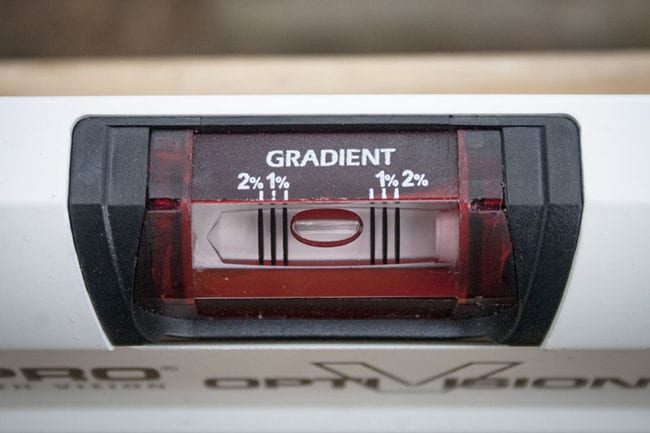
The first thing anyone notices about the Kapro Condor is the center vial. Instead of the standard clear tube with faint black lines, you’re greeted by a vivid red background that fills almost the entire vial cavity. The bubble floats in the center as a brilliant, uncolored window through that red field. It looks wrong at first-our brains have been trained for decades that a spirit level’s vial should be yellow or green-but the optical principle is sound. The human eye achieves its sharpest contrast perception when viewing a dark or highly saturated color against white. The red background acts like a high‑contrast stage curtain; the clear bubble becomes the performer that the eye locks onto instantly.
Kapro claims the OptiVision design makes the bubble up to eight times easier to see. Quantifying “ease of seeing” is a messy business, but in practice, the difference is tangible. In the blazing noon sun that washes out traditional black lines, the red stays intense and the bubble’s edge remains razor‑sharp. In the dim confines of a basement or an attic, where black lines disappear into shadow, the red glows just enough to provide a clear reference. You don’t find yourself tilting the level back and forth to catch the light, because the contrast is independent of ambient angle. It just works, and it works so consistently that after an hour you stop noticing the red at all and simply take faster, more confident readings.
Inside that same center vial, you’ll find two gradient lines-1% and 2% slope indicators-etched directly into the acrylic. They’re not printed or painted on the outside where they can wear off. They’re part of the vial itself. For a concrete finisher setting a driveway pitch, or a plumber establishing the fall on a waste line, having these references permanently available transforms the level into a slope gauge. Align the bubble with the 2% line, and you’ve got a standard 1/4‑inch‑per‑foot drainage pitch without touching a calculator. It’s a small feature with outsized daily utility, and it reflects Kapro’s habit of building secondary capabilities into what looks like a single‑use instrument.
Tri‑Surface Horizontal Vial : More Viewing Angles, One Clear Tradeoff
The Condor’s horizontal vial is not housed in the typical flat‑top bridge of a box beam level. Kapro designed what they call a tri‑surface vial : the top of the frame angles down in a chamfered shape, and the vial is mounted at a 45‑degree tilt inside that angled peak. This geometry means you can view the bubble from directly above, from the front, or from an oblique angle without rotating the level completely. It’s particularly useful when you’re working in a corner, or when the level is pressed against a ceiling and you can’t get your head under it. The vial essentially wraps the corner of the frame, giving you multiple sight lines.
That versatility comes with one inescapable tradeoff : the level is not reversible. On a standard box beam, the center vial is readable from both the front and the back; you can pick the level up in any orientation and go. The Condor has a distinct “front” and “back.” Flip it to the wrong side, and the red OptiVision vial is hidden from view. In the first hour of use, you will flip it the wrong way. You’ll mutter something uncharitable about Israeli engineers. Then your hand will memorize the feel of the rubber grip, the shape of the top ridge, and the location of the PlumbSite window, and you’ll automatically orient the tool correctly without thinking. The learning curve is real but brief, and for most users, the gain in viewing flexibility outweighs the minor inconvenience of a non‑reversible design. If it drives you absolutely crazy, the Condor may not be your level. If you can adapt, the tri‑surface vial becomes a genuine asset.
PlumbSite Dual‑View : The Mirror That Lets You Read Plumb Without Pressing Your Face Against a Wall
If the OptiVision vial is the Condor’s headline, the PlumbSite mirror system might be its sleeper hit. The vertical plumb vial, located near one end, is paired with a small angled mirror and a top‑facing window. When you hold the level vertically against a wall, you don’t have to lean your shoulder and cheek against the surface to peer sideways at the bubble. Instead, you glance down through the top of the level, and the mirror projects exactly what the side‑view vial shows. You see the bubble centered as clearly as if you were looking at it directly, but from a comfortable, natural head position.
This might sound like a solution in search of a problem, right up until you’re plumbing a door jamb in a tight hallway, or checking a panel on a finished wall that you absolutely cannot lean against without leaving a mark. The PlumbSite eliminates that awkward sideways head tilt, reduces neck strain, and makes it possible to check plumb on a freshly painted surface without ever making contact. It’s also a blessing for anyone wearing a hard hat or safety glasses with restricted peripheral vision-the top‑down view stays clear regardless of what’s on your head. Kapro pairs the PlumbSite with RedEffect coloring on the vertical vial, so the same high‑contrast red‑on‑white visibility extends to the plumb check. Once you’ve used it a dozen times, you’ll wonder why every level doesn’t borrow this trick.
Solid Acrylic Vials and Shockproof Construction : Surviving a Life of Drops, Dust, and Temperature Swings
Kapro builds every Condor level around solid acrylic vials-not glass tubes prone to shattering. Acrylic resists cracking under impact and doesn’t fracture when temperatures swing from a frosty morning to a scorching afternoon. The vials are sealed into shockproof polycarbonate housings that absorb energy before it reaches the liquid‑filled core. The center vial’s tri‑surface bridge also acts as a reinforced arch, adding structural strength to the most vulnerable part of the frame. You can drop the Condor onto concrete, kick it off a scaffold, or toss it into the back of a truck without the anxiety that accompanies a glass‑vial level costing twice as much.
The end caps are oversized and made from a rubber compound that squishes on impact, directing force away from the frame. They wrap around the corners fully, protecting the milled edges that you rely on for accurate marking. The frame itself is a rigid aluminum extrusion, finely milled on the bottom surface-the marking edge-up to the 48‑inch models. Longer Condors (60 inches and above) may feature a slightly different milling process, but for the 24‑incher we’re evaluating, the bottom edge is dead flat and smooth, ready to guide a pencil or a utility knife.
Wall‑Grip Pads : Unexpected Traction That Keeps the Level Where You Put It
A level that slides down a wall the instant you let go is more than an annoyance-it’s a productivity drain. Kapro embedded textured rubber wall‑grip pads on both the front and back of the Condor’s frame. When you press the level against drywall, wood, or even painted concrete, these pads create enough friction to hold the tool in place while you mark your line, grab a fastener, or step back to check your work. They’re not magnets, so they don’t attract metal shavings, and they don’t add meaningful weight. They simply stop the slow, infuriating drift that plagues smooth‑faced levels. On the 24‑inch model, this grip is especially useful because the shorter length has less inherent stability; the pads compensate by biting into the surface.
Accuracy You Can Trust : VPA Certification and the 0.0005 in/in Standard
Every bubble level eventually faces the question : “Is this thing accurate, or am I squinting at a liar?” Kapro answers that question with a third‑party certification that’s rare in the North American market. The Condor’s accuracy is verified by the German testing institute Versuchs‑ und Prüfanstalt Remscheid (VPA), which guarantees a tolerance of less than 0.0005 inches per inch. That’s the same 1/2‑thousandth specification shared by Empire’s top‑tier True Blue levels and Stabila’s professional series. Across the Condor’s 24‑inch span, the maximum possible deviation is roughly 0.012 inches-thinner than a business card. For framing, cabinet install, siding layout, and tile work, you’re operating well within the margin that any human installer can achieve.
The VPA certification means that each Condor level leaves the factory individually checked, not batch‑sampled. A sticker on the frame confirms the tool has been tested and meets the standard. This isn’t a marketing claim; it’s a traceable quality control measure. For the Pro who lives and dies by accurate layout, that VPA sticker is a quiet piece of mind.
24‑Inch Sweet Spot : When a 48‑Inch Level Is Overkill and a Torpedo Is Undersized
Forty‑eight inches is the default length for good reason : it spans studs, door jambs, and countertops, giving you a broad read on a surface’s flatness. But forty‑eight inches is also unwieldy in tight spaces. Try plumbing a 30‑inch upper cabinet with a 48‑inch level and you’ll be bumping into adjacent walls and contorting your wrists. A torpedo level fits anywhere but gives you only a 9‑inch or 10‑inch reference-too short to reveal a gentle bow in a stud or a gradual twist in a window jamb. The 24‑inch Condor splits the difference beautifully. It’s long enough to span most door and window jambs, check the flatness of a cabinet side, or level a bank of conduit runs, yet it’s compact enough to live on a tool belt, fit inside a drawer, or ride behind a truck seat.
At 24 inches, the Condor also gains the benefit of the tri‑surface vial’s improved visibility without the momentum that makes a longer level tiring to hold all day. It’s heavy for its size-thanks to the robust aluminum extrusion and thick end caps-but that weight conveys a sense of sturdiness rather than fatigue. When you pick it up, you know you’re holding a tool, not a toy. The rubber Ergo Grip handle is positioned at the balance point and features an ergonomic contour that fits the hand naturally. Even with sweaty palms or damp gloves, the grip stays secure.
Kapro Condor 24‑Inch Box Level Specifications
| Specification | Detail |
|---|---|
| Model Number | 905‑41‑24 |
| Length | 24 inches |
| Available Lengths | 24, 32, 36, 40, 48, 60, 72, 80, 96 inches |
| Accuracy | <0.0005 inches per inch (VPA certified) |
| Vial Type | Solid acrylic, shockproof, UV‑resistant |
| Center Vial | OptiVision Red, tri‑surface, gradient lines at 1% and 2% |
| Plumb Vial | PlumbSite Dual‑View with mirror and RedEffect |
| Magnetic | No (available on select longer models) |
| Marking Edge | Finely milled bottom edge, continuous |
| End Caps | Oversized, shock‑absorbing rubber |
| Grip | Ergo Grip rubber handle with wall‑grip texture on front and back |
| Weight | Approx. 1.5 lbs |
| Certification | VPA (Versuchs‑ und Prüfanstalt Remscheid) |
| Price | $32.52 |
Price and Value : Thirty‑Two Bucks Buys You Features That Punch Twice That Weight
At $32.52, the Kapro Condor 24‑inch resides in an interesting neighborhood. It’s noticeably pricier than the $12 generic aluminum box levels found in big‑box bargain bins, but it undercuts almost every level that offers a comparable feature set. The Stabila Type 70 TMW torpedo with a rotating vial and rare‑earth magnets runs around $40. The Empire em75.24 magnetic 24‑inch lacks an adjustable vial, lacks OptiVision, and costs roughly the same. Milwaukee’s 24‑inch Redstick compact level, without a rotating vial or a mirror, is $49.99. In that context, Kapro is offering a level with a unique visibility technology, a dedicated plumb mirror, gradient lines, wall grips, and VPA‑certified accuracy for less than the price of a tank of gas. That’s aggressive. It’s not the cheapest, but it is arguably the most feature‑dense for the dollar.
Is the Condor Right for You? Who Benefits Most-and Who Might Pass
The Kapro Condor 24‑inch will resonate strongest with professionals who split their day between bright outdoor conditions and dim interiors, and who value visibility above absolute weight minimization. Trim carpenters, cabinet installers, electricians, plumbers, and concrete finishers will all find the OptiVision vial and PlumbSite meaningful upgrades over a standard level. The gradient lines are a bonus for anyone who sets drainage slopes, stair pitches, or wheelchair ramp grades. The wall‑grip pads make the Condor particularly appealing for solo operators who need the tool to stay put while they mark or fasten.
If you’re a pure framer who beats levels mercilessly and never looks at a slope gradient, and you demand a reversible design because you literally cannot tolerate a unidirectional tool, the Condor might frustrate you-at least until muscle memory sets in. And if you work exclusively on metal studs and need magnetic hold, the 24‑inch Condor lacks magnets, though longer Condor models do offer them. For everyone else, the Condor is a compelling demonstration that a level can be both affordable and genuinely innovative, and that the spirit level, a tool that hasn’t fundamentally changed in centuries, still has room for improvement.
The Bottom Line : Kapro Condor Brings Real Innovation to a Crowded Category Without Emptying Your Wallet
The Kapro Condor 24‑inch Box Level with OptiVision is not a me‑too product. In a market saturated with yellow and silver boxes that all look roughly the same, Kapro dared to break the mold-literally. The OptiVision red vial delivers on its promise of faster, less eye‑straining readings in challenging light. The PlumbSite mirror solves a genuine ergonomic annoyance that most tradespeople have just learned to live with. The tri‑surface vial, wall grips, solid acrylic construction, etched gradient lines, and VPA accuracy certification combine to create a tool that feels modern, durable, and refreshingly thoughtful.
The non‑reversible design is a quirk, not a flaw, and most users will adapt to it within days. The absence of magnets on the 24‑inch model is a mild disappointment, but Kapro offers magnetic versions in longer lengths for those who need them. At just over thirty dollars, the Condor 24‑inch delivers a feature suite that many levels costing three times as much cannot match. It’s a reminder that you don’t need to spend $100 to get a genuinely excellent level; you just need to buy one designed by people who actually understand the difference between seeing a bubble and reading a bubble. That’s Kapro’s gift to the trades. The Condor is a level that makes you faster, more accurate, and just a little bit less tired at the end of the day-and for $32.52, that’s a trade worth making.
Comments 0
Leave a Comment