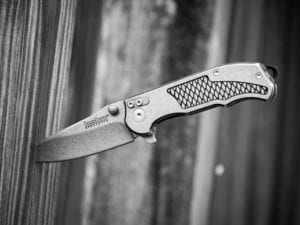
The Agile is part of a relatively rare breed in the production knife world: a knife built around customization. At the butt of the handle, held in place by a single hex screw, sits one of three interchangeable backspacers. You can choose a bottle opener, a flathead screwdriver tip, or a simple lanyard attachment. Or you can remove the backspacer entirely and run the knife without any attachment at all. The idea is seductively simple: one knife, multiple personalities, all tailored to the user's daily needs. It is the kind of feature that makes you wonder why more manufacturers do not offer something similar. But does the customization improve the functionality, practicality, or overall value of the knife? Or is it a gimmick that adds complexity without genuine benefit? I spent a month carrying the Agile as my primary EDC, rotating through all three backspacers, in search of an answer.
The Swappable Backspacers: A Closer Look at Each Option
The Agile ships with three backspacer attachments, each designed to slot into the rear of the handle and secured by a single hex set screw. The screw is small—small enough that if you are not very careful during a swap, you will drop it, and it will vanish into the cracks of your floor or the grass of your yard, never to be seen again. This is not a hypothetical; I dropped the screw twice during my testing period, and both times I was fortunate enough to find it. Keep a magnetic tray or a well‑lit work surface handy when swapping attachments, because losing that screw renders the entire customization feature moot until you source a replacement.
The bottle opener attachment is machined from aluminum and fits flush against the backspacer post. It functions exactly as you would expect: hook the lip of a bottle cap under the steel tang, lever upward, and the cap pops off. It works reliably, and it adds a social, convivial dimension to the knife that other EDC blades lack. There is something delightfully anachronistic about pulling out a folding knife to open a bottle of root beer at a barbecue. It transforms the knife from a purely utilitarian object into a conversation starter. The tradeoff is that the bottle opener is the least comfortable attachment when the blade is deployed and you are cutting. The heel of your palm wraps around the butt of the handle, and the bottle opener creates a slight pressure point that is not painful, but is noticeable. Over extended cutting sessions, you will become aware of it, and you may find yourself shifting your grip to avoid it.
The flathead screwdriver tip is also machined from aluminum, though it is a steel‑reinforced insert in later production runs that can actually turn a screw without deforming. It serves its purpose as a light‑duty prying and turning tool. I used it to tighten a loose faceplate screw on a light switch, to pry open a painted‑shut window, and to scrape a dried drip of paint off a door frame. It worked adequately for all of these tasks, though it is not a substitute for a dedicated multi‑tool. The screwdriver tip, like the bottle opener, creates a mild pressure point against the heel of the palm during cutting, but it is slightly less obtrusive than the bottle opener. The screwdriver tip also includes a small hole that can accommodate a lanyard, which raises the question of why a separate lanyard attachment is included at all.
The lanyard attachment is the simplest of the three, made from glass‑filled nylon plastic rather than aluminum. It is a lightweight loop that allows you to thread paracord or a lanyard through the rear of the handle for retention or decoration. With the lanyard attachment installed, the heel of the palm wraps around the butt of the handle with the least amount of interference; it is the most comfortable configuration for actual cutting work. The lanyard loop also serves a safety purpose: if you work at height, OSHA regulations increasingly require tools to be tethered, and a lanyard loop provides a secure attachment point. However, the screwdriver tip also has a lanyard‑compatible hole, which makes the dedicated lanyard attachment feel somewhat redundant. A Phillips head bit, a glass breaker, or a firestarter rod would have been more compelling alternatives.
Build Quality: Steel Frame, Sturdy Construction, and a Pocket Clip That Stays Put
The Agile is built around a steel frame secured by steel pins—a construction method that prioritizes durability over weight savings. After a month of daily carry and frequent use, the knife shows no signs of developing blade play, handle flex, or loose fasteners. The frame lock engages the blade tang with a solid, confidence‑inspiring click, and the blade locks open with virtually no lateral or vertical movement. The pocket clip is a three‑position design, offering tip‑down carry on either side or tip‑up carry on the right side. Left‑handed users who prefer tip‑up carry are out of luck, a limitation common to many production knives. The clip itself has a nice tension to it—firm enough to keep the knife securely in the pocket, but not so tight that it resists removal. The knife has not crept out of my pocket during any activity, including running, climbing ladders, or lying prone to reach under furniture.
The finish on both the blade and the handle is a stonewash that serves two purposes: it looks attractive, with a subtle, matte texture that catches light in a soft, diffuse way, and it hides scratches remarkably well. A stonewashed knife can accumulate the small scuffs and wear marks of daily use without looking battered; each new scratch blends into the existing pattern. The feel of the stonewashed steel is notably smooth—so smooth that it could almost be mistaken for being oily. This could be problematic in genuinely oily or wet conditions, but Kershaw has added a diamond‑plate texture on the handle to improve grip. The texture is subtle, not as aggressive as the G‑10 on some tactical knives, but it provides enough friction to keep the handle secure in a dry or slightly damp palm. The spine of the blade features thumb jimping, though the jimping is somewhat rounded and less aggressive than I prefer. It provides a reference point for the thumb without biting into the skin during hard cuts.
Blade Steel and Geometry: 8Cr13MoV, Modified Drop Point, and a Hints‑of‑Tanto Profile
The Agile's blade is forged from 8Cr13MoV, the ubiquitous Chinese‑made stainless steel that has become the default choice for budget and mid‑range production knives. 8Cr13MoV is functionally similar to AUS‑8, offering reasonable corrosion resistance, adequate edge retention, and exceptional ease of sharpening. It is not a steel that will hold an edge for weeks of heavy use, but it takes a keen edge in minutes and responds well to a quick strop or a few passes on a ceramic rod. For a knife at this price point, it is an appropriate and proven choice.
The blade profile is where things get interesting. Kershaw describes it as a modified drop point, but that description does not fully capture the blade's personality. The spine drops gently toward the tip in a classic drop‑point fashion, but the tip itself is more acute and reinforced than a typical drop point, lending it a hint of tanto DNA. The belly is generous, providing ample slicing surface for a 2.75‑inch blade, and the plain edge tracks cleanly through cardboard, rope, and plastic. The blade deploys via Kershaw's SpeedSafe assisted opening, actuated by either the flipper tab or the dual thumb studs. The action is smooth and fast, with the blade snapping into lockup with the kind of satisfying authority that assisted openers are known for. The flipper is the preferred method for most users; the thumb studs work, but they require more deliberate pressure. The SpeedSafe mechanism on the Agile is well‑tuned, providing a consistent, reliable deployment throughout the testing period.
Ergonomics: Sized for Small‑to‑Medium Hands, but Comfortable for All
With a blade length of 2.75 inches and an open length of 6.25 inches, the Agile is a compact knife that will fit best in smaller to medium‑sized hands. The finger grooves are well‑positioned, with the index finger settling naturally into the forward choil and the remaining three fingers wrapping around the handle without crowding. Users with larger hands may find that their pinky hangs off the end of the handle or that the finger grooves do not align perfectly with their digits. However, even with my medium‑large hands, I found the Agile comfortable to use for extended periods. The key is to accept the knife for what it is—a compact EDC—rather than expecting it to fill the hand like a full‑sized tactical folder. In the pocket, the Agile is a delight. It is small enough to disappear into the corner of a jeans pocket, and I often forgot I was carrying it until I needed it. For the office worker, the student, or anyone who values discreet carry, the Agile's dimensions are ideal.
The Kershaw Agile at Work: Real‑World Cutting and Swapping
I rotated through all three backspacers during my month of carry, and I found that I gravitated most toward the lanyard attachment—not because I needed a lanyard, but because it was simply the most comfortable for cutting. The screwdriver tip was useful on the two occasions I actually needed a flathead screwdriver and did not have one handy, but those occasions were rare. The bottle opener was used once, at a family gathering, where it performed its job admirably and generated several minutes of conversation about the knife. The takeaway, for me, is that the swappable backspacer system is a genuinely clever idea, but in practice, most users will find the one they like best and stick with it. The system adds value primarily as a marketing differentiator; once the novelty wears off, the utility of swapping attachments diminishes. That does not make the feature worthless—it is genuinely nice to have options—but it is not the primary reason to buy the knife.
Kershaw Agile Specifications
| Specification | Detail |
|---|---|
| Designer | Rick Hinderer |
| Steel | 8Cr13MoV, stonewashed finish |
| Handle | Steel, two‑tone stonewashed/BlackWash finish |
| Blade Length | 2.75 inches (7 cm) |
| Closed Length | 3.5 inches (8.9 cm) |
| Open Length | 6.25 inches (15.9 cm) |
| Weight | 3.9 oz. (110.5 g) |
| Lock | Frame lock |
| Deployment | SpeedSafe assisted, flipper and thumb studs |
| Clip | 3‑position (left/right tip‑down; right tip‑up) |
| MSRP | $49.99 |
| Street Price | ~$25‑$35 |
Conclusion: A Clever, Compact, and Affordable EDC With a Useful But Not Transformative Gimmick
The Kershaw Agile is a knife that succeeds on its fundamentals. It is well‑built, comfortable to carry, easy to deploy, and attractive to look at. The stonewashed finish feels wonderful in the hand, and the compact size makes it a natural choice for discreet everyday carry. The swappable backspacers are a fun and occasionally useful feature, but they are not the reason to buy the Agile. The reason to buy the Agile is that it is an affordable, well‑designed SpeedSafe flipper that punches above its price point in build quality and aesthetics. If you are the kind of person who enjoys tinkering with your tools and customizing them to suit your mood, the Agile will delight you. If you simply want a reliable, sharp, compact EDC that you can clip into your pocket and forget about, the Agile will serve you equally well—just pick the attachment that works for you and leave it there. At its street price, which is often significantly below MSRP, the Agile is a compelling value and a worthy addition to any everyday carry rotation.
Comments 0
Leave a Comment