Ernest Emerson, for those unfamiliar with his work, is one of the most influential knife designers of the modern era. He is the inventor of the Emerson Wave opening mechanism, which automatically deploys a folding knife blade as it leaves the pocket—a feature that has been licensed by manufacturers like Kershaw for years. His philosophy, stated succinctly, is this: "It must cut, and it must be comfortable. Any function or design feature that does not add to those attributes simply makes the knife less functional." That philosophy is evident in every aspect of the Cook's Set, from the handle contours to the steel selection to the blade geometry. These knives prioritize cutting performance and ergonomics above all else, and they do so at a price point that makes them accessible to the home cook who is ready to upgrade from the mismatched collection of bargain‑bin blades that has been accumulating in the kitchen drawer since the last time someone moved apartments.
Steel Selection: DIN 1.4116—The European Workhorse
The Cook's Set blades are forged from DIN 1.4116 stainless steel, a German‑origin alloy that is one of the most widely used steels in European kitchen cutlery. J.A. Henckels, Wüsthof, and other Solingen‑based manufacturers have used variants of this steel for decades. Its composition is roughly analogous to the American 420HC, with approximately 0.5% carbon and 14–15% chromium, along with small amounts of vanadium and molybdenum. It is not a high‑carbon powder steel that will hold an edge for months of daily use without attention, but it is stain‑resistant, relatively tough, and exceptionally easy to resharpen. For a set of kitchen knives intended for home use—where they will likely be sharpened once or twice a year at most, and where they may be run through a dishwasher despite all warnings to the contrary—1.4116 is a pragmatic and durable choice.
The cutting edges are ground to a 16‑degree angle on both sides, which is standard for Western‑style kitchen knives. The edge bevel is consistent, with no visible irregularities, and the knives arrived sharp enough to cleanly slice a tomato without crushing the skin. Out of the box, they are ready for use, which is more than can be said for some budget kitchen sets that ship with a coarse, toothy edge that requires extensive honing before it will perform. The steel's corrosion resistance is a significant advantage in the kitchen, where knives are exposed to acidic foods like citrus and tomatoes, and where they are frequently rinsed and left to air‑dry. I did not observe any rust spotting or discoloration during the testing period, despite the Florida humidity and the occasional overnight stay in a sink of soapy water—a practice I do not condone but which inevitably happens in a busy household.
The Chef's Knife: Forward‑Heavy, Bolster‑Free, and Efficient
The 7‑3/4‑inch chef's knife is the workhorse of the set, and at 5.1 ounces, it is notably lighter than the 7.3‑ounce Wolfgang Puck chef's knife that I have been using as a daily driver. The weight difference translates into a slightly different cutting experience. The Emerson chef's knife feels more nimble, more responsive to wrist movement, but also slightly less authoritative when chopping through dense root vegetables. The balance point is forward of the handle, which creates a natural rocking motion ideal for the French technique of chopping herbs or dicing onions. The blade heel is entirely bolster‑free—there is no thick metal band between the blade and the handle—which means the cutting edge runs all the way to the handle. This is a double‑edged sword, figuratively speaking. On the one hand, it allows the entire blade length to be used for cutting, and it makes sharpening the full edge easier because there is no bolster to obstruct the stone. On the other hand, it removes a safety feature that prevents the user's finger from sliding under the heel of the blade when gripping forward of the handle. Users accustomed to a pronounced bolster will need to exercise caution when choking up on the knife.
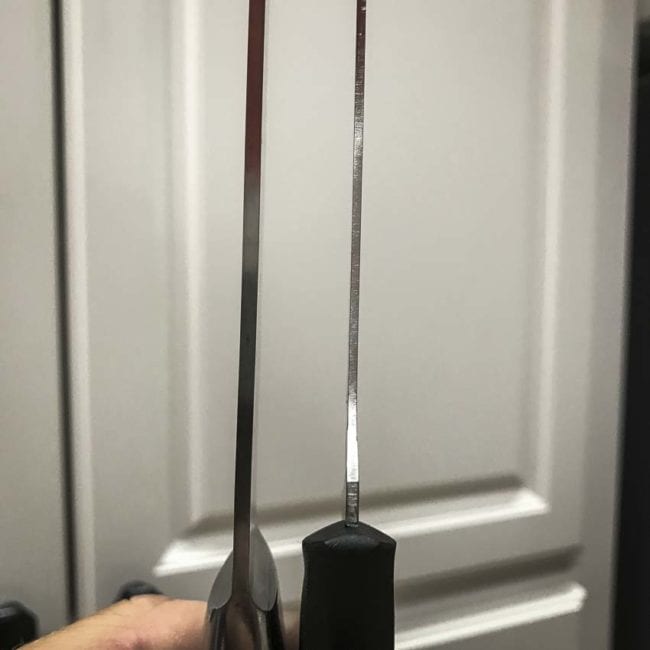
The blade height and shape are classic chef's knife proportions, with a slight upward curve at the tip that facilitates rocking cuts. The flat of the blade is tall enough to clear the knuckles when chopping, and the belly is generous enough to provide a smooth slicing motion. During testing, the knife performed admirably on a range of ingredients: it slice through ripe tomatoes without crushing, diced onions with minimal tear‑inducing cell rupture, julienned bell peppers evenly, and even tackled a large watermelon without the blade flexing or binding. The thin blade stock—approximately half the thickness of my everyday Wolfgang Puck knife—accounts for the weight difference and contributes to the knife's efficient slicing, but it also results in noticeable lateral deflection when applying side pressure. This is not a knife for splitting acorn squash or cutting through frozen food; it is a precision slicing and chopping tool, and it rewards a light, controlled touch.
The Paring Knife: A Thumb Rise and Feather‑Light Control
The 4‑1/4‑inch paring knife weighs a mere 1.4 ounces, making it one of the lightest I have ever handled. The standout feature is the thumb rise—a slight upward contour at the spine of the blade where the steel meets the handle—that gives the thumb a natural, secure placement point for detail work like peeling, coring, and trimming. There is no jimping on the thumb rise, but the shape alone provides adequate control. The blade is thin and sharp, and it excels at in‑hand tasks like peeling an apple or trimming the eyes from a potato. The lack of a bolster pays dividends here, allowing the edge to make contact with the cutting board at the heel without the knife rocking on a thick metal band. The weight is so minimal that extended use causes no hand fatigue whatsoever; you can core a dozen apples or devein several pounds of shrimp without your hand cramping. The tradeoff, again, is the lack of heft and stability during heavier tasks, but a paring knife is not intended for heavy tasks. It is a precision instrument, and in that role, the Emerson paring knife performs beautifully.
The Bread Knife: Deep Serrations, an Aggressive Bite, and Blade Deflection
The 7‑1/4‑inch serrated bread knife is the lightest of the three at 4.1 ounces. The serrations are deep and pointed, with a more aggressive bite on the forward cutting stroke than on the return stroke—an intentional asymmetry that helps the knife initiate cuts in a hard crust without requiring excessive downward pressure. The knife sailed through a fresh sourdough loaf, producing thin, even slices with minimal crumbs. It also worked well on ripe tomatoes, where the serrations act as micro‑saws that pierce the skin without the blade having to be razor‑sharp at every point along the edge. However, the bread knife exhibited noticeable lateral deflection when pressure was applied—more so than the chef's knife. The blade bends sideways relatively easily, a consequence of the thin stock and the absence of a full‑height tang that would stiffen the blade along its entire length. The tang appears to narrow inside the handle, which reduces weight but sacrifices some rigidity. For slicing bread and soft fruits, the deflection is not an issue because the blade encounters minimal resistance. For anything that requires a stiff, unyielding blade—slicing a hard salami, for example, or cutting through a crusty artisan loaf with a very thick, hard bottom crust—the deflection becomes noticeable and requires a more careful, deliberate sawing motion.
Handle Design: Glass‑Filled Nylon, a Central Bump, and Ergonomic Intent
The handles on all three Cook's Set knives are made from glass‑filled nylon, a durable synthetic material commonly used in power tool housings and automotive components. It resists moisture, heat, and the mild acids found in kitchen environments, and it will not crack or warp with repeated washing. The handles are textured along the sides, providing a non‑slip surface even when wet, and smooth along the top and bottom edges. The central design feature is a subtle bump along the spine of the handle—a contour that fills the palm slightly when the knife is held in a standard grip. This bump is more pronounced than the uninterrupted arc of a traditional Western handle, and it encourages a forward grip that channels cutting force through the front fingers and into the blade. It is an ergonomic choice that may take some getting used to if your muscle memory is trained on classic chef's knife handles, but once adapted to, it feels natural and controlled. The handles are attached to the blades via what Kershaw describes as a full‑tang design, though the tang is hidden within the handle material rather than exposed along the spine. This is a common construction method for kitchen knives in this price range; the tang provides full‑length stability, but the user does not see it. The knives feel solid in the hand, with no perceptible looseness or movement between the blade and the handle after weeks of use and repeated washing.
Kershaw Emerson 3‑Piece Kitchen Knife Set Specifications
| Specification | Chef's Knife | Paring Knife | Bread Knife |
|---|---|---|---|
| Steel | DIN 1.4116 | DIN 1.4116 | DIN 1.4116 |
| Blade Length | 7.75 inches | 4.25 inches | 7.25 inches |
| Overall Length | 13.25 inches | 8 inches | 12.5 inches |
| Weight | 5.1 oz. | 1.4 oz. | 4.1 oz. |
| Handle | Glass‑filled nylon | Glass‑filled nylon | Glass‑filled nylon |
| Edge Angle | 16 degrees | 16 degrees | Serrated |
| Warranty | Limited Lifetime | Limited Lifetime | Limited Lifetime |
Who Should Buy the Kershaw Emerson Cook's Set?
The Cook's Set is ideally suited for the home cook who is ready to move beyond the assortment of mismatched, dull, and uncomfortable knives that have accumulated over years of casual use. It is a set that prioritizes the fundamentals: sharp edges, comfortable handles, lightweight construction, and easy maintenance. The glass‑filled nylon handles are durable and dishwasher‑safe (though hand washing is always recommended for longevity), and the DIN 1.4116 steel sharpens easily with a simple pull‑through sharpener or a honing rod. The knives are attractive in a utilitarian way, with a clean, modern aesthetic that does not draw attention to itself but looks competent in any kitchen. They would make an excellent gift for a new homeowner, a college student outfitting their first apartment, or anyone who appreciates the Emerson design philosophy but does not need the kitchen equivalent of a $200 Japanese gyuto. They are not professional‑grade tools, and they do not pretend to be. They are residential kitchen knives, designed and built by a company that understands blades, and for the vast majority of home cooking tasks, they are more than adequate—they are genuinely pleasant to use. For under $50 for the set, they represent a compelling value proposition in a market where many comparable sets cost significantly more while offering less thoughtful design.
Comments 0
Leave a Comment