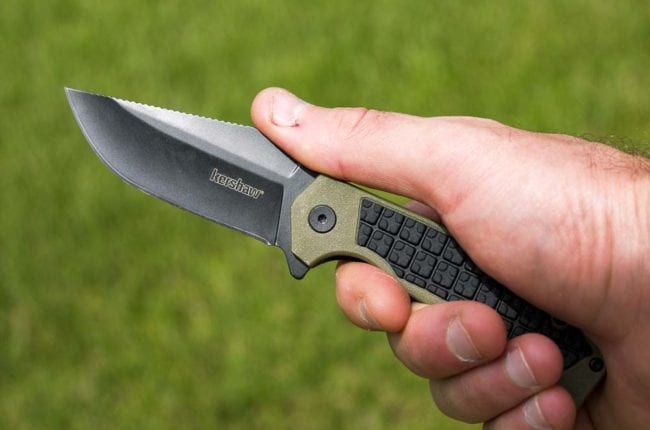
The Blade: 8Cr13MoV, Black Oxide, Clip Point, and a Surprising Amount of Jimping
Kershaw builds the Faultline around its standard mid‑grade 8Cr13MoV blade steel, a choice that is entirely appropriate for the knife's price point. The steel is hardened, ground, and finished to Kershaw's consistent production standards, and it arrives sharp enough to cleanly slice printer paper and shave arm hair with moderate pressure. The blade profile is an elongated clip point—a shape that features a concave cutout along the spine, sweeping downward to a fine, acute tip. This is a blade style with a long and storied history in American folding knives, dating back to the classic Bowie patterns of the 19th century. The clip point provides an exceptionally sharp, penetrating tip that is ideal for piercing tasks like opening clamshell packaging, starting a cut in drywall, or drilling a hole in leather with a twisting motion. The belly is generous enough for efficient slicing, though the clip‑point profile inevitably sacrifices some belly length compared to a drop point of the same overall dimensions. The blade is finished with a black oxide coating, a conversion treatment that darkens the steel surface and provides a modest improvement in corrosion resistance. Black oxide is not as wear‑resistant as a PVD or DLC coating; it will show scratches and wear over time, particularly along the contact points with the handle and the cutting edge. But that wear, for many users, is part of the knife's charm—it records the history of use, giving the tool a personalized patina that no factory finish can replicate. The blade spine features two distinct styles of jimping: deeper, more aggressive notches near the base of the blade for secure thumb placement, and finer, more closely spaced grooves further forward. This dual‑texture approach provides grip options for different hand sizes and cutting grips, and it is a level of detail that is uncommon at this price point.
The Handle: Glass‑Filled Nylon, Olive Drab, and a Rubber Overmold That Feels Like It Belongs on a Power Tool
The handle of the Faultline is constructed from glass‑filled nylon—a durable, lightweight synthetic material that is widely used in power tool housings and automotive components—in a muted olive drab color that pairs beautifully with the black blade. The olive drab is a distinctive choice in a market dominated by black, gray, and coyote tan, and it gives the Faultline a subtle military‑surplus aesthetic that is both rugged and refined. Over the glass‑filled nylon, Kershaw has applied a rubber overmold in key grip areas. The overmold is soft enough to feel comfortable in the hand but firm enough to resist tearing or peeling, and its texture provides a significant improvement in grip security over bare nylon. The combination of the contoured handle shape and the overmold creates a knife that is genuinely pleasant to hold, with no hot spots or pressure points during extended cutting tasks. Inside the handle, a liner lock engages the blade tang securely. The lock bar slides fully into position, contacting the tang across its full face. There is no blade play in any direction, and the lock disengages smoothly with thumb pressure. The clip is a single‑position design, set for right‑side, tip‑up carry only. It is a deep‑carry clip that positions the knife low in the pocket, with only a small portion of the handle visible. The clip is small but significantly stronger than it looks—so strong, in fact, that I initially struggled to clip the knife onto my pocket. I ended up bending the clip outward slightly to achieve a usable tension. Once adjusted, the clip held securely and did not creep out of the pocket during daily activity. Left‑handed users will be disappointed by the lack of reversibility, but for right‑handed tip‑up carry, the clip is effective.
Deployment: KVT Bearings, a Manual Flipper, and an Action That Punches Above Its Price
The Faultline deploys via Kershaw's KVT (Kershaw Velocity Technology) ball‑bearing system, a caged bearing pivot that provides smooth, low‑friction blade rotation. There is no spring assist—the Faultline is a manual flipper—and none is needed. The detent is well‑tuned, requiring a firm but not excessive press on the flipper tab to overcome. Once the detent releases, the blade glides through its arc on the bearings and locks open with a satisfying click. The action is not as fast as a spring‑assisted opener, but it is smooth and controlled, and it rewards a deliberate, consistent flipping motion. The flipper tab is positioned for easy access and provides a secure purchase for the index finger. The KVT bearings give the Faultline a deployment feel that is far more refined than its price suggests; this is an action that would be at home on a knife costing twice as much. The blade tracks perfectly centered between the handle scales when closed, and there is no side‑to‑side play when open. The overall build quality is impressive, with tight tolerances and clean machining throughout. The Faultline feels like a knife that was designed with care and assembled with pride, not rushed through a production line to meet a cost target.
Kershaw Faultline Folding Knife Specifications
| Specification | Detail |
|---|---|
| Model | Kershaw 8760 |
| Steel | 8Cr13MoV with black oxide coating |
| Handle | Glass‑filled nylon with rubber overmold |
| Blade Length | 3.0 inches |
| Closed Length | 4.0 inches |
| Open Length | 7.0 inches |
| Weight | 3.4 ounces |
| Deployment | KVT ball‑bearing manual flipper |
| Lock | Liner lock |
| Clip | Single‑position, right‑hand tip‑up, deep‑carry |
| MSRP | $39.99 |
| Street Price | ~$25.40 |
Who Should Carry the Kershaw Faultline?
The Faultline is an ideal knife for the budget‑conscious enthusiast who refuses to compromise on design or deployment quality. It is a knife that looks and feels far more expensive than it is, and it will attract compliments from knife people and non‑knife people alike. The olive drab and black color scheme is distinctive without being loud, and the rubber overmold adds a tactile dimension that makes the knife a pleasure to handle. The KVT bearing action is a genuine upgrade over the washers found on most knives at this price, and it makes deployment a satisfying ritual rather than a chore. The single‑position clip and the 8Cr13MoV steel are the two most notable limitations, but at $25, they are limitations that are easy to accept. The Faultline is an excellent gift knife, a reliable everyday carry for the office or the jobsite, and a compelling argument that you do not need to spend $100 or more to get a genuinely great folding knife. Kershaw has packed an impressive amount of design, materials, and manufacturing quality into a package that costs roughly the same as a large pizza, and the result is a knife that inspires exactly the kind of irrational love that my colleague described—except, upon closer examination, the love turns out to be entirely rational.
Conclusion: The Faultline Is a Faultless Value
It is difficult to find meaningful fault with the Kershaw Faultline. The blade steel could be upgraded—but then the price would rise. The clip could be reversible—but the deep‑carry design and the secure retention are already excellent. The knife could be lighter—but the 3.4‑ounce weight is already well within the comfortable carry range. For what it is—a $25 manual flipper with bearing action, a distinctive clip‑point blade, an olive drab handle with rubber overmold, and a build quality that belies its price—the Faultline is virtually peerless. It is a knife that makes you smile when you pick it up, that works smoothly and reliably when you use it, and that leaves enough money in your wallet to buy another one for your truck, your toolbox, or your friend who keeps borrowing yours. Kershaw has a well‑deserved reputation for delivering excellent value at every price point, and the Faultline is one of the strongest arguments for that reputation. Buy one. Carry it. Enjoy it. At this price, there is no reason not to.
Comments 0
Leave a Comment