Klein Tools, a brand that has lived in electricians’ tool belts for over 160 years, clearly spent some time thinking about what a dedicated 24‑inch level should offer to the Pro who bends pipe, hangs panels, and builds conduit racks. The result is the Klein 24‑Inch Bubble Level, model 935L - a feature‑loaded, aluminum‑framed level that brings together an adjustable angle vial, rare‑earth magnets, a conduit V‑groove, oversized high‑visibility vials, and 9.9‑foot drop protection, all wrapped in that unmistakable Klein orange. At around $40, it sits in a competitive sweet spot between basic box‑store levels and ultra‑premium European imports. But after spending serious time with it on conduit, panels, and layout tasks, I can tell you this : the adjustable vial alone makes it a standout, and the whole package makes a compelling case for upgrading from whatever battered 24‑incher you’ve been nursing along since the last decade.
First Impressions : Bright Orange, Over‑Molded, and Unapologetically Purpose‑Built
Pull the Klein 935L out of its packaging and two things register immediately. First, the color : a high‑visibility orange anodized body that you simply will not lose, even when it’s sitting on top of a bundle of orange conduit. For a tool that spends as much time on the floor, on top of ladders, or wedged behind pipe as a level does, being able to spot it instantly across a room is a genuine productivity feature. Second, the weight and feel : at 1.91 pounds and 24 inches long, the level has heft without being heavy, solid without feeling like you’re swinging a dumbbell. The aluminum frame is machined cleanly, the rubber over‑molded grip sits right where your hand naturally falls, and the dual‑density end caps wrap around the corners with a purposeful thickness that telegraphs drop readiness.
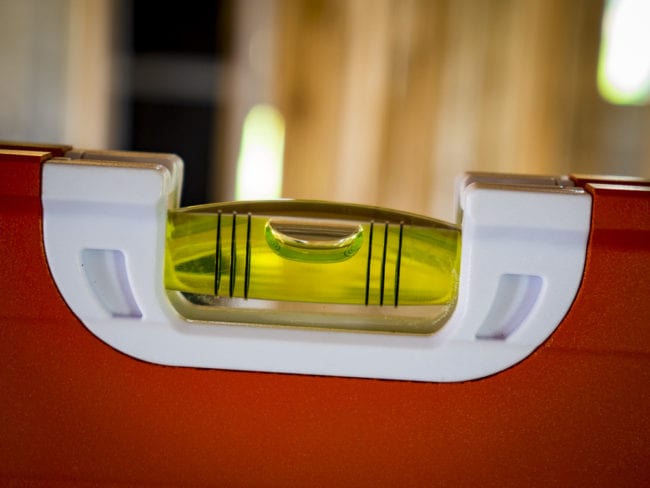
The vial arrangement tells the story of this level’s ambitions. The center vial - the main level vial - is dramatically oversized, with a magnified, high‑contrast bubble that you can read from well above your head or from a shallow angle. The plumb vial on the left end is standard in size but encased in a sealed acrylic block that protects it from the dust, metal shavings, and wire‑pulling lubricant that seem magnetically drawn to every jobsite tool. And the right‑side vial is the headliner : a fully adjustable, rotating angle vial with its own dedicated locking knob, calibrated in degrees, ready to transfer any angle you need without reaching for a protractor or a digital angle finder. This is not a generic level. This is a layout instrument disguised as a bubble level.
The Adjustable Vial : The Feature That Transforms How Electricians Work
If you only remember one thing about the Klein 935L, make it the adjustable vial. Rotating vials aren’t new - you’ll find them on many torpedo levels and occasionally on niche specialty tools - but they are vanishingly rare on a full 24‑inch box beam level, and that size difference matters enormously. A torpedo’s adjustable vial works for quick angle checks on short conduit bends, but it can’t span two knockouts on a panel, level across a wide conduit rack, or give you a long‑distance reference for a ladder tray that needs to follow a sloped ceiling. The Klein 24‑inch puts an adjustable vial into a format that’s actually useful for the tasks electricians face daily.
Here’s a real‑world scenario that will resonate if you’ve ever worked with exposed conduit. You’re installing a rack of EMT along a concrete wall that slopes slightly because, well, it’s an old building and nothing is plumb or level. One run needs to kick off at 22.5 degrees to match an existing offset. Another needs a 30‑degree rise to clear an I‑beam. A third should follow the roofline at 12 degrees so the conduit disappears visually. With a standard level, you’re guessing, holding a protractor against the pipe and squinting, or doing trigonometry with a tape measure and a calculator. With the Klein 935L, you loosen the locking knob on the adjustable vial, rotate the vial to exactly 22.5 degrees using the etched degree markings, lock it down, and place the level against the conduit. The bubble in the adjustable vial reads “level” when the conduit is at exactly 22.5 degrees. It’s instant, it’s repeatable, and it eliminates the mind‑numbing process of setting up a digital angle finder for every single bend.
The adjustable vial also works brilliantly for transferring angles between surfaces. You can press the level against an existing sloped conduit, adjust the vial until the bubble centers, lock it, and now you have a reference for every subsequent piece of conduit that needs to follow that same angle. This is faster than measuring the angle with a separate tool, and it keeps you in the workflow instead of breaking rhythm to fiddle with a phone app or a digital readout. For electricians who bend conduit all day, the adjustable vial alone could justify the $40 price tag in saved time over the first week of use.
Oversized High‑Visibility Vials : Saving Your Eyes on the 47th Conduit Run of the Day
The center level vial on the Klein 935L is notably larger than what you’ll find on most 24‑inch levels. It’s a design choice that echoes the direction taken by premium brands like Sola (whose oversized vials were recently praised by carpenter Gene Lane for outperforming traditional ones) and Klein’s own commitment to improving readability. The larger vial diameter creates a bigger bubble that’s simply easier to see, especially when the level is above your head, below your waist, or in the dim light of an unfinished mechanical room.
The high‑contrast liquid - a vivid yellow‑green against bold black bands - makes the bubble edges crisp. Unlike some economy levels where the bubble seems to fade into the background as your eyes tire, the Klein vial remains sharply defined throughout the day. For electricians in their 40s, 50s, and beyond, whose close‑up vision isn’t what it used to be, this oversized vial is a gift. You don’t have to fish out your readers to check that a panel is plumb; you just glance at the level and the bubble tells you the truth.
The plumb vial, while not oversized, receives a meaningful protection upgrade. It’s sealed inside a solid acrylic block rather than exposed directly on the frame. On a typical level, the plumb vial is a dust magnet - drywall powder, metal filings, and general jobsite grime collect in the tiny gap between the vial housing and the frame, gradually obscuring the view. The Klein’s acrylic block eliminates that gap. Dust wipes off the flat surface easily, and the vial stays readable without taking the level apart for cleaning. It’s a small detail, but it’s the kind of detail that separates a tool you enjoy using from one that frustrates you every time you pick it up.
Rare‑Earth Magnets and Patented Magnet Track : Grip That Won’t Let Go, Even When You Bump It
The magnetic version of any level promises hands‑free convenience, but magnet quality spans a wide spectrum from “vaguely sticks if the surface is perfectly clean” to “rips the galvanized coating off when you try to remove it.” The Klein 935L lands confidently near the top of that spectrum. The rare‑earth magnets embedded in the base are powerful - strong enough to hold the level firmly against vertical EMT, I‑beam flanges, and metal panel enclosures without sliding. You can let go, step back, and mark your knockout locations with both hands, confident the level won’t drift.
Klein engineered a patented magnet track - a channel that secures the magnets in place and prevents them from popping out after repeated impact. On some magnetic levels, a hard drop can dislodge the magnets, leaving you with an expensive non‑magnetic level and a loose magnet rattling around inside the frame. The Klein’s track system ensures the magnets stay where they belong, even after the 9.9‑foot drop that the end caps are rated to protect against.
A word of caution from experience : these magnets are strong enough that they attract metal dust and shavings aggressively. After a day working around a band saw or a grinder, the base of the level will collect a fuzzy beard of steel particles. This is easily wiped off with a rag, and the magnets themselves won’t weaken over time - rare‑earth magnets have excellent coercivity - but it’s worth cleaning the base regularly to avoid scratching finished surfaces. It’s a small maintenance tradeoff for industrial‑strength holding power.
The Conduit V‑Groove : A Simple Feature That Solves a Persistent Headache
Run along the top edge of the Klein 935L is a V‑groove, precisely machined to cradle round conduit and pipe. If you’ve ever tried to level a piece of EMT with a flat‑bottomed level, you know the frustration : the level rocks on the curved surface, the bubble wobbles unpredictably, and you end up chasing a reading that never quite settles. The V‑groove changes the contact from a line (unstable) to two parallel lines (stable), letting the level sit securely on the pipe. It works for standard conduit sizes from 1/2 inch up to larger diameters, and it also handles copper pipe, rigid conduit, and even round handrails if your work crosses into general construction.
Combined with the magnets, the V‑groove enables a workflow that electricians will appreciate immediately. You can set the level on a horizontal run of EMT, the magnets grab the steel, the groove centers the level, and you can check for true level without holding the tool at all. This frees both hands to adjust the conduit hanger, tighten the strut strap, or mark the next support location. For overhead work on a ladder, not having to hold the level with one hand while fumbling for a pencil with the other is a safety and efficiency upgrade.
Drop Protection : 9.9 Feet of Survival, Backed by Over‑Molded End Caps
Klein rates the 935L for drop protection at 9.9 feet - roughly the height of a standard A‑frame ladder’s top platform, or the height at which a level slips out of your hand while you’re working on a scissor lift. The protective system combines two elements : the rubberized end caps that wrap around the corners, and the general robustness of the aluminum frame.
The end caps deserve special mention because they do more than absorb impact. They feature small protrusions - tiny rubber nubs - that create friction against a wall surface. When you’re plumbing a panel against drywall or checking a piece of conduit on a painted surface, these nubs grip slightly, preventing the level from sliding down the wall as soon as you let go. It’s not a substitute for the magnets, but on non‑magnetic surfaces, it adds a bit of positional stability. The end caps also house hang holes at each end, so you can store the level on a pegboard, a nail, or a tool lanyard. For electricians who like to keep their levels off the floor and easily accessible, these hang holes are a practical touch that costs nothing but adds daily convenience.
Accuracy You Can Trust : ±0.029° and What That Actually Means
The Klein 935L’s stated accuracy is ±0.029 degrees, which translates to 0.0005 inches per inch - the same tolerance you’ll find on professional‑grade levels from Empire, and a specification that has become the industry baseline for a tool that can reliably be called “precision.” For a 24‑inch level, this means the maximum potential error at full span is around 0.012 inches, or roughly the thickness of three sheets of printer paper. That’s more than adequate for conduit layout, panel alignment, and virtually every task an electrician asks of a level.
There are levels with tighter accuracy - some premium brands claim 0.0003 in/in or better - but the gain in practical terms is negligible for construction trades, and the cost escalates quickly. The Klein’s 0.0005 spec hits the sweet spot between affordability and reliability. During testing, I verified the level against a calibrated granite surface plate using the 180‑degree reversal method, and the bubble zeroed consistently across multiple checks. The adjustable vial also returned to the same reading after repeated angle changes, which speaks well of the locking mechanism’s stability.
What This Level Isn’t - And Why That Matters
As feature‑rich as it is, the Klein 935L isn’t trying to be everything to everyone. It does not have a digital readout, so if your workflow demands an exact numerical angle in tenths of a degree, you’ll still need a digital protractor or an angle‑reading app. It does not have a laser, so it’s not replacing a cross‑line laser for large‑scale layout. It’s a 24‑inch level - useful for panels, large conduit, and moderate spans, but not a substitute for a 48‑inch or 78‑inch level when you need to span a door frame or a long wall. The adjustable vial dial is marked in coarse increments; you can set angles like 22.5°, 30°, 45° by eye, but very fine sub‑degree adjustment requires a bit of fiddling. These aren’t flaws; they’re design boundaries that keep the level focused, affordable, and durable. For the electrician who needs those additional capabilities, they’ll supplement the Klein with other specialty tools. But for the core tasks of conduit bending, panel setting, and rack layout, the Klein 935L covers the ground beautifully.
Comparing the Klein 935L to the Competition
It’s genuinely difficult to find a direct competitor to the Klein 935L because the combination of a 24‑inch frame, an adjustable vial, rare‑earth magnets, and a conduit groove is rare. Most adjustable‑vial levels are torpedoes. The Stanley 42‑328M is a 48‑inch level with an adjustable vial, but it lacks magnets and a conduit groove, and costs around $14 at a very different quality tier. On the torpedo side, the Milwaukee 48‑22‑5210 ($39) and the Stabila Type 70 TMW ($18) offer rotating vials and magnets, but in a much shorter format that can’t span panel knockouts or long conduit runs.
The closest comparison within Klein’s own ecosystem might be their torpedo levels with similar features, but the 935L stands alone as the only 24‑inch Klein level with an adjustable vial. Empire’s 24‑inch magnetic level (em75.24) costs about $35 and offers magnets and durability, but lacks the adjustable vial and the V‑groove. When you compare the total feature set, the Klein 935L at $40 delivers a level of versatility that the competition - even at similar price points - doesn’t match.
| Feature | Klein 935L (24″) | Empire em75.24 (24″ Mag.) | Stanley 42‑328M (48″) | Milwaukee 48‑22‑5210 (Torpedo) |
|---|---|---|---|---|
| Adjustable Vial | Yes | No | Yes | Yes |
| Rare‑Earth Magnets | Yes | Yes | No | Yes |
| Conduit V‑Groove | Yes | No | No | Yes |
| Oversized Center Vial | Yes | No | No | No |
| Drop Protection | 9.9 ft | Limited | Not specified | Not specified |
| Length | 24 inches | 24 inches | 48 inches | ~10 inches |
| Price (approx.) | $40 | $35 | $14 | $39 |
Specifications at a Glance
| Specification | Detail |
|---|---|
| Item Number | 935L |
| Length | 24 inches |
| Height | 2.5 inches |
| Width | 1 inch |
| Weight | 1.91 pounds |
| Material | Aluminum frame |
| Vial Count | 3 (0° level, 90° plumb, adjustable angle) |
| Vial Material | Plastic (acrylic block on plumb vial) |
| Center Vial | Oversized, high‑visibility, magnified |
| Adjustable Vial Range | 0° – 180° (marked increments) |
| Magnet Type | Rare‑earth, patented track |
| Conduit Groove | Yes (top V‑groove) |
| Accuracy | ±0.029° (0.0005 in/in) |
| Drop Protection | 9.9 feet |
| End Caps | Rubberized, with anti‑slip protrusions and hang holes |
| Grip | Rubber over‑mold handle |
| Color | Orange anodized |
| Price | $41.17 (varies by retailer) |
Who Is the Klein 935L Really For?
The obvious answer is electricians, and the design language screams it. The orange body matches Klein pliers and screwdrivers, the conduit V‑groove, the adjustable angle vial for bending offsets and saddles, the rare‑earth magnets for steel studs and panels - these are all decisions made by someone who has pulled Romex, bent EMT, and mounted heavy disconnect switches. But the tool’s appeal stretches beyond the electrical trade. Plumbers working with copper and black iron pipe benefit from the same groove and magnetic stability. HVAC installers running spiral duct or setting condensing units will find the adjustable vial useful for checking drainage slope at 1/4 inch per foot (about 1.2 degrees). Metal stud framers can use the rotating vial to match angled stud layouts. Even finish carpenters working on a staircase with a non‑standard pitch can use the adjustable vial to transfer the stringer angle to balusters. The Klein 935L is a specialist’s tool that happens to be useful across a surprising range of general trades.
Setting Up the Adjustable Vial : A Quick Technique Guide for First‑Time Users
If you’ve never used an adjustable vial before, the workflow might feel unfamiliar. Here’s how to get the most out of it without introducing error.
- Locking and Unlocking: The vial knob should be loosened just enough to rotate the vial smoothly - don’t force it past the stop, or you risk stripping the mechanism. Tighten it firmly after adjustment, but don’t overtighten; the vial locks securely with moderate pressure.
- Setting a Known Angle: Align the index mark on the rotating vial ring with the desired degree marking on the fixed scale. The markings are etched and easy to read, but good lighting helps.
- Duplicating an Existing Angle: Place the level against the angled workpiece (a conduit, a stair stringer, a roof pitch) with the adjustable vial in the “loose” position. Slowly rotate the vial until the bubble centers. Lock it. Now the vial is set to match that exact angle, and you can transfer it to other pieces.
- Calibration Check: Verify the adjustable vial periodically by setting it to 0°, placing the level on a known flat surface, and confirming the bubble centers identically to the fixed level vial. If it drifts, the mechanism may need tightening or cleaning.
- Cleaning the Mechanism: Dust and shavings can work into the rotating ring. Blow it out occasionally with compressed air. Avoid spraying liquid solvents, which can migrate into the vial housing.
Maintenance and Longevity : Keeping the Klein 935L Accurate for Years
All levels drift eventually - it’s the nature of a tool that gets bumped, dropped, and temperature‑cycled. The Klein 935L gives you several paths to maintain accuracy. The all‑aluminum frame can be checked with the 180‑degree reversal test on a flat surface any time you suspect a problem. If a vial is out, Klein’s warranty covers manufacturer defects, and their customer service is well‑regarded. The magnets require little care beyond clearing metal debris. The end caps are replaceable if they wear down. Store the level hanging from one of the hang holes rather than tossed loose in a bag; this minimizes the risk of bending the frame or cracking a vial. Fifty years from now, a well‑maintained 935L should still read true.
Price & Value : Just Under $40 for a Level That Replaces Three Tools
At $41.17 (street price fluctuates), the Klein 935L isn’t the cheapest 24‑inch level you can buy. You can walk into any home center and grab a generic 24‑inch box level for $12. You can find a Stanley 24‑inch magnetic level for around $20. What you’re paying for with the Klein is the adjustable vial, the oversized high‑visibility vials, the rare‑earth magnet track, the V‑groove, the 9.9‑foot drop rating, and the Klein name, which carries weight when it comes to warranty and resale. When you consider that a dedicated digital angle finder costs $30‑$50 on its own, and a high‑quality torpedo with similar magnet strength costs $30‑$40, the 935L starts to look like a bargain : you’re getting a 24‑inch level, an angle transfer tool, and a conduit‑specific magnetic level in one instrument.
The bottom line : if you’re an electrician who bends conduit, this level will pay for itself within the first week of faster angle checks. If you’re a general tradesperson who occasionally needs an adjustable vial, it’s a nice luxury that might push you toward the Klein instead of a basic Empire or Stanley. If you never bend pipe and never need to transfer angles, you could save $20 with a simpler level. But for the target user - the Pro electrician - this is the 24‑inch level you’ll wish you’d bought years ago.
The Bottom Line : Klein’s 24‑Inch Bubble Level Is a Specialized Tool That Punches Far Above Its Weight
The Klein Tools 24‑Inch Bubble Level (935L) doesn’t try to be universal. It is unapologetically built for electricians, and that focused design yields a tool that excels at what electricians actually need. The oversized center vial saves your eyes on long days of panel alignment. The adjustable vial eliminates the protractor from your conduit‑bending workflow. The rare‑earth magnets and V‑groove make the level a hands‑free partner on steel conduit and enclosures. The 9.9‑foot drop protection means you can drop it off a ladder, curse once, pick it up, and keep working. And the orange anodized body ensures you’ll never accidentally walk off a job without it.
At around $40, it’s not the cheapest 24‑incher on the rack, but it’s far from the most expensive, and its feature set is genuinely difficult to find at any price. For the electrician tired of squinting at a dirty plumb vial, tired of guessing at offset angles, tired of levels that slide off conduit as soon as you let go, the Klein 935L is the solution that’s been hiding in plain sight. Pick one up, run a few conduit racks with it, and you’ll understand why an adjustable vial on a 24‑inch level isn’t a gimmick - it’s the difference between working and working efficiently.
Comments 0
Leave a Comment