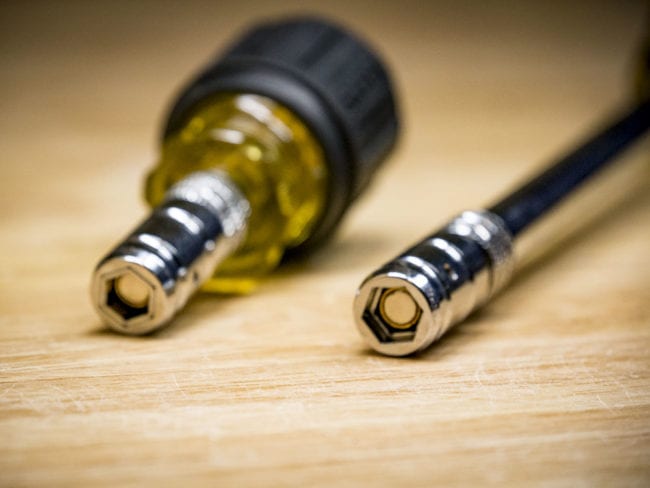
The Slide Driver is available in two shank lengths: a stubby version with a 1‑1/2‑inch shank, ideal for tight spaces and overhead work, and a 6‑inch version for reaching deeply recessed fasteners. Both models are built around Klein's iconic cushion‑grip handle, the same deep‑black, slightly tacky rubber grip that has become synonymous with professional‑grade electrical tools. The handle provides a comfortable, secure, non‑slip surface for the palm, and it is designed to withstand the oils, solvents, and general grime that accumulate on a working electrician's hands over the course of a day. The top of the handle features Klein's patented "Tip‑Ident" marking, a label that identifies the tool and its sizes so that you can find it quickly when it is stored handle‑up in a tool pouch—a small but genuinely useful feature that eliminates the need to pull out and inspect each driver to find the right one. The patented sliding mechanism is the heart of the tool. The hex tip is a single piece of machined steel that slides back and forth within the shank. In the retracted position, the tip presents the smaller 1/4‑inch hex driver. Slide the tip forward, engage the thumb‑nut lock, and the tip now presents the larger 5/16‑inch hex driver. Both positions are magnetic, holding the screw securely during fastening and preventing the frustration of dropping a critical screw into a dark, inaccessible void. The magnetic strength is adequate for the common screws these sizes encounter—it will hold a panel cover screw, a receptacle screw, or a conduit clamp screw without difficulty, though it will not lift a heavy lag bolt. For the intended applications, the magnetic hold is exactly right.
The Sliding Mechanism: How It Works, and Why It Matters
The sliding mechanism on the Klein 2‑in‑1 Hex Head Slide Driver is deceptively simple. The hex tip, which is machined from a single piece of hardened steel, rides inside the shank on a precisely fitted track. To switch from the 1/4‑inch size to the 5/16‑inch size, you grasp the tip—or simply press it against a flat surface—and slide it forward until it reaches the extended position. The tip protrudes beyond the shank by a short distance, exposing the larger hex profile. To lock it in place, you twist the thumb nut, which tightens against the shank and prevents the tip from sliding back during use. The thumb nut is knurled for easy grip, even with gloved hands, and it turns smoothly with moderate resistance. Once locked, the tip is as solid as a fixed‑shaft driver—there is no wobble, no play, no sense that the tool is anything other than a dedicated hex driver in the selected size. To switch back to the 1/4‑inch size, you loosen the thumb nut, slide the tip back into its retracted position, and lock it again. The entire process takes about two seconds, and it can be performed with one hand. The mechanism is metal‑on‑metal, with no plastic parts to wear, crack, or deform under load. It is built to the same standard as Klein's heavy‑duty nut drivers, which means it should withstand years of daily use without loosening or failing.
One nuance of the locking mechanism is worth noting for prospective users. The thumb nut locks the tip securely in the extended (5/16‑inch) position, but if you twist the lock into position when the tip is retracted (the 1/4‑inch position), the pressure of the lock can actually push the tip out into the 5/16‑inch position. This is not a defect; it is a consequence of the design. When the tip is retracted, the thumb nut does not actually engage a locking surface—it simply tightens against the tip, and the tip, being under some spring tension, may pop forward. The solution is simple: do not lock the thumb nut when the tip is in the 1/4‑inch position. The tip remains securely in the retracted position without the lock, held by spring tension and friction. The lock is only needed for the extended position. Once you understand this quirk, it becomes second nature, and it does not affect the functionality of the tool in any meaningful way. It is the kind of minor design characteristic that every multi‑tool possesses—a small behavioral quirk that the user adapts to within the first day of use and soon forgets entirely.
The Cushion‑Grip Handle and the Stubby vs. Long Shaft Decision
Klein offers the Slide Driver in two shank lengths, and the choice between them depends on the nature of your work. The stubby version, with its 1‑1/2‑inch shank, is the more versatile of the two. It fits easily into a tool pouch, a pocket, or even a tight space between a conduit and a wall where a longer driver would be impossible to fit. The stubby handle is compact, filling the palm without extending beyond it, and it provides excellent control for the kind of close‑quarters work that electricians and HVAC installers perform daily—tightening a screw on a junction box that is positioned between two studs, driving a fastener on a motor housing that is mounted inches from a wall, reaching into the back of a control panel to secure a terminal block. The 6‑inch shaft version provides extended reach for deeply recessed fasteners—the kind of screws that are set back inside a housing, behind a bundle of wires, or at the bottom of a narrow channel. The long shaft also provides additional leverage, making it easier to break loose a stubborn fastener or to apply the final torque needed to seat a screw firmly. The trade‑off is that the 6‑inch version is less maneuverable in tight quarters, and it adds more weight to the tool bag. Many professionals will find the stubby version to be the more practical daily driver, supplementing it with the 6‑inch version for the specific tasks that require extended reach. Klein prices the stubby at $19.99 and the 6‑inch at $24.99, making both models affordable enough that owning both is a reasonable option.
The cushion‑grip handle on both models is, as I have mentioned, an iconic design that has become synonymous with Klein tools. The deep‑black rubber sleeve is slightly tacky to the touch, providing a secure, comfortable grip that does not slip even when the hand is damp with sweat or coated in a light film of oil. The handle is thick enough to absorb vibration and provide a comfortable platform for the palm, but not so thick that it becomes cumbersome. The shape is a simple cylinder with a subtle taper toward the shank, a profile that works equally well in the standard palm‑wrapping grip for high‑torque driving and the fingertips grip for delicate, precise work. The handle on the stubby version is necessarily shorter than the handle on a full‑sized screwdriver, but it still provides enough surface area for a secure hold. The handle on the 6‑inch version is longer, providing a more traditional screwdriver feel. For the stubby version, I would personally prefer a slightly longer handle to provide more surface area for the palm, but the compact size is a deliberate choice that prioritizes portability and tight‑space access over handle length. It is a trade‑off that makes sense for the intended use case.
Field Testing: From Junction Boxes to Motor Housings
I used the Klein 2‑in‑1 Hex Head Slide Driver across a variety of tasks during several weeks of testing. The majority of the work was electrical in nature: installing new breakers into a 200‑amp service panel, mounting junction boxes, securing conduit clamps, and replacing receptacles and switches. The 5/16‑inch size was the workhorse for panel work, fitting the lugs on the breakers and the screws on the panel cover. The 1/4‑inch size was used for the smaller screws on the receptacles and switches. The magnetic tip held the screws securely during positioning, allowing me to start the screws with one hand while holding the fixture in place with the other—a critical capability for tasks like mounting a heavy ceiling fan junction box where both hands are needed to align the fixture before driving the screws. The stubby version was my preferred tool for most of this work, as the short shank allowed me to work inside the panel without the handle bumping against adjacent breakers, wires, or the panel enclosure. The 6‑inch version came out for a few specific tasks—reaching a deeply recessed screw on a motor housing and driving a fastener that was set back inside a conduit body—and it performed as expected, providing the extra reach without compromising the torque transfer.
The switching mechanism between sizes was quick and intuitive. After a day of use, I no longer thought about it; it became an automatic motion, like shifting gears in a car. The lock was only engaged when using the 5/16‑inch size, and I quickly learned the habit of unlocking before retracting. The magnetic tip held the screws well—not as strongly as a neodymium rare‑earth magnet would, but adequately for the task. It held a panel cover screw, a receptacle screw, a conduit clamp screw, a motor terminal screw—all of the common fasteners I encountered. The Tip‑Ident marking on the top of the handle was genuinely useful when the driver was stored handle‑up in my tool pouch. I could glance down, see the label, and grab the Slide Driver without pulling it out and inspecting the tip. It is a small feature, but small features add up to a better user experience.
Durability and the Klein Lifetime Warranty
Klein backs the Slide Driver with their standard lifetime warranty, a promise that the tool will be free from defects in materials and workmanship for the life of the owner. This warranty is a significant part of the value proposition for any Klein tool. It means that if the sliding mechanism ever fails, if the magnetic tip ever loses its magnetism to the point of unusability, if the cushion grip ever separates from the handle, or if any other manufacturing defect manifests, Klein will repair or replace the tool at no charge. In practice, Klein tools rarely need to be warrantied; they are built to withstand a career of daily use. The sliding mechanism on the Slide Driver, with its all‑metal construction and simple locking design, has no obvious failure points. The magnetic tip will weaken over a very long period of time—all permanent magnets do—but for a tool that is expected to last a career, the rate of magnetic decay is negligible. The cushion grip is chemical‑resistant and mechanically bonded to the handle, so it should not loosen or slide over time. For the professional who relies on their tools to make a living, the lifetime warranty provides peace of mind and confirms that Klein stands behind the quality of their products.
Klein 2‑in‑1 Hex Head Slide Driver Specifications
| Specification | Stubby Model | 6‑Inch Shaft Model |
|---|---|---|
| Overall Length | 3‑23/64 inches (85.3 mm) | 10‑1/4 inches (260.4 mm) |
| Handle Length | 1.85 inches (47 mm) | 4‑5/16 inches (109.5 mm) |
| Shank Length | 1.5 inches (38.1 mm) | 6 inches (152.4 mm) |
| Hex Sizes | 1/4 and 5/16 inches | 1/4 and 5/16 inches |
| Magnetic Tip | Yes, in both positions | Yes, in both positions |
| Handle Type | Cushion‑Grip | Cushion‑Grip |
| Locking Mechanism | Thumb nut twist lock | Thumb nut twist lock |
| Tip‑Ident Marking | Yes | Yes |
| Patent | U.S. Patent 7,654,175 B2 | U.S. Patent 7,654,175 B2 |
| Warranty | Lifetime | Lifetime |
| Price | $19.99 | $24.99 |
Who Should Buy the Klein 2‑in‑1 Hex Head Slide Driver?
The Slide Driver is ideally suited for the professional who frequently uses both 1/4‑inch and 5/16‑inch hex drivers and wants to reduce the number of individual tools in their bag. Electricians, HVAC installers, alarm and security technicians, maintenance professionals, and anyone who works with common hex‑head fasteners will find the Slide Driver to be a practical, time‑saving upgrade. The stubby version is the more versatile choice for most users, providing excellent tight‑space access and comfortable one‑handed operation. The 6‑inch version is a valuable supplement for those who encounter deeply recessed fasteners or who prefer the feel of a full‑sized screwdriver handle. For the professional who already owns a collection of Klein nut drivers and screwdrivers, the Slide Driver integrates seamlessly, using the same cushion‑grip handle and the same color‑coding and labeling conventions. It is not a replacement for a complete multi‑bit screwdriver or a full nut driver set, but it is not intended to be. It is a specialist tool that does one thing—switch between 1/4‑inch and 5/16‑inch hex sizes—and it does that one thing exceptionally well. For under $25, it eliminates a redundant tool from the pouch, reduces weight, and speeds up the workflow. It is a classic example of a Klein innovation: a small, clever improvement to a tool that most people never thought to improve, executed with the precision and durability that the brand demands.
Comments 0
Leave a Comment