The Nesting Design: Five Drivers, One Handle, No Compromises
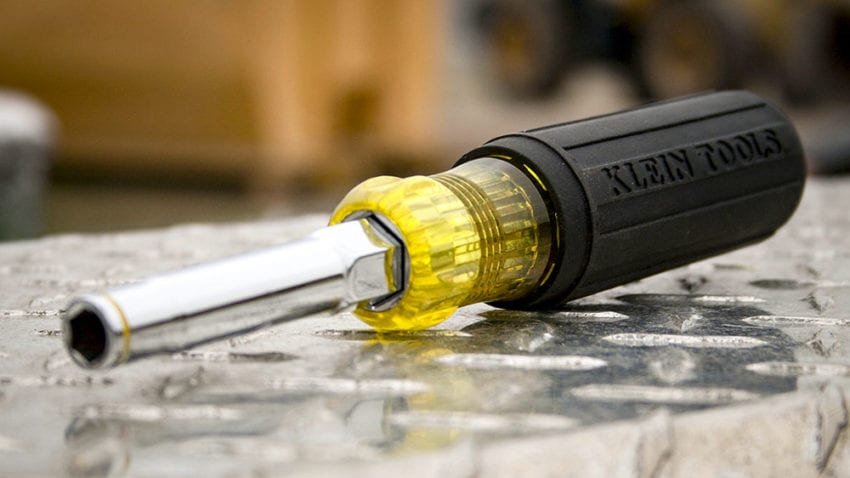
The Klein 5‑in‑1 Multi‑Nut Driver covers five of the most common hex sizes an electrician encounters: 3/16, 1/4, 5/16, 3/8, and 9/16 inches. These sizes nest inside one another in a telescoping arrangement that is intuitive and quick to use. The 9/16‑inch driver is the handle itself—the largest shaft is permanently mounted in the cushion grip, and it serves as the master handle for all the smaller sizes. The 3/8‑inch shaft nests inside the 9/16‑inch, the 5/16‑inch nests inside the 3/8‑inch, the 1/4‑inch nests inside the 5/16‑inch, and the 3/16‑inch nests inside the 1/4‑inch. To access a given size, you simply pull apart the nested shafts and insert the desired driver into the handle. Ball‑bearing tension holds the nested pieces together during transport, preventing the maddening rattle of loose shafts in a tool bag, but the pieces separate easily when you need them to. The fit of each shaft in the handle is precise and secure; there is no wobble, no perceptible play, no sense that the tool is anything other than a solid‑shaft nut driver when it is assembled. This is the critical distinction between a premium multi‑driver and a budget alternative. On cheap multi‑drivers, the shafts rattle in the handle, creating an imprecise, frustrating experience that makes you long for a fixed driver. On the Klein, the connection feels monolithic. The shaft locks into the handle with a reassuring click, and you can apply full torque without the shaft twisting, slipping, or disengaging. The hex bolster on each shaft is positioned just above the handle, ready to accept a wrench or an adjustable pliers for those moments when a fastener has corroded, been overtightened, or is simply reluctant to move. The bolster is generously sized and properly heat‑treated, so it will not deform under the pressure of a wrench. This wrench‑assist feature is particularly valuable for electricians working on older installations where fasteners may have been in place for decades and require significantly more breakaway torque than a hand‑driven nut driver can deliver.
The Cushion‑Grip Handle: Klein's Signature Interface Between Hand and Tool
Klein's cushion‑grip handle is one of those rare industrial design elements that has become so iconic, so universally recognized, that it transcends mere function and becomes part of the brand's identity. The deep‑black, slightly textured rubber sleeve with the Klein logo embossed on the side is instantly familiar to any electrician who has ever held a Klein screwdriver, a Klein Linesman pliers, or a Klein nut driver. The grip is thick enough to absorb vibration and provide a comfortable, non‑slip surface for the palm, but not so thick that it becomes cumbersome or reduces the user's ability to feel the fastener. It resists oils, solvents, and the general grime of an active jobsite, and it can be wiped clean with a rag or even a quick swipe across a jeans leg. The shape of the handle is cylindrical with a slight taper toward the shaft, providing a natural purchase for the hand in both the standard grip and the fingertips‑only grip used for running down a fastener quickly. The handle diameter is larger than that of a fixed‑shaft driver due to the nesting design—it must accommodate the handle‑mounted 9/16‑inch shaft—but the increase is not objectionable. For users with average to large hands, the handle fills the palm comfortably and provides excellent torque transfer. For users with very small hands, the diameter may feel slightly oversized, but the grip texture compensates by preventing the hand from slipping. The back of the handle features markings that identify the tool as a Klein Multi‑Nut Driver, but these markings are not color‑coded or sized in a way that aids identification when the tool is handle‑up in a tool pouch. The color‑coding on the shafts themselves is the primary identification system, and it is effective once memorized.
The Color‑Coding System: Visual Verification When You Need It Most
Each shaft of the Klein 5‑in‑1 Multi‑Nut Driver is finished with a color‑coded band near the bolster. The 3/16‑inch is blue, the 1/4‑inch is green, the 5/16‑inch is red, the 3/8‑inch is yellow, and the 9/16‑inch is black. These colors are consistent with the coding system Klein uses across their entire nut driver line, so an electrician who already owns individual Klein nut drivers will find the same colors on their multi‑driver shafts. The color‑coding serves as a rapid visual verification of the size you are about to use. Even the best electricians occasionally grab the wrong size; a 5/16‑inch and a 3/8‑inch are close enough in appearance that, in a dim basement or an attic with a single drop light, the difference can be missed. A glance at the colored band eliminates the guesswork. The colors are bright and durable, retaining their visibility even after extended use and exposure to jobsite conditions. The size of each driver is also stamped into the shaft near the bolster, providing a permanent, non‑fading identification that supplements the color‑coding.
The Missing 11/32‑Inch: A Quirk That Frustrates Ballast Changers
If the Klein 5‑in‑1 Multi‑Nut Driver has a flaw that prevents it from being the perfect multi‑tool for electricians, it is the inclusion of the 3/16‑inch driver at the expense of an 11/32‑inch. The 3/16‑inch hex is, for most electricians, the least frequently used size in the set. It handles tiny fasteners that are encountered far less often than the ubiquitous 11/32‑inch, which is the standard size for the nuts that secure ballasts in fluorescent light fixtures. Ballast replacement is a bread‑and‑butter task for a commercial or industrial electrician—walk into any aging office building, any hospital corridor, any warehouse, and you will find rows of fluorescent fixtures whose ballasts eventually fail and need to be swapped. The technician who arrives to perform that work needs an 11/32‑inch driver. With the Klein 5‑in‑1, they must carry a separate driver for that single size, defeating some of the space‑saving advantage of the multi‑tool. Klein has addressed this in their 6‑in‑1 Multi‑Nut Driver (model 32800), which adds an 11/32‑inch shaft and swaps the 3/16‑inch for a 7/16‑inch—a much more useful selection. However, that model is slightly larger and more expensive. The 5‑in‑1 remains the compact, affordable option, and for the electrician who rarely or never changes ballasts, the omission of the 11/32‑inch is irrelevant. For the electrician who changes ballasts weekly, it is a frustration that may drive them toward the 6‑in‑1 or toward carrying a dedicated 11/32‑inch driver. It is a trade‑off, and the wisdom of the trade depends entirely on the nature of your work.
Field Use: Bucket Trucks, Pylon Signs, and the Freedom of Fewer Tools
I used to do a lot of bucket truck work, the kind of job where you are raised forty feet in the air in a fiberglass basket, working on pylon signs whose internal fasteners come in a bewildering variety of sizes. The sign was built by a fabricator, modified by a service technician, and repaired by whoever was available, which means the fasteners are a mix of SAE sizes, a stray metric bolt or two, and a handful of screws that someone installed with whatever driver was closest at hand. In those days, I carried a full set of individual nut drivers in a tool roll that weighed more than I care to remember. Every time I switched sizes, I had to retrieve the new driver from the roll, perform the task, return the driver to its sleeve, and repeat. The Klein 5‑in‑1 Multi‑Nut Driver would have eliminated five individual drivers from that roll, consolidating them into a single tool that could be clipped to my belt or laid on the floor of the basket without taking up significant space. The time saved by not swapping back and forth between individual drivers, multiplied across dozens of fasteners per sign, would have been meaningful. Even now, working primarily at ground level, the space savings are significant. A tool bag, especially the compact bags preferred by service electricians who move between multiple job sites per day, has finite real estate. Every inch occupied by a redundant tool is an inch that could hold a voltage tester, a multi‑bit screwdriver, a pair of pliers, or a thermal imaging camera. The Klein 5‑in‑1 consolidates five commonly used sizes into a fraction of the space, freeing up room for other essential tools. The cost savings are similarly compelling. At under $25, the 5‑in‑1 replaces five individual nut drivers that, purchased separately from Klein, would cost between $12 and $20 each—a total cost of $60 to $100. The multi‑driver is not just a convenience; it is a genuine value proposition.
The Loose Shaft Problem: Managing the Nest When It's Empty
Multi‑drivers with nesting shafts have one inherent inconvenience: when the smaller shafts are removed from the handle, they must be stored somewhere. The Klein 5‑in‑1 addresses this partially but not completely. The smaller driver shaft fits into the 3/8‑inch shaft, and this assembly sits inside the handle when using the 5/16‑inch driver. However, when using the 3/8‑inch driver, the 5/16‑inch shaft is not in the handle—it is running around loose on your work surface or, ideally, in a zippered pocket of your tool bag. When using the handle alone as a 9/16‑inch driver, both the 3/8‑inch and all nested smaller shafts are loose. This is an inherent limitation of any nesting design, and it is a matter of personal workflow whether it bothers you. Electricians who work methodically at a bench or in a panel, with a clean surface on which to lay out components, will find the loose shafts a minor inconvenience. Electricians who work in the air, in tight spaces, or in environments where loose parts can fall and be lost will want to keep the shafts in a dedicated pocket or pouch when not in use. Klein would do well to offer a small, clip‑on holster or pocket sleeve for the disassembled shafts, but the lack of such an accessory does not diminish the fundamental utility of the tool.
Klein 5‑in‑1 Multi‑Nut Driver Specifications
| Specification | Detail |
|---|---|
| Model | Klein 32801 |
| Hex Sizes | 3/16, 1/4, 5/16, 3/8, 9/16 inches |
| Shank Length | 4 inches (101.6 mm) |
| Overall Length | 9‑1/2 inches (241.3 mm) |
| Blade Material | Steel |
| Handle Color | Black |
| Shank Type | Round, hollow shafts for screw clearance |
| Special Features | Wrench assist, color‑coded shafts, ball‑bearing nesting |
| Warranty | Lifetime |
| Price | $22.48 |
Conclusion: A Space‑Saving, Work‑Ready Tool That Nearly Nails It
The Klein 5‑in‑1 Multi‑Nut Driver is the kind of tool that, once you have used it for a week, makes you wonder why you carried five individual drivers for so long. It consolidates the most frequently used nut driver sizes into a single, well‑balanced, precisely engineered package that saves space, saves weight, and saves money. The cushion‑grip handle provides the same comfortable, secure interface that Klein users have trusted for generations. The wrench‑assist bolster gives you a mechanical advantage when you need it. The color‑coding provides instant size confirmation. The nesting design, while it does leave loose shafts during certain configurations, is manageable with minimal organization. The omission of the 11/32‑inch size will frustrate electricians who change fluorescent ballasts, but for everyone else, the five included sizes cover the overwhelming majority of daily work. At $22.48, the Klein 5‑in‑1 is competitively priced with other multi‑drivers on the market, and it carries Klein's lifetime warranty—a promise that the tool will perform as expected for as long as you own it. I have recommended this driver to other electricians, and one of my co‑workers purchased his own within a week of seeing mine in action. It earns its place in the tool bag not through flash or novelty, but through the quiet, dependable competence that defines Klein's best tools. It is not the only multi‑nut driver on the market, but it is the one that feels most like a collection of individual great drivers rather than a collection of compromises.
Comments 0
Leave a Comment