The Photodiode Sensor and Spectral Response Filter: Why Accuracy Depends on Getting the Sensor Right
The heart of any light meter is its sensor, and the quality of the sensor determines the accuracy and the usefulness of the measurements. The Klein ET130 uses a silicon photodiode as its sensing element. A photodiode is a semiconductor device that converts light into electrical current. When photons strike the surface of the photodiode, they dislodge electrons, creating a small electric current that is proportional to the intensity of the light. This current is amplified and processed by the meter's electronics, and the result is displayed as an illuminance reading. However, a bare photodiode is not, by itself, an accurate light meter. The human eye is not equally sensitive to all wavelengths of light. It is most sensitive to green light, at a wavelength of approximately 555 nanometers, and its sensitivity falls off sharply toward the blue and red ends of the spectrum. A photodiode, left to its own devices, has a different spectral sensitivity curve than the human eye. It may be more sensitive to infrared radiation (which the eye cannot see at all) or to ultraviolet radiation, and its peak sensitivity may be at a different wavelength. To make the photodiode respond like the human eye, it must be fitted with a spectral response filter—a carefully designed optical filter that attenuates the wavelengths that the eye is less sensitive to and passes the wavelengths that the eye sees best. The filter shapes the photodiode's response so that it closely matches the CIE (International Commission on Illumination) standard photopic curve, which is the internationally accepted model of human visual sensitivity under normal daylight conditions. The Klein ET130 incorporates such a filter, which is why its measurements are specified according to the CIE standard for white light. The spectral range of the meter is 400 to 760 nanometers, which covers the full visible spectrum from violet to deep red. The inclusion of a proper spectral response filter is what distinguishes a professional light meter from a cheap, unfiltered sensor that might be found in a smartphone app or a low‑cost gadget. An unfiltered sensor will give readings that are inconsistent and that do not correlate well with human visual perception, particularly under light sources that have unusual spectral distributions, such as LED or fluorescent lamps. The Klein ET130, with its filtered sensor, provides readings that are consistent, repeatable, and meaningful in terms of how a human observer would actually perceive the brightness of the space.
Measurement Range, Units, and the Foot‑Candle vs. Lux Distinction
The Klein ET130 measures illuminance in two units: foot‑candles (FC) and lux. The foot‑candle is the traditional unit used in the United States and is defined as the illuminance produced by one standard candle at a distance of one foot—or, more precisely, one lumen per square foot. Lux is the metric equivalent, defined as one lumen per square meter. One foot‑candle is equal to approximately 10.764 lux. The choice of units depends on the standards that the user is working to. OSHA standards for workplace illumination are typically expressed in foot‑candles, while international standards and many lighting design specifications use lux. The Klein ET130 can measure from 0 to 4,000 foot‑candles, or 0 to 40,000 lux, with a resolution of 0.1 FC or 1 lux in the lower ranges. This range covers virtually all indoor and outdoor artificial lighting scenarios that a professional is likely to encounter. For reference, a typical office is illuminated to about 30 to 50 foot‑candles, a detailed assembly area to about 100 foot‑candles, and a surgical operating room to several hundred foot‑candles. Direct sunlight at noon can exceed 10,000 foot‑candles, which is beyond the range of the meter, but measuring sunlight is rarely the purpose of a tool designed for verifying artificial lighting compliance. The meter has an automatic ranging function, which selects the appropriate measurement range based on the illuminance level, and a manual range function, which allows the user to lock the meter into a specific range for consistent comparisons. The sample rate is two measurements per second, which provides a responsive, real‑time reading that updates smoothly as the sensor is moved or as the lighting conditions change.
The Display, the Bar Graph, and One‑Handed Operation
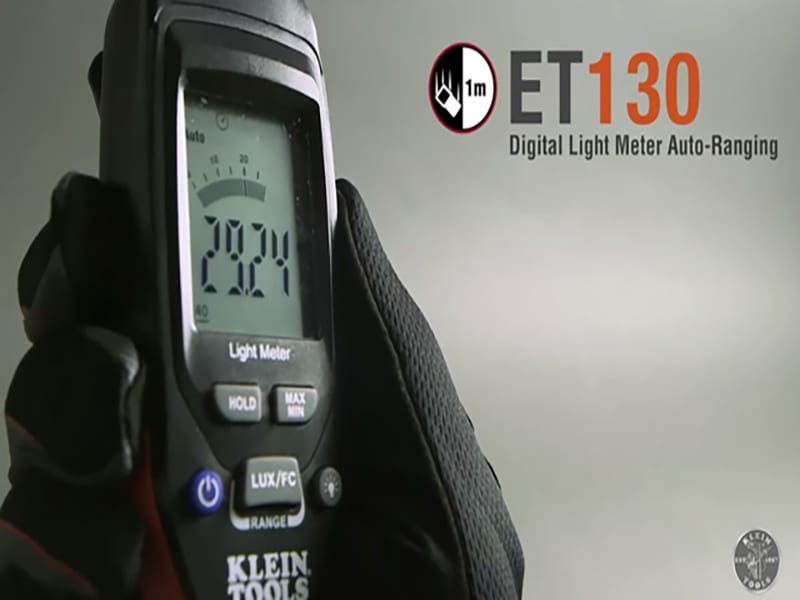
The ET130 is designed to be operated with one hand, leaving the other hand free to hold a clipboard, to adjust a light fixture, or to stabilize a ladder. The housing is shaped to fit comfortably in the palm, with a soft overmold that provides grip and some protection against drops. The sensor is located at the top of the device, facing upward, which is the correct orientation for measuring the light that falls on a work surface from overhead fixtures. A protective cap covers the sensor when the meter is not in use, preventing scratches and dust accumulation on the sensitive photodiode surface. The display is a backlit LCD with large, legible digits that can be read in dim environments—exactly the kind of environments where a light meter is most likely to be used. The backlight can be switched on and off manually. The 40‑segment analog bar graph provides a visual representation of the light level that is easier to interpret at a glance than a digital number. If the user is scanning a room and looking for areas where the light level drops below a threshold, the bar graph gives an immediate, intuitive indication of the relative brightness. The bar graph also updates faster than the digital display, which makes it useful for detecting rapid fluctuations in light level—for example, from a flickering fluorescent tube or a failing LED driver. The Hold button freezes the current reading on the display, allowing the user to capture a measurement and then bring the meter to a better‑lit area to read it. The Max/Min button toggles the display to show the maximum or minimum reading that has been captured since the meter was turned on or since the last reset. This is useful for checking the uniformity of illumination across a space—the user can walk through the room holding the meter, and then recall the highest and lowest readings to see whether the lighting meets the required uniformity ratio. The Range/FC/Lux button cycles between the automatic and manual range modes, and between foot‑candle and lux units. The meter automatically powers off after 15 minutes of inactivity to conserve battery life, and a low‑battery indicator warns the user when the 9‑volt battery needs to be replaced.
Durability, the Carrying Pouch, and Professional Applications
The Klein ET130 is built to survive the job site. The drop protection rating of 3.3 feet (1 meter) means it can be knocked off a workbench or a ladder without damage. The overmolded housing provides additional impact absorption and grip. The included custom carrying pouch protects the meter when it is not in use and provides a convenient way to store it in a tool bag or a service vehicle without the sensor becoming scratched or contaminated. The meter is backed by Klein's reputation for building tools that last, and it carries the appropriate CE and RoHS certifications. The primary application for the ET130 is verifying compliance with OSHA and other lighting standards. OSHA Standard 1926.56, for example, specifies minimum illumination levels for construction sites: 5 foot‑candles for general construction areas, 10 foot‑candles for first‑aid stations and infirmaries, and 30 foot‑candles for offices and similar spaces. A contractor or a safety officer can use the ET130 to walk a job site, take spot measurements, and document that these levels are being met. Beyond OSHA compliance, the ET130 is useful for commissioning new lighting installations, for troubleshooting complaints about inadequate lighting, for comparing the output of different lamp types, and for establishing baseline measurements as part of a preventive maintenance program. For the facility manager who is considering an LED retrofit, the ET130 can measure the existing light levels, calculate the expected improvement from the new fixtures, and verify that the improvement has been achieved after installation. For the electrical contractor who is installing a new lighting system, the ET130 provides the objective evidence that the system is performing to specification.
Klein ET130 Digital Light Meter Specifications
| Specification | Detail |
|---|---|
| Catalogue Number | ET130 |
| Measuring Range | 0–4,000 FC / 0–40,000 Lux |
| Spectral Range | 400–760 nm (CIE standard white light) |
| Repeatability | ±3% |
| Sample Rate | 2 times/second |
| Display | Backlit LCD with 40‑segment bar graph |
| Functions | Data Hold, Max/Min, Auto/Manual Range, FC/Lux Toggle |
| Auto Power Off | After 15 minutes |
| Drop Protection | 3.3 feet (1 meter) |
| Power Source | 9V battery (included) |
| Weight | 5.5 oz (156 g) |
| Included Accessories | Battery, carrying pouch |
| Price | ~$55–$65 (varies by retailer) |
Conclusion: A Simple, Reliable Tool for the Professional Who Needs to Measure Light
The Klein Digital Light Meter ET130 is not a tool that will be used every day by every electrician. But for the professional who needs it—the safety inspector verifying OSHA compliance, the lighting contractor commissioning a new installation, the facility manager troubleshooting a complaint about inadequate illumination—it is an essential instrument. It is designed to do one thing—measure illuminance—and it does that one thing well. The photodiode sensor with its spectral response filter provides measurements that are accurate and that correlate with human visual perception. The backlit display with its analog bar graph makes the measurements easy to read and interpret. The one‑handed design and the simple, intuitive controls make the meter easy to use. The rugged, overmolded housing and the drop protection rating mean it will survive the job site. And the price, at well under $100, makes it accessible to any professional who has a need to measure light. The ET130 is a worthy addition to Klein's growing line of test and measurement tools, and it is a product that reflects the company's understanding of what professionals need: not flashy features or cutting‑edge technology, but reliable, accurate, and durable tools that do their job and then get out of the way.
Comments 0
Leave a Comment