The Rogowski Coil in Practice: How the CL150 Works
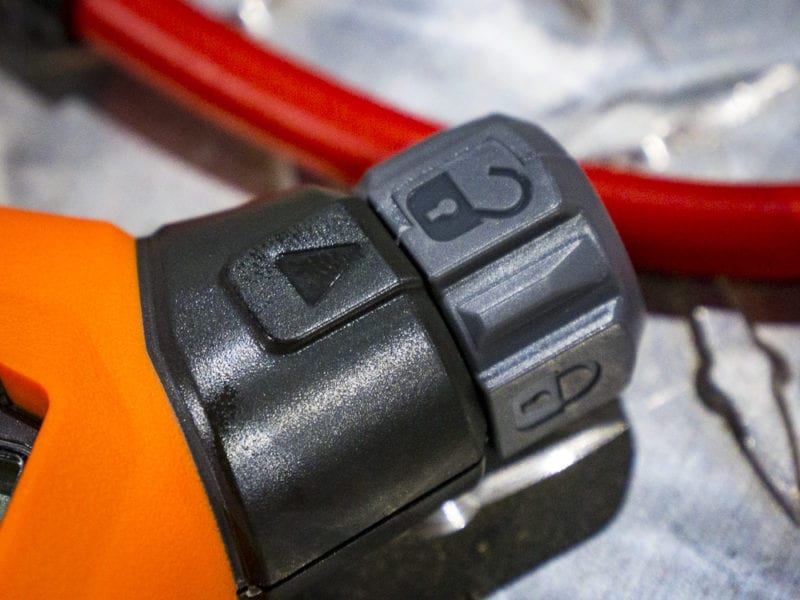
Using the CL150 is straightforward. The flexible coil is disconnected from one of its mounting posts—the meter has two "ears" into which the ends of the coil plug—and the coil is looped around the conductor to be measured. The coil is then reconnected to the meter, and the current reading appears on the large, backlit 3,000‑count LCD display. The coil itself is a thin, flexible tube, similar in diameter to a pencil, and it can be bent and manipulated easily. The 18‑inch length is sufficient to encircle even the largest service‑entrance cables, and the flexibility allows it to be threaded through tight spaces and around obstacles. Because the coil has no iron core, there is no magnetic saturation at high currents—the meter remains accurate across its entire 3,000‑amp range. This is a significant advantage over traditional clamp meters, which can saturate and become non‑linear at very high currents, leading to inaccurate readings. The CL150 also measures the minimum and maximum current over a measurement period, displays those values on the screen, and can be set to capture the inrush current that occurs when a motor or a large load starts. The backlit display is easy to read in dim environments, and the meter includes an auto‑power‑off function that conserves battery life after 15 minutes of inactivity. The meter runs on two AAA batteries, which are housed in an easily accessible compartment, and a low‑battery indicator warns the user when replacement is needed. The meter has been drop‑tested to survive falls from 6.6 feet onto concrete—a realistic specification for a tool that will be used on ladders, scaffolds, and in the cramped confines of electrical rooms.
Why Flexibility Matters: Real‑World Applications for the CL150
The defining advantage of the CL150 over a traditional clamp meter is its flexibility. When an electrician is working in a panel or a switchgear enclosure, the conductors they need to measure are often tightly packed, with minimal clearance between individual wires and between the wires and the enclosure walls. A rigid clamp meter, with its fixed jaw opening and its solid body, may simply not fit into the space available. The flexible Rogowski coil, by contrast, can be snaked between wires, looped around a single conductor, and secured, all without disturbing the adjacent wiring or risking contact with live terminals. For measuring current on parallel conductors—multiple wires that are connected to the same phase, a common configuration in large service entrances and feeder circuits—the CL150 can encircle all of the parallel conductors simultaneously, providing a total current reading without the need to measure each conductor individually and add the results. The risk of making a measurement error due to a conductor being missed or double‑counted is eliminated. The flexibility of the coil also makes the CL150 useful for measuring current in conductors that are not round—bus bars, for example, which are flat metal bars used in switchgear and panel boards. A traditional clamp meter cannot encircle a bus bar because its jaws are shaped for round cables. The Rogowski coil, being flexible, can be wrapped around a bus bar of any cross‑section, as long as the circumference of the coil is sufficient to encircle it. The Klein CL150 is designed to be a simple, focused tool. It does not measure voltage, resistance, continuity, or any of the other parameters that a full‑featured multimeter or clamp meter would provide. It measures AC current, and that is all it does. For the electrician who already owns a good multimeter that handles voltage, resistance, and continuity, the CL150 is a complementary tool that adds the specific capability of flexible, high‑current, True‑RMS AC current measurement to their toolkit. It is not a replacement for a general‑purpose clamp meter; it is a specialist tool for the applications where a general‑purpose clamp meter cannot reach.
Klein Flexible Clamp Meter Specifications
| Specification | Detail |
|---|---|
| Item Number | CL150 |
| Type | Flexible AC Current Clamp (Rogowski coil) |
| Measurement Range | 0.01 to 3,000 A AC |
| Coil Length | 18 inches |
| Display | Backlit 3,000‑count LCD |
| Functions | Auto‑range, Hold, Max/Min, Auto‑Power Off |
| Safety Rating | CAT IV 600V, CAT III 1000V, Class 2 |
| Drop Protection | 6.6 feet (2 meters) |
| Power Source | 2 × AAA (included) |
| Weight (with batteries) | 6.6 ounces |
| Included | Carrying case, batteries, instruction manual |
| Price | ~$90 |
Conclusion: A Specialist Tool That Earns Its Place
The Klein Flexible Clamp Meter CL150 is not a tool for every electrician, and it is not a replacement for a general‑purpose clamp meter. But for the electrician who routinely works with large conductors, crowded panels, bus bars, or parallel feeder circuits, it is a tool that solves problems that a rigid clamp meter simply cannot address. The 18‑inch flexible Rogowski coil provides access where a rigid jaw cannot reach, and the 3,000‑amp range covers the highest currents that most electricians will ever need to measure. The True‑RMS accuracy, the simple controls, the backlit display, and the rugged construction make it a reliable and easy‑to‑use instrument. At a price of around $90, it is significantly less expensive than many competing flexible clamp meters, and it is backed by Klein's reputation for professional‑grade tools. For the electrician who has ever struggled to get a rigid clamp meter into a tight space, the CL150 will feel like the tool they should have bought years ago.
Comments 0
Leave a Comment