Blade: 440A Steel, Half‑Serrated, and the Black Oxide Shield
The blade of the Klein 44223 is forged from 440A stainless steel, a material that knife enthusiasts often dismiss as entry‑level. It is true that 440A cannot compete with the edge retention of S30V, 154CM, or even the 8Cr13MoV found on many Kershaw knives. Its carbon content is relatively low—around 0.65 to 0.75 percent—which limits its maximum achievable hardness and means the edge will require more frequent touch‑ups during heavy use. However, 440A possesses two qualities that make it an acceptable choice for a work‑oriented knife at this price. First, it is exceptionally corrosion‑resistant, thanks to its chromium content of approximately 16 to 18 percent. For an electrician working in damp environments, a plumber dealing with moisture, or anyone carrying a knife in a humid climate, this corrosion resistance is a meaningful practical benefit. Second, 440A is extremely easy to sharpen. A few passes on a pocket stone or a ceramic rod will bring back a working edge, and the steel is forgiving of inconsistent angles—a virtue for tradespeople who sharpen their knives quickly between tasks rather than at a dedicated sharpening station. Klein further protects the blade with a black oxide coating, which enhances corrosion resistance and gives the knife a subdued, professional appearance.
The blade profile is a modified drop point with a partially serrated edge. The serrations occupy roughly the rear third of the cutting edge, closest to the handle, while the forward two‑thirds is a plain edge. This combination—half serrated, half plain—is a perennial subject of debate in the knife community. Proponents argue that it offers the best of both worlds: the plain edge for clean slicing and push cuts, the serrations for sawing through tough, fibrous materials like rope, strapping, or rubber hose. Detractors contend that a half‑serrated blade compromises both functions, providing too little plain edge for efficient slicing and too few serrations for aggressive sawing. The truth, as usual, lies somewhere in between, and depends heavily on the user's typical cutting tasks. For an electrician who occasionally needs to cut through Romex sheathing, zip ties, or nylon pull cord, the serrations can be genuinely useful. For someone who primarily opens packages and breaks down cardboard, a full plain edge would be more efficient. The blade length is 3.5 inches, providing ample cutting surface for most EDC tasks, and the overall open length is 8.1 inches, which gives a full four‑finger grip.
Handle: Anodized Aluminum, Skeletonized Aesthetics, and a Grip That Needs Help
The handle of the 44223 is machined from anodized aluminum, a material choice that is a step above the glass‑filled nylon or basic steel found on many knives in this price bracket. Aluminum offers an excellent strength‑to‑weight ratio, good corrosion resistance, and the ability to be anodized in a range of colors. The Klein handle is anodized in a dark gray or charcoal finish that pairs well with the black oxide blade. The handle is not skeletonized to the degree of some ultralight knives, but it features decorative machining that adds visual texture without significantly reducing weight. The knife weighs 5.3 ounces on our scale—not heavy by any means, but substantial enough to feel solid in the hand. The balance point is near the pivot, giving the knife a neutral feel during cutting.
The grip, however, is where the handle falls short. The anodized aluminum surface is smooth, with almost no texture to provide friction. There is some light jimping on the liner lock—the part of the lock bar that contacts the thumb—and additional jimping on the rear of the blade spine, near the thumb studs. These two small textured areas provide some purchase for the thumb and index finger, but the remaining three fingers wrap around smooth aluminum. In dry conditions, this is manageable. In wet conditions, or when wearing gloves, the knife could become difficult to control securely. This is a design choice that prioritizes aesthetics and cost over function, and it is one of the most significant compromises the 44223 makes to hit its price point. A simple solution—adding a few machined grooves or a textured inlay to the handle slabs—would dramatically improve grip without adding significant cost. It is a missed opportunity.
Deployment and Locking: Spring Assist, Dual Thumb Studs, and a Safety Switch
The 44223 is a spring‑assisted knife, meaning that a torsion bar inside the pivot provides the force needed to complete blade deployment once the user overcomes the initial detent resistance. The deployment method is dual thumb studs, positioned symmetrically on both sides of the blade for ambidextrous operation. The action is snappy—not as polished as the SpeedSafe mechanism on a Kershaw, but entirely functional. The blade deploys reliably every time, and the spring provides enough force to lock the blade open even if you release the thumb stud early. There is a small amount of blade play in the open position, a common characteristic of budget‑friendly spring‑assisted knives, but it does not affect cutting performance.
The lock is a liner lock—a thin leaf of steel that slides into place behind the blade tang when the knife is opened. Liner locks have a reputation, not entirely undeserved, for being less secure than frame locks or lock‑backs, but the 44223's liner lock is adequately thick and engages the tang fully. I experienced no issues with unintentional disengagement during testing, and the lock held firm under spine pressure. One unique feature of the 44223 is the safety switch, a small sliding tab located near the middle of the handle. When engaged, this switch physically blocks the blade from opening, providing an additional layer of security against accidental deployment in a pocket or tool bag. For tradespeople who work in environments where an unexpected blade opening could be dangerous—around live electrical panels, for example—the safety switch is a thoughtful inclusion. For EDC enthusiasts accustomed to knives without safeties, it may feel redundant. The switch is easy to operate with the thumb and does not interfere with normal use when disengaged.
The Clip: Deep Carry, Tip‑Down, and Immovable
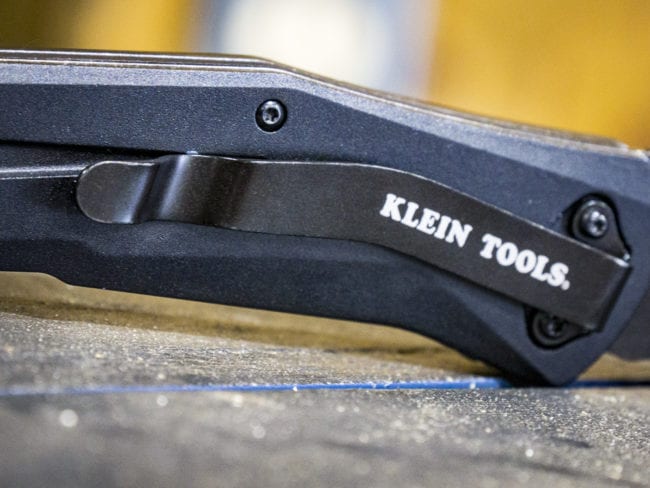
The pocket clip on the 44223 is a single‑position design, set for right‑hand, tip‑down carry only. There is no option to switch it to tip‑up, and no provision for left‑hand carry. This is the knife's most significant ergonomic limitation. Tip‑down carry means the knife sits in the pocket with the pivot end upward, so that when you draw it, the knife is already oriented for a rapid opening via the thumb studs. However, tip‑up carry—where the pivot end is at the bottom of the pocket and the blade spine rests against the pocket seam—is generally preferred for defensive carry and for knives with flipper tabs. The fact that Klein chose a single‑position clip suggests they prioritized safety and simplicity over the customization that EDC enthusiasts expect. The clip itself is a deep‑carry design, positioning the knife low in the pocket with only a small portion of the handle visible. The clip tension is strong, and the knife stays securely in place during daily activity. It is, functionally, a good clip—it just does not give you any options.
Klein Spring‑Assisted Pocket Knife 44223 Specifications
| Specification | Detail |
|---|---|
| Model Number | Klein 44223 |
| Blade Type | Half‑Serrated Drop Point |
| Blade Material | 440A Stainless Steel with black oxide coating |
| Handle Material | Anodized Aluminum |
| Lock Style | Liner Lock |
| Deployment | Spring‑assisted, dual thumb studs |
| Safety | Sliding safety lock |
| Clip | Single‑position, right‑hand tip‑down only |
| Weight | 5.3 oz |
| Blade Length | 3.5 inches |
| Overall Length | 8.1 inches |
| MSRP | $29.93 |
Who Should Carry the Klein 44223?
The Klein Spring‑Assisted Pocket Knife is best suited for the professional tradesperson—particularly electricians, for whom the safety switch and corrosion‑resistant 440A steel are directly relevant features—who wants a functional, safe, and affordable assisted opener for jobsite use. It is also a reasonable choice for the DIYer or homeowner who wants a reliable cutting tool that will not require frequent sharpening attention and that can be replaced without financial pain if lost. The knife is not, however, well‑suited for the EDC enthusiast who demands premium steel, multiple clip positions, or a highly textured grip. At $30, those expectations are unrealistic. What the 44223 offers is a solidly built, safely operated, spring‑assisted knife from a brand with a century of experience making tools for professionals. It will cut, it will lock, and it will not surprise you with an accidental opening. For many users, that is exactly what they need.
Conclusion: A Safe, Sensible Knife That Prioritizes Protection Over Performance
The Klein 44223 is not the most exciting knife you will ever carry. It will not win any awards for blade steel, handle texture, or deployment speed. But it is a knife that understands its audience—working professionals who need a dependable cutting tool that they can safely carry in a crowded tool belt or a pocket full of wire nuts and screws. The safety switch, the corrosion‑resistant steel, and the secure liner lock all speak to a design philosophy that values reliability and safety above all else. The single‑position clip and the slick handle are genuine drawbacks, but they are drawbacks that many users will accept in exchange for Klein's reputation, warranty, and the peace of mind that comes from carrying a knife built by a company that has been making tools for electricians since before your grandfather was an apprentice. At $30, the 44223 earns its place. It is not the knife you dream about. It is the knife you reach for when the job needs doing.
Comments 0
Leave a Comment