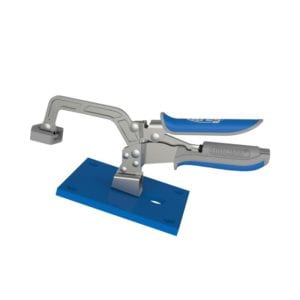
The Concept: Why a One‑Sided Clamp Works
The first thing anyone notices about the Kreg Bench Clamp is that it appears to be incomplete. A traditional clamp has two jaws: one on each side of the workpiece, squeezing toward each other with equal and opposite force. The Kreg Bench Clamp has only one jaw—a single, padded metal arm that presses downward. Where, the observer naturally asks, is the opposing jaw? The answer is elegant in its simplicity: the opposing jaw is the workbench itself. The Kreg system uses a keyhole plate, recessed into the bench surface, as the anchor point. An anchor screw, attached to the base of the clamp, slides into the keyhole and locks the clamp to the bench. When you squeeze the clamp handle, the single jaw presses down on the top of the workpiece, and the bench surface—massive, rigid, immovable—resists from below. The workpiece is sandwiched between the clamp jaw and the bench top, held as securely as if it were in the grip of a traditional two‑jawed clamp. The keyhole design allows the clamp to be positioned anywhere on the bench where a keyhole plate has been installed. The clamp can swivel a full 360 degrees around its mounting point, so the jaw can be oriented to press against any face of the workpiece, from any direction. When the clamp is not needed, the anchor screw simply slides out of the keyhole, and the clamp can be stored away, leaving the bench surface flat and unobstructed. If you are unwilling to cut into your workbench—and I understand the reluctance; a well‑loved bench is a sacred object—Kreg offers self‑adhering rubber bumpers that lift the keyhole plate slightly above the bench surface, providing the necessary clearance for the anchor screw without requiring any permanent modification to the bench. The bumpers work, but they are a compromise; a recessed plate, flush with the bench surface, is the ideal installation because it leaves the bench flat for other work.
Automaxx: The Technology That Eliminates Screw Adjustments
The single most impressive feature of the Kreg Bench Clamp System is Automaxx, Kreg's proprietary clamping technology that automatically adjusts to the thickness of the material being clamped. On a traditional F‑clamp or quick‑grip clamp, the user must adjust the jaw opening to match the workpiece. This usually involves turning a threaded screw or squeezing a trigger repeatedly until the jaws make contact, then applying a final clamping force with a lever or a screw handle. It is a process that takes time—not much time, perhaps five or ten seconds per clamp—but when you are setting up a complex assembly that requires a dozen clamps, those seconds accumulate into minutes, and the constant fiddling with adjustments becomes a source of low‑grade frustration. Automaxx eliminates the adjustment step entirely. The clamp has a fixed jaw opening (3 inches of reach, with a maximum clamping capacity of 3‑3/4 inches of material thickness), but the mechanism inside the clamp head automatically compensates for variations in material thickness. You place the workpiece under the jaw, squeeze the handle, and the clamp grips it with the same firm, consistent pressure regardless of whether the material is a sheet of 1/4‑inch plywood or a 3‑1/2‑inch‑thick block of hardwood. There is a tension adjust screw on the clamp head that allows you to set the clamping pressure—lighter for delicate work, heavier for rough stock—but once that screw is set to your preference, you never need to touch it again. The Automaxx mechanism handles the rest. In practice, this is a revelation. I found myself reaching for the Kreg Bench Clamp for tasks that I would normally have done with a traditional F‑clamp, simply because the Automaxx made the process so much faster and so much more pleasant. Hold the workpiece in position, squeeze the handle, and it is locked down. Release the handle, and the clamp lets go. No screws to turn, no triggers to pump, no adjustments to make. Just clamp and release, clamp and release, in a rhythm that becomes almost meditative.
Installation: What It Takes to Recess the Keyhole Plate
Installing the Kreg Bench Clamp System to its full potential—with the keyhole plate recessed flush into the bench top—requires a few tools and a few hours of careful work. The process begins with a template, which Kreg instructs you to build from four pieces of 3/4‑inch stock arranged in a pinwheel pattern around the keyhole plate. The template must be precisely sized so that the router base is fully supported throughout the cut and the resulting recess matches the dimensions of the plate exactly. This is not the place for a trim router; the template is too large for the small base of a compact router, and the depth of cut required demands the power and stability of a full‑sized plunge router. I used the Triton TRA001, a powerful 3‑1/4‑horsepower router that handled the cut with ease. A top‑bearing pattern bit is the correct tool for the job, as the bearing rides against the template and transfers its shape to the workpiece. Before routing, set the depth stop to the combined thickness of the template plus the clamp plate, so that the finished recess will be exactly as deep as the plate is thick. Make the cut in multiple passes if the material is dense or if the router is struggling; taking too deep a cut in a single pass is hard on the tool and can result in tear‑out. Once the recess is routed, you will notice that the corners are rounded—the rotary action of the bit cannot create sharp inside corners. The waste in the corners must be removed with a sharp chisel, paring back to the layout lines until the plate drops into the recess with a snug, friction‑fit. Then mark out the keyhole channel on the bottom of the recess, drill two holes at each end of the channel, and remove the waste between them with a chisel. This channel provides clearance for the anchor screw that locks the clamp to the plate. Fit the plate back into the recess, slide the clamp with its anchor screw into the keyhole, and verify that the screw has enough depth to engage securely. If everything fits, fasten the plate to the bench with the included screws. The installation is complete. From this point forward, whenever you need to clamp something to the bench, you simply slide the anchor screw into the keyhole, position the workpiece, and squeeze the handle. The entire setup takes less than five seconds. When the work is done, slide the clamp out of the keyhole, and the bench is clear.
Performance: An Iron Grip and a 360‑Degree World of Possibilities
Once the setup was complete, I put the Kreg Bench Clamp through its paces across a range of woodworking tasks. I used it to hold templates for routing, to secure stock for cutting with a jigsaw and a circular saw, to clamp pieces together for pocket‑hole fastening with the Kreg K4 jig, and to hold workpieces steady for sanding and planing. In every application, the clamp held the material with a grip that felt as secure as any traditional clamp I have used. The padded jaw, with its large, rubberized face, distributed the clamping pressure evenly and did not leave marks on the workpiece. The Automaxx mechanism never failed to engage properly, regardless of the material thickness. The 360‑degree swivel allowed me to position the clamp at whatever angle was most convenient for the task at hand—pressing against the side of a board, the end of a board, or diagonally across a corner. The only minor complaint I encountered was that the rubber foot on the end of the clamp jaw, which provides the padded contact surface, had a tendency to work its way off the metal jaw as the clamp was repeatedly engaged and released. It was a small annoyance—pushing the rubber foot back into place took only a second—but it happened frequently enough that it was worth noting. A more secure attachment method for the rubber foot, perhaps a mechanical interlock rather than a friction fit, would be a welcome improvement in a future revision of the product.
Expanding the System: The Heavy‑Duty Plate, the Clamp Vise, and the Clamp Trak
The standard Kreg Bench Clamp System, with its single 3‑inch‑reach clamp and single keyhole plate, is the entry point. But Kreg has designed the system to be expandable, so that a woodworker can build a comprehensive clamping solution tailored to their specific needs. The heavy‑duty bench clamp system uses a much larger mounting plate that itself becomes a portable clamping station. The large plate takes the place of the bench as the opposing jaw, allowing the user to clamp workpieces anywhere—on a jobsite, on a sawhorse, on the tailgate of a truck—without needing a keyhole plate installed in a permanent bench. This is a remarkably versatile adaptation that transforms the system from a fixed bench accessory into a portable clamping solution. The clamp vise uses the same keyhole plate and Automaxx technology, but in a configuration that functions like a traditional bench vise, with the jaw pressing against a fixed stop. It is designed for holding workpieces vertically, for tasks like joinery cutting, sawing, and planing the ends of boards. The Clamp Trak is a track that can be mounted to the front edge of a workbench, providing a continuous line of clamping positions along the entire length of the bench. Multiple clamps can be mounted to the track simultaneously, allowing the user to secure an entire panel or a long board along its full length. The expandability of the system means that a woodworker can start with a single clamp and a single keyhole plate, and gradually build out their clamping capabilities as their needs and budget allow.
Kreg Bench Clamp System Specifications
| Specification | Detail |
|---|---|
| Clamp Reach | 3 inches (76 mm) |
| Maximum Clamping Thickness | 3‑3/4 inches (95 mm) |
| Clamping Range | 360‑degree rotation around mounting point |
| Auto‑Adjust Technology | Automaxx, adjusts automatically to material thickness |
| Clamp Plate Material | Anodized aluminum |
| Installation | Recessed (flush mount) or surface mount with included bumpers |
| Included | 3″ Bench Clamp, aluminum Clamp Plate, mounting hardware |
| Compatibility | Kreg Clamp Trak, Clamp Vise, Heavy‑Duty Bench Clamp System |
| Price | $49.99 |
Conclusion: A Clamp That Changes How You Think About Your Workbench
The Kreg Bench Clamp System is one of those rare tools that, once installed, subtly changes how you work. The bench, which was previously a passive surface—a flat place to set things down while you fetch the clamps—becomes an active participant in the clamping process. The Automaxx technology removes the friction of adjustment, making clamping so fast and so effortless that you find yourself using the clamp for tasks where you might previously have held the workpiece with your free hand or braced it against your body. The keyhole mounting system keeps the bench surface clear when the clamp is not in use, which is most of the time, so the bench does not become a permanent clamp station at the expense of its other functions. The expandability of the system—the heavy‑duty plate, the clamp vise, the Clamp Trak—means that the initial investment in a single clamp and plate is not a dead end; it is the beginning of a modular clamping solution that can grow with the woodworker's needs. For $49.99, the cost of a single quality F‑clamp, the Kreg Bench Clamp offers a level of speed, convenience, and versatility that no traditional clamp can match. It will not eliminate the need for other clamps—bar clamps and pipe clamps are still essential for large glue‑ups, and spring clamps still have their place for light holding tasks—but it will reduce the number of clamps you need to reach for during the course of a typical woodworking session. And in a workshop where every minute counts, a tool that saves time on every clamping operation will pay for itself many times over. I would recommend the Kreg Bench Clamp System to any woodworker who is willing to invest the time in installing the keyhole plate correctly, and who values speed, convenience, and the quiet satisfaction of a tool that does its job so well that you stop thinking about it and simply reach for it, again and again, until it becomes as natural an extension of the bench as the bench itself.
Comments 0
Leave a Comment