Build Quality: Aluminum, Rubber, and a User‑Replaceable Battery
The first thing you notice when you pick up the Maxxeon Lumenator is that it is heavy—not in a burdensome way, but in a way that communicates solidity and quality. The main body of the light is constructed from aluminum, with thick, machined heat sink fins running across the rear surface to dissipate heat from the 20‑watt LED panel. The aluminum is anodized in a dark gray finish that resists corrosion and hides the minor scratches that accumulate with use. A thick rubber edge protector wraps around the entire perimeter of the light, providing impact absorption and a non‑slip surface when the light is set on a sloped or uneven surface. The rubber also protects the light when it is dropped—Maxxeon rates the Lumenator to survive drops from 6 feet onto concrete, which is a credible claim given the robust construction and the shock‑absorbing rubber surround. The lens is made from a tough, scratch‑resistant polycarbonate that is recessed behind the rubber protector, minimizing the risk of impact damage. The single control is a red, weatherproof pushbutton on the rear of the housing, adjacent to the heat sink fins. Pressing the button cycles through the modes: Low (600 lumens), High (1800 lumens), and Off. The button is large, easy to operate with gloved hands, and sealed against moisture and dust—the entire light carries an IP67 rating, which means it is completely dust‑tight and can survive temporary immersion in water. In practical terms, you can use the Lumenator in the rain, set it in a puddle, or clean it with a hose without damaging the electronics. One of the most appealing features of the Lumenator is the user‑replaceable battery pack. The 11.1‑volt, 4‑amp‑hour lithium‑ion battery is housed inside the aluminum body, accessed by removing four Allen screws from the rear panel. This is not a tool‑free operation—you will need a hex key—but it is straightforward, and it means that when the battery eventually reaches the end of its service life, you can replace it yourself rather than sending the entire light back to the manufacturer or discarding it. The battery is a standard pack available from Maxxeon, and replacement is inexpensive compared to the cost of replacing a light with an integrated, non‑replaceable battery. The included charger is a small DC adapter that plugs into a port on the side of the light, protected by a rubber cover. The charge time is approximately 5 hours for a full charge, and the charger outputs at a modest rate—this is not a fast charger, but it is gentle on the battery and will maximize its cycle life. The charge port is a standard barrel connector, and a 100‑240V AC power supply is included for international compatibility. The ability to replace the battery, combined with the rugged, all‑metal construction, means that the Lumenator is not a disposable product. It is designed to be used for years, maintained as needed, and repaired rather than discarded when a component fails.
Light Output and Quality: 1800 Lumens, 3:1 Flood Ratio, and an Even, Artifact‑Free Beam
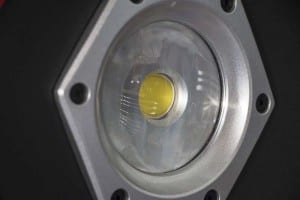
The Lumenator produces its light from a single, large LED panel that incorporates multiple individual chips behind a diffusing optic. The result is a beam that is remarkably smooth and even, with no hot spots, no dark rings, and no color fringing. The 3:1 flood beam ratio means that for every foot of distance from the light, the beam spreads three feet wide—so at a distance of 10 feet, the illuminated area is approximately 30 feet across. This is a broad, area‑filling beam, not a tight spot, and it is ideal for the kind of general work lighting that the Lumenator is designed to provide: lighting up an engine bay, a workbench, a room under renovation, a section of a job site, or an outdoor work area after dark. The color temperature is a cool white, approximately 6000K, which provides good contrast and visibility. It is not as color‑accurate as a 5000K neutral white light—painters and electricians who require precise color discrimination may prefer a warmer or more neutral light—but for general work, the cool white is bright, clear, and easy on the eyes. The High mode, at 1800 lumens, is significantly brighter than most cordless work lights in its size and price class. It is bright enough to illuminate a two‑car garage, a large room, or a wide section of outdoor workspace. For tasks that require less brightness, or for extended run time, the Low mode of 600 lumens is useful for safety lighting or for close‑up work where maximum brightness would create uncomfortable glare. The run times, with a fully charged battery, are approximately 2 hours on High and 8 hours on Low. These are respectable figures, consistent with the capacity of the battery and the efficiency of the LED panel. For a full day of intermittent use, Low mode is often sufficient; for continuous use on High, a spare battery—which can be purchased separately—is a wise investment. The Lumenator does not have a built‑in battery gauge, so the user must estimate the remaining run time based on how long the light has been operating. This is a minor inconvenience, but it is common among work lights in this class, and it can be managed with a bit of experience.
Accessories: The Tripod, the Neodymium Magnet, and the Nylon Handle
Maxxeon offers several accessories for the Lumenator that extend its versatility significantly. The telescoping tripod adjusts from approximately 2.5 feet to 5 feet 8 inches, allowing the light to be elevated for better coverage of a work area. The tripod is lightweight, made from aluminum, and folds compactly for storage. The Lumenator attaches to the tripod via a bracket that is included with the light, and the bracket allows the light to be tilted and angled as needed. For the professional who works in environments where a tripod is impractical—under a vehicle, inside a steel structure, on a piece of equipment—the optional neodymium magnetic base is a game‑changer. This is not a small, weak magnet. It is a large, powerful rare‑earth magnet, encased in a steel housing, that attaches to the nylon carry handle on the top of the Lumenator. With the magnet installed, you can stick the light to any ferrous metal surface—an I‑beam, a steel column, the frame of a vehicle, the side of a steel building, a piece of heavy equipment—and it will hold securely, even against vibration and moderate bumps. The magnet is so strong that removing the light from a thick steel surface requires a deliberate, forceful pull. For the contractor working on a steel‑framed building, the mechanic working under a vehicle, or the industrial maintenance technician working in a plant, the magnetic base turns the Lumenator from a stationary work light into a highly portable, hands‑free illumination solution that can be positioned anywhere there is steel. The nylon carry handle, which is integrated into the top of the rubber protector, provides a convenient way to transport the light and doubles as a hanging point when a hook or a nail is available. The handle is sturdy, with reinforced stitching, and it is designed to support the weight of the light without stretching or tearing.
Maxxeon WorkStar 5000 Lumenator Specifications
| Specification | Detail |
|---|---|
| LED Brightness | High: 1800 lumens; Low: 600 lumens |
| LED Type | 20W cool white |
| Beam Ratio | 3:1 flood |
| Battery | 11.1V, 4 Ah Li‑ion, user‑replaceable |
| Run Time | High: ~2 hours; Low: ~8 hours |
| Recharge Time | ~5 hours |
| Body Material | Aluminum with rubber edge protector |
| IP Rating | IP67; 6 ft. drop tested |
| Dimensions | 9 x 8 x 3 inches (approx.) |
| Weight | 3 lbs |
| Included | WorkStar 5000, rechargeable Li‑ion battery, AC power supply (100‑220 VAC) |
| Warranty | 1 year against manufacturing defects |
| Price | ~$150 (varies by retailer) |
Real‑World Use: Under the Hood, On the Job, and In the Shop
I put the Lumenator to work in a variety of settings, and it performed well in each. The most demanding test was a multi‑day project rebuilding the engine on a Chevrolet Trailblazer—a task that requires sustained, high‑quality illumination of a complex, three‑dimensional workspace. The Lumenator, positioned on the floor under the front of the vehicle, cast a broad wash of light upward into the engine bay, illuminating the entire area from below. The 3:1 flood ratio meant that the light spread wide enough to cover both sides of the engine simultaneously, and the even beam, with its lack of hot spots, made it easy to see the details of fasteners, connectors, and components without constantly repositioning the light. The 1800‑lumen High mode was used for the majority of the work, and the battery held up well—I typically got about two hours of continuous use per charge, which was sufficient for an evening's work session. The Low mode was useful for the final cleanup and tool collection at the end of each night, providing enough light to see what I was doing without wasting battery charge at full brightness. The Lumenator's aluminum housing and rubber protector survived the inevitable bumps and knocks of working in a garage—it was kicked, nudged, and once dropped from a workbench onto a concrete floor, with no visible damage and no change in performance. The lack of a cord was a significant advantage; I could move the light around the vehicle, from the front to the side to the rear, without wrangling an extension cord or searching for an available outlet. For a mobile mechanic or a contractor who moves between job sites, the cordless operation is not merely a convenience but a genuine productivity enhancement.
Conclusion: A Professional‑Grade Light Built for the Long Haul
The Maxxeon WorkStar 5000 Lumenator is not a flashy product. It will not set records for brightness or run time, and it lacks the Bluetooth connectivity and smartphone app integration that are becoming common on newer work lights. What it offers instead is a level of build quality, durability, and serviceability that is increasingly rare in a market dominated by plastic‑bodied, non‑repairable products. The aluminum housing with its integrated heat sinks is designed to protect the LED panel and extend its life. The user‑replaceable battery ensures that a worn‑out pack does not mean the end of the light. The IP67 rating and the rubber edge protector provide confidence that the light will survive the drops, dust, and dampness of a professional job site. The 3:1 flood beam, with its smooth, even coverage, is ideal for illuminating a large work area without the distracting hot spots and shadows that plague cheaper LED panels. The optional magnetic base and telescoping tripod extend the light's versatility into applications that a stationary work light cannot reach. At its price point—typically around $150—the Lumenator is not an impulse purchase. But for the professional who values quality and longevity, it is a sound investment. It is a light that will still be working, with the same brightness and the same reliable performance, years after a cheaper, plastic‑bodied alternative would have been discarded. It is a tool for the long haul, built by a company that clearly understands what a professional work light needs to be.
Comments 0
Leave a Comment