Image Quality and Lighting: The Foundation of a Good Inspection
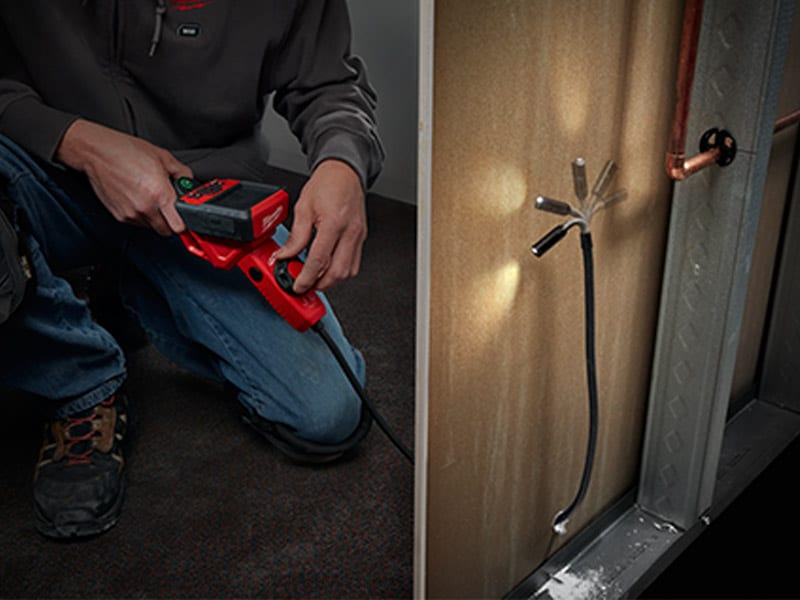
The M‑Spector Flex camera head captures images at a resolution of 640 by 480 pixels—VGA quality—which is the standard for professional inspection cameras in this class. The resolution is adequate for the intended applications: identifying pipes, wires, studs, and obstructions inside walls; inspecting the interior of conduits and ducts; examining the condition of structural members; locating the source of a leak; and documenting the state of an installation before it is closed up. The image sensor is paired with an LED lighting system that Milwaukee claims provides 15 times the illumination of competing cameras. While such claims are difficult to verify independently, the practical result is that the M‑Spector Flex produces a bright, clear image even in completely dark cavities, allowing the user to see details that would be lost in shadow with a less capable light. The brightness of the LED is adjustable via a dial on the handle, allowing it to be dimmed for close‑up work where full brightness would produce glare. The camera has a 4X digital zoom and a 90‑degree image rotation function, which allows the user to orient the image correctly regardless of how the camera head is positioned. These are useful features that make it easier to interpret what is being seen, particularly when the camera is at an awkward angle.
The Wireless Display: Detachable, Rechargeable, and Game‑Changing
The display console is a 3.5‑inch color LCD that is completely detachable from the handle. It communicates with the handle wirelessly, at a range of up to 15 feet, which means the user can set the display on a stable surface, on the floor, or on a ladder rung, and operate the camera without having to hold the display in one hand while manipulating the cable with the other. This is a significant ergonomic improvement that makes the inspection process less physically demanding and more efficient. The display can capture still images and record video with audio, storing the files on the included 8‑GB SD card. Files can be transferred to a computer via the SD card or via a micro‑USB connection on the console. The console and the handle are both powered by Milwaukee's M12 RedLithium battery system, which means they use the same batteries that power hundreds of other Milwaukee tools. The kit includes an M12 compact battery and a charger, and the system is compatible with all M12 batteries, including the high‑capacity extended‑run packs. The battery life is sufficient for a full day of intermittent inspection work, and the ability to swap in a fresh battery means the system is never out of commission while waiting for a recharge. The cables are available in two lengths: 3 feet and 9 feet. The 3‑foot cable is suitable for most residential and light commercial applications—inspecting wall cavities, ceilings, and small access points. The 9‑foot cable is for larger commercial and industrial applications—inspecting long conduit runs, large ducts, and deep wall cavities. The cables are detachable, so a user who owns the base system can purchase an additional cable of a different length without buying a second complete kit. The cable is water‑tight, which means it can be inserted into wet or damp environments without damaging the internal wiring or the camera head. The camera head itself has a diameter of just 12.5 millimeters—less than half an inch—and a length of 35 millimeters, which allows it to fit through very small openings.
Applications and the Professional Workflow
The M12 M‑Spector Flex is designed for the professional who needs to see inside spaces that are inaccessible, and who needs to document what they see. The electrician can use it to inspect the interior of a conduit before pulling wire, to verify that a wall cavity is clear of obstructions before installing a box, or to locate a buried junction box. The plumber can use it to inspect the inside of a drain line for blockages or damage. The HVAC technician can use it to check the condition of ductwork, to locate a damper that is stuck, or to inspect a heat exchanger for cracks. The remodeler can use it to see what is inside a wall before cutting into it. The ability to document inspections with still images and video is essential for the professional who needs to communicate findings to a client, a supervisor, or a subcontractor. A picture of a corroded pipe, a damaged stud, or a missing insulation bat is worth far more than a verbal description, and it provides a record that can be referenced later if questions arise. The Milwaukee M12 M‑Spector Flex is not an inexpensive tool—the PivotView model retails for $799—but for the professional who uses an inspection camera regularly, it is an investment that pays for itself in time saved, in more accurate diagnoses, and in the professional credibility that comes from being able to show a client exactly what is inside their wall.
Milwaukee M12 M‑Spector Flex System Specifications
| Specification | 2315‑21 (3 ft, No PivotView) | 2316‑21 (9 ft, No PivotView) | 2317‑21 (3 ft, PivotView) |
|---|---|---|---|
| Cable Length | 3 feet | 9 feet | 3 feet |
| PivotView (270°) | No | No | Yes |
| Camera Head Diameter | 12.5 mm (0.49″) | 12.5 mm (0.49″) | 12.5 mm (0.49″) |
| Camera Resolution | 640 × 480 (VGA) | 640 × 480 (VGA) | 640 × 480 (VGA) |
| Display | 3.5″ wireless LCD | 3.5″ wireless LCD | 3.5″ wireless LCD |
| Wireless Range | Up to 15 feet | Up to 15 feet | Up to 15 feet |
| Image/Video Capture | Yes (with audio) | Yes (with audio) | Yes (with audio) |
| Storage | 8 GB SD card, Micro‑USB | 8 GB SD card, Micro‑USB | 8 GB SD card, Micro‑USB |
| Battery Platform | M12 RedLithium | M12 RedLithium | M12 RedLithium |
| Warranty | 5 years | 5 years | 5 years |
| Price | $499 | $579 | $799 |
Conclusion: The Inspection Camera That Finally Works the Way It Should
The Milwaukee M12 M‑Spector Flex System with PivotView is the inspection camera that professionals who have used earlier generations of the technology have been waiting for. The PivotView camera head eliminates the most frustrating aspect of using an inspection camera—the difficulty of aiming the camera once it is inside a cavity. The improved image quality and lighting make it possible to see details that would be lost with a less capable camera. The wireless, detachable display frees the user from the awkwardness of holding both the handle and the screen simultaneously. The compatibility with the M12 battery platform means that users who already own Milwaukee cordless tools can share batteries and chargers, reducing the cost and the clutter of managing multiple battery systems. At $799 for the PivotView model, the M‑Spector Flex is a premium tool with a premium price, but it is a tool that justifies its cost through increased efficiency, improved diagnostic accuracy, and the professional credibility that comes from being able to show a client, clearly and unambiguously, what lies behind the wall.
Comments 0
Leave a Comment