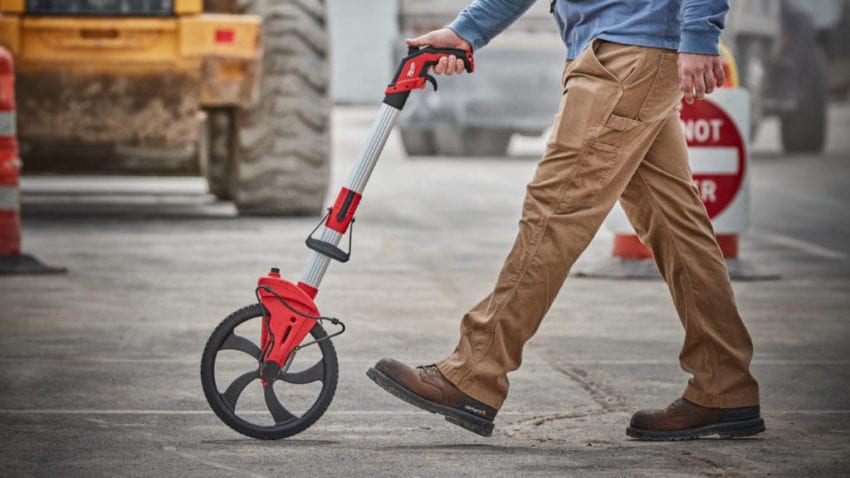
Milwaukee Tool looked at this cycle of break‑and‑replace and decided it was unacceptable. At their annual New Product Symposium, they introduced the Milwaukee Measuring Wheel, available in a 12‑inch diameter professional model and a 6‑inch compact model, and they invited attendees to try to break one. Someone grabbed the 12‑inch version by the handle and kicked into it with a sideways stomp that would have shattered an ankle had it landed on a person. The wheel didn’t bend. The frame didn’t crack. The locking pivot held. The wheel kept spinning true. That moment-a brutal, unscientific, deeply satisfying demonstration-encapsulated the philosophy behind the tool : Milwaukee was done with disposable measuring wheels. They were going to build one that could survive the jobsite, fold down for easy storage, and incorporate ergonomic innovations that actually make a measuring wheel pleasant to use, not just cheap to own. The result is a pair of measuring wheels that look and feel like they belong in the same product family as Milwaukee’s cordless power tools : reinforced aluminum frames, pistol‑grip handles borrowed from drill design, top‑side brake mechanisms, debris‑clearing flaps, and a clearing function that resets the measurement from the handle so you never have to bend over. Let’s roll through every detail, including the differences between the two models, the features that matter most when you’re walking a thousand‑foot lot line, and why these wheels might be the last trundle wheels you’ll ever need to buy.
The Two Models : 12‑Inch Heavy‑Duty Professional and 6‑Inch Ultra‑Portable Compact
Milwaukee launched two distinct measuring wheels under the same design language, and choosing between them comes down to how far you walk, how smooth your terrain is, and how small you need the folded package to be.
Milwaukee 12‑Inch Measuring Wheel (48‑22‑5012): This is the full‑size workhorse, built for estimators, grading contractors, concrete crews, and anyone who covers long distances over rough ground. The large diameter wheel rolls over gravel, rebar‑studded slabs, expansion joints, and uneven turf more easily than a smaller wheel because it bridges surface irregularities rather than dropping into them. It weighs 4 pounds, which is substantial enough to feel planted but not so heavy that you dread carrying it back to the truck. The maximum measurement length is 10,000 feet-nearly two miles-covering the largest commercial site, parking lot, or roadway layout in a single session without resetting. The frame is reinforced aluminum, the pivot points lock solidly in both the open and folded positions, and it includes features not found on the 6‑inch model : a top‑side clearing function that resets the counter to zero without bending over, a kickstand that keeps the wheel upright when parked, a debris‑cleaning wheel flap that sweeps dirt and mud off the wheel as it rotates, and an integrated carrying handle for one‑handed transport.
Milwaukee 6‑Inch Measuring Wheel (48‑22‑5006): The compact version scales down the weight to 2.4 pounds and folds into a package just 18 inches long, making it the obvious choice for contractors who work out of smaller vehicles, for interior measurements in warehouses and big‑box retail spaces, or for tradespeople who only occasionally need a trundle wheel and can’t justify the storage footprint of a full‑size model. The maximum measurement length is still an impressive 10,000 feet-same as the 12‑inch-so you’re not sacrificing range, just wheel diameter and the clearing function. The 6‑inch wheel shares the aluminum frame, locking pivot points, pistol‑grip handle, and top brake, but dispenses with the kickstand, the debris flap, and the top‑side clearing function to hit its compact form factor.
Both models are available now at Acme Tools and other Milwaukee retailers. Pricing, at the time of launch, positions these wheels at a premium over the typical $20–$30 throwaway wheels, but well below the cost of high‑end surveyor‑grade instruments. You are paying for durability and ergonomics, not for a brand sticker.
Build Quality : Reinforced Aluminum, Locking Pivots, and Nothing That Feels Cheap
The first thing you notice when you pick up a Milwaukee Measuring Wheel is that nothing rattles. The frame is extruded and welded aluminum, not the thin‑gauge steel tubing that bends the first time someone leans on it. The pivot mechanism-the hinge point where the handle meets the wheel frame-is a heavy‑duty locking joint that engages with a solid, satisfying clunk. When locked open for use, the handle feels like a rigid extension of the frame, not a wobbly afterthought. When locked closed for storage, the assembly stays put and doesn’t flop open in transit. This is the critical joint where most measuring wheels fail; Milwaukee engineered it with the same over‑built sensibility they apply to their power tool handles.
The wheel itself is a high‑impact polymer with a textured tread that maintains traction on grass, gravel, asphalt, and unfinished concrete. The tread pattern is designed not to pick up mud like a knobbie tire, reducing the amount of cleaning you need to do between measurements. On the 12‑inch model, the debris‑cleaning flap acts as a constant wiper, scraping off any dirt, pebbles, or wet leaves that adhere to the wheel surface. This is important because a dirty wheel effectively changes diameter, introducing measurement error over long distances. The flap keeps the wheel circumference consistent, which keeps the counter accurate.
The counter itself is a mechanical unit, not a battery‑dependent digital display that will die in the rain or freeze on a cold morning. It reads in feet and inches (or meters, depending on the model variant), with large, legible numerals that you can read without squinting. Mechanical counters are inherently more reliable than digital ones for outdoor work; they don’t care about moisture, temperature swings, or the low battery warning that always appears at the most inconvenient moment. The counter advances smoothly as the wheel rotates, and the reading is steady even when walking at a brisk pace.
Pistol‑Grip Handle and Top Brake : Ergonomics Borrowed from Power Tools
Traditional measuring wheels feature a straight, horizontal handle-essentially a bicycle grip mounted perpendicular to the push frame. This design works, but it forces your wrist into an unnatural angle, especially if you’re taller or shorter than the “average” user for whom the handle height was designed. Over a thousand‑foot walk, that wrist strain becomes a nagging discomfort. Milwaukee’s engineering team looked at their cordless drill handles-the iconic pistol grip that fills the palm and aligns the arm in a natural punching motion-and adapted it to a measuring wheel. The pistol‑grip handle on both Milwaukee models is angled and contoured to fit the hand, with a soft overmold that provides a secure grip even when your palms are sweaty or gloved.
The second ergonomic breakthrough is the top brake. On most wheels, you stop the measurement by stopping the wheel, then you bend over to read the counter, and if you want to lock it, you fiddle with a small lever near the hub. Milwaukee relocated the brake to the top of the handle, right under your thumb. At the end of a measurement run, you press the brake with your thumb, the wheel stops, and the reading is locked. You can lift the wheel off the ground, walk over to whatever you need to measure against, and read the counter at your leisure without the number shifting. On the 12‑inch model, the top handle also incorporates a clearing function : a separate button that resets the counter to zero without requiring you to reach down to the hub. This is huge for fatigue reduction. If you’re taking multiple measurements per day-say, measuring out parking stall widths, curb lengths, and planting bed perimeters-you save dozens of bends, and your lower back will thank you.
The Kickstand, Carrying Handle, and Debris Flap : The 12‑Inch Model’s Field‑Tested Upgrades
The 12‑inch Milwaukee Measuring Wheel is the model that will see the most action on heavy construction sites, and Milwaukee gave it three additional features that address real‑world usage.
Kickstand: A fold‑out metal arm at the base of the frame lets the wheel stand upright on its own. When you’re setting up to begin a measurement, or you pause to write down a number, you don’t have to lay the wheel on its side in the mud or lean it against a wall that might be 50 feet away. Just kick the stand into position and it’s stable. It’s a small convenience that becomes surprisingly gratifying when you’re on a muddy site with nowhere clean to set a tool down.
Carrying Handle: A dedicated handle on the top of the frame, separate from the measuring handle, allows you to carry the folded wheel with one hand, like a briefcase. This makes loading and unloading from a truck bed or climbing stairs far easier than bear‑hugging the folded assembly.
Debris‑Cleaning Wheel Flap: As mentioned, this simple rubber wiper rides against the wheel surface and constantly sheds dirt, mud, and debris. It’s the difference between a wheel whose effective diameter changes as it collects mud and a wheel that stays consistent all day. Long‑term, it also protects the counter mechanism from grit intrusion.
Folding and Storage : The 6‑Inch Wheel Fits Where the 12‑Inch Won’t
Both Milwaukee measuring wheels fold at the pivot point and lock in the closed position. The 12‑inch wheel remains a sizeable package when folded-not unwieldy, but it occupies a certain footprint in a truck bed or gang box. The 6‑inch wheel was designed explicitly for those who need a trundle wheel but lack the storage space for a full‑size model. When folded, it shrinks to just 18 inches in length, which is short enough to fit behind a truck seat, in a large tool bag, or on a shelf in a service van. At 2.4 pounds, it’s light enough to grab and carry without a dedicated handle, though the lack of a carrying handle on the compact model is a minor tradeoff. For electricians estimating conduit runs, low‑voltage installers measuring cable paths, or facility managers checking room dimensions, the 6‑inch wheel offers portability that the 12‑inch can’t match.
Accuracy and Measurable Range : 10,000 Feet Without Resetting
Both models boast a 10,000‑foot maximum measurement before the counter rolls over or resets. That’s nearly two miles, which exceeds the perimeter of most commercial building lots, the length of a large airport runway, or the distance of a long driveway and access road combined-all within a single measurement session. The mechanical counter increments accurately as long as the wheel is properly calibrated, and Milwaukee’s debris flap and tread design help maintain calibration by keeping the wheel circumference constant. For estimating earthwork, paving, fencing, or irrigation pipe quantities, this range allows you to walk an entire property line without stopping to reset the counter, a significant time‑saver on large acreage. The wheels read in feet and inches, which aligns with U.S. trade practice, though metric models may also be available through international distributors. The counter’s large numerals are readable without glasses for most eyes, and the window is shielded from direct sun glare by a slight hood.
Comparison : Milwaukee Measuring Wheels vs. The Disposable Competition
The typical contractor‑grade measuring wheel sold at home centers and tool retailers for $20–$35 is built to a price point, not a performance standard. The frames are thin‑walled steel that dents and bends when the wheel is dropped or run into a curb. The folding pivots are simple bolts that loosen over time, introducing slop that makes the handle feel disconnected from the wheel. The counters are plastic‑geared mechanisms that jam when dirt gets inside, and some lack any sealing at all. The grips are cylindrical black foam that disintegrates after a season of sun exposure. These wheels are consumable-fine for a one‑off use or a homeowner project, but not tools you can rely on for daily professional estimating.
At the other extreme, professional surveyor‑grade wheels from brands like Rolatape and DuraWheel can cost $100–$200 and offer excellent durability and accuracy, but they often lack the ergonomic innovations Milwaukee brings : the pistol grip, the top brake and clearing function, the debris flap, and the integrated kickstand. They’re tough, but they feel like old‑school equipment. Milwaukee is attempting to occupy the middle ground-a wheel that’s built like a surveyor’s tool but priced and designed for the heavy‑use construction contractor. They’re positioning the measuring wheel as an extension of their hand tool lineup, with the same “Nothing But Heavy Duty” branding that signifies durability.
Milwaukee Measuring Wheel Specifications at a Glance
| Specification | 12‑Inch Model (48‑22‑5012) | 6‑Inch Model (48‑22‑5006) |
|---|---|---|
| Wheel Diameter | 12 inches | 6 inches |
| Weight | 4 pounds | 2.4 pounds |
| Max Measurement | 10,000 feet | 10,000 feet |
| Frame Material | Reinforced aluminum | Reinforced aluminum |
| Pivot Locking | Locking pivot points (open & folded) | Locking pivot points (open & folded) |
| Handle Type | Pistol grip with soft overmold | Pistol grip with soft overmold |
| Top Brake | Yes | Yes |
| Top Clearing Function | Yes (resets counter from handle) | No (manual reset at counter) |
| Kickstand | Yes | No |
| Debris‑Cleaning Flap | Yes | No |
| Carrying Handle | Yes | No |
| Folded Size | ~30 inches (approx.) | 18 inches |
| Counter Type | Mechanical, feet/inches | Mechanical, feet/inches |
| Buy At | Acme Tools and Milwaukee retailers | Acme Tools and Milwaukee retailers |
Key Features Summary
- Heavy‑duty aluminum frame: Resists bending, denting, and the kind of abuse that destroys budget wheels.
- Locking pivot joints: Provide rigid handle feel when in use and secure folding for storage.
- Pistol‑grip handle: Ergonomic design reduces wrist strain; mimics the grip of a cordless drill.
- Top brake (both models): Locks the measurement from the handle, preventing accidental movement.
- Top clearing function (12‑inch only): Resets counter to zero without bending over, saving your back.
- 10,000‑foot maximum measurement: Handles the largest commercial sites in a single session.
- Debris‑cleaning wheel flap (12‑inch only): Keeps wheel circumference consistent and counter accurate.
- Kickstand (12‑inch only): Allows the wheel to stand upright on its own when parked.
- Carrying handle (12‑inch only): Facilitates one‑handed transport of the folded wheel.
- 6‑inch model folds to 18 inches: Ultra‑portable; fits behind seats, in tool bags, and in tight storage spaces.
- Mechanical counter: No batteries, no weather sensitivity, always ready to work.
Who This Wheel Is For-and Who Should Stick With a Cheap One
The Milwaukee Measuring Wheel makes the most sense for professionals who use a wheel frequently and have grown tired of replacing it. If you’re a general contractor who estimates half a dozen jobs per month, a concrete flatwork foreman who measures slab perimeters daily, a landscaping designer who walks large residential properties, a fencing contractor quoting miles of perimeter, or a site superintendent who needs reliable layout tools that can sit in the weather and still work, the investment will pay for itself within a year of not buying replacements. The ergonomic features-especially the top brake and the clearing function on the 12‑inch-will also save measurable time and physical strain over the long haul.
If you’re a homeowner who needs to measure the backyard once for a sprinkler system, a $25 throwaway wheel is probably the smarter financial choice. The Milwaukee would work beautifully, but it’s over‑engineered for a single project. Similarly, if you work exclusively indoors in clean, dry conditions and rarely cover more than a few hundred feet at a time, the extra durability and the top‑side features may not be necessary, though the 6‑inch’s compact folded size could still be attractive.
The Bottom Line : Finally, a Measuring Wheel That’s Not a Consumable
The Milwaukee Measuring Wheel series fills a gap in the layout tool market that most of us had accepted as permanent : the gap between the disposable $25 wheel that breaks when you look at it and the professional surveyor’s wheel that costs $150 and feels like a museum piece. Milwaukee brought their heavy‑duty DNA to a category that desperately needed it. The reinforced aluminum frame, locking pivots, and pistol‑grip handle make these wheels feel like legitimate professional tools, not an afterthought. The top brake on both models, and the clearing function, kickstand, debris flap, and carrying handle on the 12‑inch, show that the engineering team actually spent time walking with a trundle wheel and noted every moment of frustration.
The symposium kick test may have been a spectacle, but it proved the point : these wheels can take lateral force that would snap a cheaper frame, and they keep rolling. If you’re tired of adding measuring wheels to the recycling pile every few months, the Milwaukee 12‑inch or 6‑inch is worth the step up in price. It’s the difference between a tool you use and a tool you rely on. And in an industry where a mis‑measurement can cost thousands in material and rework, relying on your layout tools isn’t a luxury-it’s a necessity.
Comments 0
Leave a Comment