Milwaukee Tool, fresh off launching the RedStick box level line with its all-metal Backbone and Sharpsite vials, clearly recognized that protecting that investment requires more than just careful handling. The answer comes in the form of the Milwaukee RedStick Level Case, available in two sizes - a 48-inch and a 78-inch - that transform how you transport, store, and defend your RedStick levels. These aren't flimsy nylon sleeves with a drawstring. They are purpose-built storage solutions constructed from heavy-duty, water-resistant 1680D nylon, reinforced with all-metal hardware, and lined with padding that cushions against the drops, knocks, and abrasion that define daily life on a construction site. With integrated tool loops, multiple padded compartments, debris-draining vents, and dual carry handles that moonlight as hanging hooks, the RedStick Level Case makes a compelling argument that a $59 or $79 case is cheap insurance for a level that can cost four times that amount.
We got our hands on the 48-inch Milwaukee RedStick Level Case. Here's everything you need to know about how Milwaukee is making a case - literally - for protecting your levels.
Why Your Level Deserves a Case : The Hidden Cost of a Bent Frame and a Shattered Vial
Before we unzip the case, let's talk economics. A Milwaukee RedStick 48-inch magnetic box level costs $139. The 78-inch magnetic version runs $229. Even the non-magnetic compact models aren't pocket change. These are precision instruments that leave the factory calibrated to within thousandths of an inch, and they rely on a perfectly straight frame to maintain that accuracy. When a level rides loose in a truck bed, gets wedged between a compressor and a stack of lumber, or takes a spill off a scaffold, two things happen. First, the frame absorbs impact that can microscopically - or visibly - bow the aluminum. Second, the vials, even if acrylic and shock-resistant, face concentrated stress that can eventually break the seal or shift them out of alignment.
A dedicated level case doesn't make the level invincible. What it does is absorb and distribute the everyday abuse that accumulates into a compromised tool. Padding cushions drops. A snug fit prevents the level from sliding around and banging against other tools. A water-resistant shell keeps rain, concrete slurry, and jobsite grime off the vials and the frame. And the organizational structure - separate compartments for a torpedo and a shorter box level - means you can store your entire level kit in one grab-and-go bag, eliminating the scramble to find all the pieces scattered across the gang box.
Maybe the strongest argument is simply this : the moment you've invested $200 in a level, the incremental cost of a $59 case is less than a single hour of billable time for most Pros. If that case prevents one bent frame or one smashed vial over the life of the level, it has paid for itself several times over.
Two Cases, One Mission : The 48-Inch and 78-Inch RedStick Level Bags
Milwaukee keeps the product line refreshingly simple. You can buy the RedStick Level Case in a 48-inch length (model MLSB48) for $59, or step up to the 78-inch version (model MLSB78) for $79. The fundamental design is identical : heavy-duty nylon, metal zipper, padded compartments, carrying handles, shoulder strap, debris vents, and external tool loops. The difference - aside from the extra 30 inches of length - is that the 78-inch case features an additional external pocket specifically designed to accommodate a 78-inch box level. This extra pocket lets the large case swallow a truly big level while still leaving room for shorter companions inside the main compartment.
For the majority of professional carpenters and cabinet installers, the 48-inch case covers the most-used sizes : a 48-inch box level for door frames and base cabinets, a 24-inch level for window stools and tight spaces, and a block torpedo level for quick checks. The 78-inch case adds the capability to carry a full-length level for framing, grading, or long wall layout, which makes it the natural choice for framers, concrete crews, and general contractors who need the reach.
Cut and Construction : 1680D Nylon, Metal Hardware, and Water-Resistant Peace of Mind
The fabric story matters because a level case spends its life getting dragged across truck beds, scraped against scaffold frames, and set down on wet concrete. Milwaukee chose a combination of 600D and 1680D nylon for the RedStick case - 1680D being the heavier, more abrasion-resistant material used in high-wear areas. Run your thumb across the shell and it feels substantial, not like the thin polyester you'd find on a promotional giveaway bag. It resists tearing, shrugs off sparks and sharp splinters, and can handle being tossed around without developing holes after a month.
Water resistance is the other half of the protection equation. The nylon shell won't soak through in a light rain, and the self-healing zipper tape (Milwaukee doesn't specify, but the feel suggests a robust, coated zipper) keeps moisture from seeping through the closure. This matters because a level stored damp can develop corrosion on the aluminum frame over time, and moisture inside a vial housing can fog the bubble, making it unreadable. The RedStick case does not make the level waterproof - submerge it and water will find a way in - but it will shrug off a downpour, a puddle splash, or a spilled water bottle without transmitting moisture to the tools inside.
All hardware - the zipper, the D-rings, the strap hooks - is metal, not plastic. This is a hallmark of a case built for professional use. Plastic zippers fail catastrophically when overstuffed or caught on a sharp corner; metal teeth may protest but they almost never shear off. The zipper glide moves smoothly from end to end, even when the case is fully loaded, and the pulls are large enough to grab with gloved hands.
Inside the Pockets : What Each Case Holds and How It Stays Organized
Open the main compartment of the 48-inch RedStick case and you're greeted by a padded, quilted interior divided into three distinct pockets. The largest slot runs the full 48-inch length of the case and can accept a 48-inch box beam level. Next to it, a shorter pocket is sized for a 24-inch box level or a compact box level - the kind you'd use for cabinet jambs and tight layout. And finally, a small, dedicated pocket holds a block or billet torpedo level, keeping it from rattling around loose.
Each pocket is separated by padded dividers that prevent the tools from rubbing against one another during transport. The padding isn't rigid - this is a soft case, not a hard case - but it's thick enough to absorb the shock of a drop from waist height or the vibration of a truck bed. Within each compartment, adjustable hook-and-loop straps cinch the level in place, so it doesn't slide up and down inside the pocket as the case is carried vertically or thrown into a pile of gear. The fit is snug without being so tight that you're wrestling your level out.
The 78-inch case adds the aforementioned external pocket that runs a good portion of the case's length, giving the 78-inch level its own padded home without forcing you to remove the other tools to access it. In both cases, the layout encourages a complete level kit : the long level for big spans, the short level for quick checks, and the torpedo for rough-in work - all in one bag, ready to grab and go.
External Storage : Tool Loops and the Extra Pocket for the 78-Inch Specialty
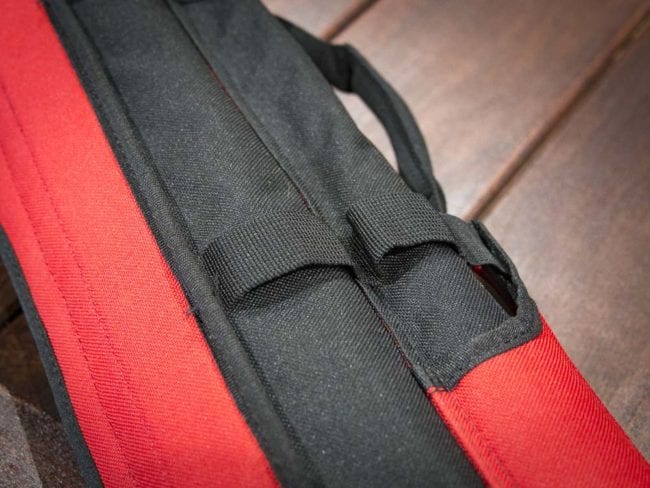
On the outside of the case, Milwaukee added integrated tool loops - sturdy fabric channels sewn onto the shell - where you can clip a tape measure, a carpenter's pencil, a marker, or even a small flashlight. These loops transform the case from a simple level carrier into a mobile layout station. You can hang the case on a ladder, unzip it, and have your levels, your marking tools, and your layout accessories all within arm's reach. It's a small touch, but one that reduces trips back to the tool bag and keeps the workflow fluid.
The 78-inch case goes a step further with its dedicated external pocket designed specifically for the 78-inch level. This pocket rides on the outside, meaning you can slide the long level in and out without disturbing the interior compartments. If you're on a framing crew and you only need the 78-inch for general layout but still want your torpedo and 24-inch nearby, the external access is a genuine convenience.
Carry Options : Dual Handles, Shoulder Strap, and Hang-It-Up Versatility
Moving a 48-inch or 78-inch case around the jobsite could be awkward, but Milwaukee gave the RedStick case two integrated carry handles that double as hanging handles. The handles are positioned to balance the load, so you can carry the case horizontally like a briefcase or vertically like a duffel. When you arrive at the work area, you can hang the case from a ladder rung, a scaffold rail, or a nail driven into a stud, using either handle, and work directly out of it.
A detachable, adjustable shoulder strap also comes included. Throw the strap over your shoulder and you're hands-free climbing stairs or carrying a bundle of material. The strap clips onto metal D-rings that feel firmly anchored and don't twist under load. For a long case, the shoulder strap option can be much less fatiguing than a one-handed carry, especially if you're walking a hundred yards from the parking area.
Debris Vents : A Small Feature That Prevents a Grimy, Wet Level
Construction sites are filthy. Even a careful Pro ends up with sawdust, drywall powder, concrete dust, and the occasional splash of wet thinset on their tools. Most tool cases trap that debris, collecting a nasty slurry in the bottom that eventually corrodes metal and clouds vials. The RedStick cases include two debris vents at the bottom - essentially mesh-covered drain holes that allow loose dirt and water to escape rather than accumulate. If you rinse off a muddy level, let it drip inside the case, and the vents will let the water run out. If you toss the case in the truck bed and a rain shower blows through, the vents help the interior dry faster. It's a detail that costs almost nothing to include but speaks volumes about Milwaukee's understanding of how tools are actually used.
Hardware and Zipper : All-Metal Durability Where It Counts
I've touched on the metal zipper and hardware already, but it's worth dedicating a few sentences to why this matters on a level case. Soft tool bags with plastic zippers are notorious for failing at the most inconvenient moment. The zipper teeth strip, the slider cracks, and suddenly your bag won't close. On a dusty jobsite, dust and grit accelerate that failure by grinding into the teeth. Metal zippers, by contrast, have a self-cleaning action - grit gets pushed out as the teeth mesh - and they withstand far more opening and closing cycles.
The D-rings for the shoulder strap are also metal, not plastic buckles that snap when the case gets snagged on a protruding nail. The hook-and-loop straps inside are robust and show no signs of fraying after repeated use. Throughout the case, Milwaukee specified components that are appropriate for a tool designed to be tossed into truck beds, dragged across subfloors, and hung from ladders in all weather. There's no hint of cost-cutting in the materials.
The Complete Packages : Starter Set and Master Set Bundles That Save You Money
Milwaukee recognizes that many Pros shopping for a level case are also in the market for - or could be convinced to upgrade to - the RedStick levels themselves. To that end, they offer two compelling bundles that package the case with a curated set of levels at a discount compared to buying each component separately.
Non-Magnetic RedStick Starter Set (MLBXC48): This kit centers on the 48-inch case and includes a 48-inch box level (non-magnetic, MLBX48), a 24-inch box level (non-magnetic, MLBX24), and a block torpedo level. All of this tucks into the case's three pockets, and you're ready to tackle trim, cabinet, and layout work. The MSRP is $169 - if you add up the individual prices, you're getting the case for a fraction of its standalone cost.
Magnetic RedStick Master Set (MLBXCM78): This is the no-compromise kit for the Pro who works with metal studs, steel beams, and conduit. It includes the 78-inch case, a 78-inch magnetic box level (MLBXM78), a 48-inch magnetic box level (MLBXM48), a 24-inch magnetic box level (MLBXM24), and a block torpedo level. MSRP is $299. Considering that the 78-inch magnetic level alone retails for $229, the rest of the kit - the case, the 48-inch, the 24-inch, and the torpedo - is essentially added for a song.
For anyone who hasn't yet entered the premium level market, these bundles offer a turn-key entry point. You don't just get a case to protect a level you don't own; you get the full RedStick system, from the 78-inch long-reach workhorse down to the pocket torpedo, all housed and ready to go.
Specifications at a Glance
| Feature | 48-Inch Case (MLSB48) | 78-Inch Case (MLSB78) |
|---|---|---|
| Length | 48 inches | 78 inches |
| Material | 600D / 1680D Nylon | 600D / 1680D Nylon |
| Hardware | All-metal (zipper, D-rings, strap hooks) | All-metal (zipper, D-rings, strap hooks) |
| Main Compartments | 3 padded pockets (up to 48″ box, 24″ box, torpedo) | 3 padded interior pockets + external 78″ pocket |
| External Storage | Integrated tool loops | Integrated tool loops + external level pocket |
| Carrying Options | Dual carry/hanging handles, removable shoulder strap | Dual carry/hanging handles, removable shoulder strap |
| Debris Vents | Yes (2 bottom vents) | Yes (2 bottom vents) |
| Closure | Robust metal zipper | Robust metal zipper |
| MSRP (Case Only) | $59.00 | $79.00 |
| Starter Set (MLBXC48) | Case + non-magnetic 48″, 24″, torpedo – $169 | N/A |
| Master Set (MLBXCM78) | N/A | Case + magnetic 78″, 48″, 24″, torpedo – $299 |
48-Inch vs 78-Inch : Choosing the Right Case for Your Kit
If your daily workflow revolves around finish carpentry, cabinet installation, or interior trim, the 48-inch case is almost certainly the right choice. It carries the two lengths you'll reach for most - a 48-inch for base cabinets, door jambs, and countertop checks, and a 24-inch for window stools, filler strips, and tight spots - plus a torpedo for rough-in verification. It's compact enough to hang on a ladder without swinging in the wind, and it fits easily behind a truck seat or in a gang box.
Framers, concrete form setters, and general contractors who regularly use a 78-inch or 96-inch level (though the case cap is 78 inches for the longest dedicated level pocket) will gravitate toward the 78-inch case. Even if your primary level is a 72-inch or 78-inch, the external pocket makes access a breeze. You can leave the 78-inch in its pocket, pull the 48-inch and torpedo from the main compartment, and you've got a complete spread of lengths for almost any situation. The $20 price premium over the 48-inch case is negligible relative to the convenience of protecting a $200-plus level.
Is a Soft Case Enough? What the RedStick Level Case Protects Against - and What It Doesn't
Let's be clear about what a soft case cannot do. It will not protect a level from being run over by a skid steer. It will not stop a framing hammer dropped from 10 feet from shattering a vial if it strikes directly on the vial location. It does not include any rigid structural support - no internal frame, no hard shell - so it will not prevent a level from bending if something heavy is placed across the case and left there for a week. If you need that level of protection, you're looking at a hard case, and those are significantly more expensive and bulkier.
What the RedStick case does exceptionally well is protect against the routine, daily threats that quietly degrade a level's accuracy and lifespan. The padding absorbs shocks from drops onto packed dirt or subfloor. The snug fit prevents the level from sliding around and rubbing against abrasive surfaces. The water-resistant nylon keeps out rain, splashes, and humidity. The debris vents stop dirt from accumulating. The organization keeps your torpedo and short level from banging into your long level. For the vast majority of Pros, these are the threats their levels actually face - not catastrophic crush events, but the slow erosion of precision through a thousand minor impacts and exposure to grit and moisture.
A soft case also serves one more critical function : it signals to everyone on the crew that what's inside is valuable and should be treated with respect. A bare level leaning in the corner of the gang box invites someone to grab it as a straightedge for cutting drywall or as a leverage bar for prying something loose. That same level zipped inside a dedicated, padded case stops being an opportunistic tool and becomes a protected instrument. The case changes behavior, and that alone can extend the level's life.
Value Analysis : $59 or $79 as Insurance for Levels That Cost Twice to Six Times as Much
Run the numbers for a typical Pro who's invested in the RedStick system. Two 48-inch magnetic box levels, a 24-inch magnetic, and a torpedo could easily total $350 or more. A 78-inch magnetic level alone is $229. Now, ask yourself : if you spend $59 on a case, and that case prevents you from having to replace even one of those levels over a five-year period, have you saved money? Absolutely. If it prevents you from showing up to a job, pulling out your 48-inch, and discovering it's now reading an eighth off because it got bent in transit, have you saved your reputation? Unquestionably.
The pricier question isn't whether you should buy a case; it's whether you should buy the case now versus waiting. Given that the RedStick cases are built from the same heavy-duty nylon as Milwaukee's best tool bags, and they come with all-metal hardware and a design that's clearly informed by professional feedback, the $59 and $79 price points feel like fair value - not a discount, but not an overcharge. The bundles sweeten the deal considerably. If you're in the market for both a new level and a storage solution, the Starter Set at $169 essentially gives you the case for free once you account for the cost of the levels included. The Master Set at $299 does the same for the magnetic lineup, and at that price you're saving at least $100 compared to buying each piece individually.
Final Thoughts : The Missing Piece in a Pro's Level Investment
Milwaukee didn't set out to reinvent the tool case with the RedStick Level Case. Instead, they took a known formula - the padded, compartmentalized carry bag - and executed it to the same standard they apply to their power tool cases : tough nylon, metal hardware, thoughtful organization, and features that make daily life easier. The debris vents, the external tool loops, the dual hang-and-carry handles, and the option to bundle with the RedStick level you're already considering all point to a product team that understands that a level case isn't just about transport; it's about readiness, efficiency, and preserving accuracy over the long haul.
If you've already invested in Milwaukee RedStick levels, or if you've got a set of premium Stabila, Empire, or Sola levels that you want to protect, the RedStick case warrants a close look. It won't make your level unbreakable, but it will dramatically reduce the odds that a trip to the jobsite turns into a trip to the tool store for a replacement. In an industry where time is money and accuracy is your reputation, $59 or $79 is a small price to pay for the confidence that your level is as true at the end of the job as it was at the beginning.
The Milwaukee RedStick Level Case is available now at authorized Milwaukee retailers and through online suppliers. If you're picking up a RedStick level, adding the case - or better yet, opting for the starter or master set - is the easiest way to ensure your precision instrument stays precise for years to come.
Comments 0
Leave a Comment