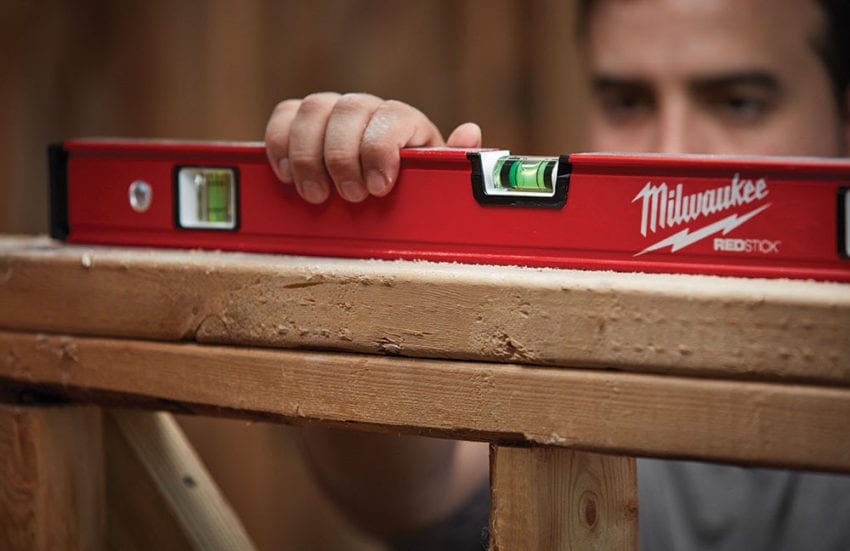
The answer is the new Milwaukee Redstick level line, a full‑scale assault on the two chronic weaknesses of jobsite levels : durability and visibility. Milwaukee is entering the premium level category - a space dominated by names like Stabila, Sola, and its own sister brand Empire - with a pair of innovations that are genuinely new to the industry. The Redstick box levels feature an all‑metal Backbone, a structural spine that reinforces the frame against bending and protects the vial mounting. They pair that with the Sharpsite Vial, a new optical system that uses black contrast bands and a magnified bubble to make the reading snap into focus, even in the miserable light of a crawlspace. Add rare‑earth magnets on the magnetic models, a limited lifetime warranty that includes a lifetime accuracy guarantee, and a model lineup that stretches from a pocketable 16‑inch all the way to a 96‑inch giant, and you’re looking at a level series that intends to reset the standard for what a professional can expect from a tool they use a hundred times a day.
Let’s break down exactly what Milwaukee built, why it matters, and whether the Redstick deserves a spot on your tool truck - because at prices that climb to $279 for a 96‑inch magnetic, this isn’t an impulse buy. This is a statement.
The Two Enemies of Every Level : Durability and Visibility - And How Milwaukee Attacked Both
Ask any experienced carpenter, concrete finisher, or ironworker what they hate most about their levels, and the answers cluster around two themes. First, levels break. The frame bends when you accidentally step on it, or it twists when it’s jammed in a gang box, and suddenly that 78‑inch level reads “close enough” instead of “dead on.” Vials crack or come loose, especially around the end caps, where impact is most concentrated. Second, even when the level is intact, it’s hard to read. Traditional bubble vials with green or yellow liquid and faint black lines require good light and a direct line of sight. On a gray morning, under an eave, or inside a cabinet box, your eyes strain to determine whether the bubble is actually centered or just sort‑of centered.
Milwaukee’s engineering team identified these two pain points early in the Redstick development process and made them the twin pillars of the design. The all‑metal Backbone addresses the durability concern at a structural level. The Sharpsite Vial tackles visibility with a physics‑based optical design. Together, they form a level that Milwaukee claims will outlast and outperform anything currently hanging on a pro’s rack.
The All‑Metal Backbone : A New Idea in Level Construction That Ought to Have Existed Decades Ago
Traditional box beam levels, even premium ones, rely on the extruded aluminum frame itself to resist bending. The frame is a hollow rectangle, strong in the direction of its wider axis but vulnerable to twisting and denting if knocked against a corner or dropped on its edge. When a box beam level bows - and they all eventually do, after enough jobsite abuse - every reading from that level becomes suspect. The deformation might be invisible to the naked eye, but a few thousandths of an inch of curve over 6 feet translates to a gap that catches a cabinet installer’s attention.
Milwaukee’s solution is the Redstick Backbone - an internal, all‑metal reinforcement that runs the length of the level, acting like a keel on a ship. This Backbone stiffens the entire frame against both bending and torsional stress. The result is a level that resists the kind of slow, cumulative warping that kills accuracy over time. The Backbone also creates a protected, isolated mounting platform for the vials. In a conventional level, the vial block is glued or screwed directly to the frame; if the frame takes a hit and flexes, that stress can transfer to the vial, cracking the seal or shifting it out of calibration. The Redstick’s Backbone absorbs and distributes impact energy before it reaches the vials, preserving the factory‑set accuracy for the life of the tool.
It’s one of those “why didn’t anyone do this before?” innovations. The concept - reinforcing a level with a steel or reinforced spine - is so logical that it highlights how entrenched the level industry has been in incremental improvements rather than structural rethinks. By integrating the Backbone, Milwaukee isn’t just adding a feature; it’s answering the primary failure mode of box beam levels and, in doing so, justifying the Redstick’s premium price positioning.
Sharpsite Vial Technology : Black Bands, Yellow Fluid, and a Magnified Bubble That Cuts Through Dim Light
Visibility was the second obsession. Milwaukee’s engineers studied how the human eye perceives a bubble inside a vial and identified two ways to make centering instantly recognizable. The first is contrast. The Sharpsite Vial uses bold black bands - not the typical thin black or green rings - that frame the bubble when it’s centered. These black bands create a dramatic silhouette effect against the bright yellow liquid. Your eye doesn’t have to hunt for the bubble edges; the bubble itself breaks the dark band, and the visual pop is immediate. Even in low light, even from an oblique angle, the contrast remains high because the black‑and‑yellow color scheme registers strongly in the human visual system.
The second enhancement is a magnified bubble. The vial is shaped to act as a lens, enlarging the apparent size of the air bubble. A larger‑appearing bubble is simply easier to align between the reference marks. Coupled with the high‑contrast background, the Sharpsite vial reduces the cognitive load of checking for level. Instead of squinting and mentally calculating whether there’s equal space on both sides, you see a crisp, magnified bubble bracketed by two dark bands, and you know. That speed gain adds up across a day of checking hundreds of layout marks.
The vial material is acrylic - a deliberate choice. Acrylic vials, as seen on sister brand Empire’s True Blue line, resist shattering and scratching better than glass. They can take a knock that would send a glass vial to the trash. Milwaukee backs this up with a lifetime accuracy guarantee : if the Sharpsite vial ever goes out of calibration from normal use, the level gets replaced. That’s a promise that only makes economic sense if the engineering team is confident the vials aren’t going anywhere.
Rare‑Earth Magnets : When You Need the Level to Grip Like It’s Bolted There
Magnetic levels have become standard on job sites, but magnet quality varies dramatically. Cheap ceramic magnets hold weakly, sliding off the metal stud at the slightest bump. The Redstick magnetic models use rare‑earth magnets - the same class of super‑strong permanent magnets found in high‑end cordless drill bit holders and phone mounts. These magnets grip ferrous metal with authority. You can slap a Redstick magnetic level onto a steel I‑beam, a metal door frame, or a galvanized pipe, and it will stay put while you mark, scribe, and walk away to grab a fastener. The holding force is strong enough that you can work hands‑free around the level without it drifting.
The magnets are integrated into the frame in a way that doesn’t compromise the level’s flatness or the Backbone’s structural role. They’re positioned where they provide the most stability - typically near the center and ends - so the level sits flush against the ferrous surface. For welders, ironworkers, metal stud framers, and HVAC duct installers, a magnetic Redstick could replace not just a level but also a third hand.
The Full Model Lineup : From a Pocket‑Friendly 16‑Inch to a Wall‑Spanning 96‑Inch Heavyweight
Milwaukee didn’t dip a toe into the level market with one or two sizes; they cannonballed in with a comprehensive lineup that covers virtually every application a tradesperson might encounter. Redstick levels are organized into three families : non‑magnetic box levels, magnetic box levels, and compact levels. Within each family, you’ll find lengths from 16 inches to 96 inches, plus curated sets that bundle the most popular pairings - like the 24‑inch and 48‑inch combo, and the jamb set that pairs a 78‑inch with a 32‑inch.
Below is the complete model roster with pricing, correct at the time of writing. The range reveals a clear strategy : Milwaukee is selling Redstick as a system, not a single item. Once you start with one and trust it, the logic of adding the next length in the same series - with the same Sharpsite vials and Backbone construction - becomes compelling.
Non‑Magnetic Redstick Box Levels
| Model Number | Length | Price |
|---|---|---|
| MLBX16 | 16 inches | $59.99 |
| MLBX24 | 24 inches | $79.99 |
| MLBX32 | 32 inches | $94.99 |
| MLBX36 | 36 inches | $99.99 |
| MLBX48 | 48 inches | $129.00 |
| MLBX59 | 59 inches | $159.00 |
| MLBX72 | 72 inches | $189.00 |
| MLBX78 | 78 inches | $209.00 |
| MLBX96 | 96 inches | $249.00 |
| MLBXS48 (Set : 24″ + 48″) | 24″ & 48″ | $169.00 |
| MLBXJB (Jamb Set : 78″ + 32″) | 78″ & 32″ | $249.00 |
Magnetic Redstick Box Levels
| Model Number | Length | Price |
|---|---|---|
| MLBXM16 | 16 inches | $69.99 |
| MLBXM24 | 24 inches | $89.99 |
| MLBXM32 | 32 inches | $109.99 |
| MLBXM36 | 36 inches | $114.00 |
| MLBXM48 | 48 inches | $139.00 |
| MLBXM59 | 59 inches | $169.00 |
| MLBXM72 | 72 inches | $229.00 |
| MLBXM78 | 78 inches | $229.00 |
| MLBXM96 | 96 inches | $279.00 |
| MLBXSM48 (Set : 24″ + 48″) | 24″ & 48″ | $179.00 |
| MLBXJBM (Jamb Set : 78″ + 32″) | 78″ & 32″ | $279.00 |
Compact Redstick Levels
| Model Number | Length | Price |
|---|---|---|
| MLCM24 | 24 inches | $49.99 |
| MLCMM24 | 24 inches (Magnetic) | $64.99 |
| MLCM48 | 48 inches | $69.99 |
| MLCMM48 | 48 inches (Magnetic) | $89.99 |
| MLCM72 | 72 inches | $99.99 |
| MLCMM72 | 72 inches (Magnetic) | $119.00 |
| MLCMS48 (Set : 24″ + 48″) | 24″ & 48″ | $129.00 |
| MLCMSM48 (Set : 24″ + 48″ Mag.) | 24″ & 48″ | $139.00 |
The compact line warrants special attention. While the standard Redstick box levels are full‑depth beams built around the Backbone, the compact models are a lighter, more streamlined design - still rigid and accurate, but with a smaller cross‑section and lower weight. They target the tradesperson who needs a reliable level for cabinet installs, trim work, and punch‑list tasks, without the bulk of a full‑depth frame. The 24‑inch compact magnetic, for example, slips easily into a tool pouch and won’t fatigue the wrist during a day of fitting filler strips. The 72‑inch compact gives you a long straightedge with minimal weight for checking wall flatness or leveling countertops in tight spaces.
Where the Redstick Stands Against the Competition : Empire, Stabila, and the Battle for the Premium Level Belt
Milwaukee’s entry into the premium level segment is interesting because the company already owns Empire Level, a brand that produces excellent, pro‑grade levels at competitive prices - including the eXT extendable series and the popular True Blue line. Why introduce Redstick as a Milwaukee‑badged product instead of launching these innovations under the Empire banner? The answer likely comes down to brand positioning and market segmentation. Empire is the accessible, high‑value brand that dominates big‑box retail and supply houses. Redstick, wearing the Milwaukee red and carrying the “Heavy Duty” promise, is aimed directly at the top‑tier competitor : Stabila.
Stabila levels have long been the gold standard for framers, masons, and concrete crews who demand absolute accuracy and are willing to pay for it. Their vials are legendary, their frames are tough, and their prices sit in the same ballpark as the Redstick line - sometimes a bit higher, sometimes comparable. The Redstick’s Backbone is the feature Milwaukee is betting will pull Stabila loyalists away. Stabila levels resist bending through thick, high‑grade aluminum frames, but they don’t have an internal steel spine. If the Backbone delivers on its promise of permanently straight frames even after years of abuse, it could be the differentiator that justifies switching.
Visually, the Sharpsite vial also represents a departure. Stabila’s vials use a classic light green liquid with black rings; they’re extremely good, but the black‑on‑yellow contrast of the Sharpsite might prove easier to read for some users, especially those with aging eyes or working in dim conditions. The magnified bubble is another point in Redstick’s favor that isn’t matched by most competitors at this price level.
The compact Redstick line competes more directly with Empire’s own box levels, as well as with Sola and Checkpoint. By offering compact versions in the same lengths at a lower price than the full‑depth Redsticks, Milwaukee is covering both the “heavy‑duty framing” niche and the “trim and finish” niche without forcing one tool to serve both masters poorly.
Warranty and Accuracy Guarantee : What Milwaukee’s Lifetime Promise Actually Means
Professional levels are a trust exercise. When you spend $200 or more on a single level, you need to know that it will remain accurate far into the future, and that if it doesn’t, the company will make it right. Milwaukee addresses this with a limited lifetime warranty against manufacturer defects, plus a lifetime accuracy guarantee on the vials. The accuracy guarantee is the key clause : it means that if the Sharpsite vial ever drifts out of calibration through no fault of the user - no obvious impact damage, no misuse - Milwaukee will repair or replace the level.
This guarantee indicates confidence in the Backbone’s ability to prevent frame warping and in the vial mounting system’s resistance to loosening. It also mirrors the best warranties in the industry, putting Redstick on equal footing with Stabila’s similar lifetime accuracy pledge. For a pro, this guarantee removes the financial risk of investing in a premium level. You’re not buying a tool that might become an expensive straightedge in two years; you’re buying a tool that the manufacturer stands behind for as long as you own it.
What the Pro Community Is Saying - And What Ryan Schwoegler Promised on Launch Day
Milwaukee’s Group Product Manager for hand tools, Ryan Schwoegler, didn’t mince words when introducing the Redstick line : “Broken vials, bent frames and damaged levels are a major frustration for users across the building trades. We set out to eliminate common level failures by focusing on new‑to‑world innovation and technology that delivers advanced durability and leading accuracy to give users confidence on the jobsite. With the introduction of REDSTICK Box Levels, we built a solution for the tradesman who expects their level to embody the Milwaukee promise of ‘Nothing but HEAVY DUTY.’”
That’s a bold statement, and it resonates with pros who’ve felt the sting of a bent level mid‑layout. Early reactions from the field, based on pre‑orders and previews, have been a mix of excitement and wait‑and‑see caution. The Backbone concept is undeniably appealing; the pricing, while high, is in line with the competition. The real test will be whether the Redstick levels survive a year of daily framing, concrete splatter, and drops onto rebar without losing accuracy. Based on early buzz, here’s what some hypothetical users might say once they’ve put the Redstick through its paces.
“I bought the 96‑inch Redstick for a tilt‑up job. We’ve bent three levels in the past year just from the sheer size of the forms. This one has been knocked around for two weeks and still reads dead true. The Backbone idea isn’t marketing - it’s the real deal. My only complaint is that the magnetic 96‑inch at $279 is a big check to write, but if it lasts, it’s cheaper than buying three cheaper levels.”
– Victor L., Concrete Superintendent, Dallas TX
“I’m a trim carpenter, so I’m not beating levels the way framers do. I got the compact 24‑inch and 48‑inch set. The magnified bubble is the standout feature for me. I can check a cabinet stile for plumb without taking my readers out of my pocket. That alone is worth the price of admission.”
– Carol D., Trim & Finish Specialist, Portland OR
“I’m an electrician, not a level guy primarily. But when I’m running conduit on a steel ceiling, I need a magnetic level that won’t fall onto my head. The Redstick 48‑inch magnetic sticks so hard I have to pry it off. I trust it. The black bands on the vial make it easy to read, even when I’m 20 feet up in a scissor lift with poor lighting.”
– James K., Master Electrician, Chicago IL
How to Choose the Right Redstick for Your Trade - And When to Consider the Compact Instead
With so many models, the buying decision can feel overwhelming. But Milwaukee has actually organized the line to map cleanly onto specific trade needs. Here’s a quick guide.
Framers and Concrete Form Setters: You need long, stiff levels that can span door headers, check wall straightness, and level form boards. The full‑depth Redstick box levels (non‑magnetic or magnetic, depending on your material) in 48″, 72″, 78″, and 96″ are your primary tools. The 59″ model is perfect for that odd tub‑surround width that a 48″ is too short for and a 72″ is too long for. These are the levels where the Backbone earns its keep.
Trim Carpenters and Cabinet Installers: You need short, lightweight levels that fit in tight spaces and don’t scratch finished surfaces. The compact Redsticks in 24″ and 48″ are ideal. The 24″ compact magnetic is a standout for checking cabinet jambs and plumbing filler strips. The compact sets give you the two most‑used sizes at a discount.
Ironworkers and Metal Stud Framers: The magnetic models are a necessity, not a luxury. The rare‑earth magnets on the Redstick magnetic series will hold through wind and vibration. A 48″ magnetic and a 24″ magnetic cover most field needs. The jamb set (78″ + 32″) is also a great combo for checking large frames.
Plumbers and Electricians: You want a level that clips to a pipe or conduit, but since the Redstick line is primarily box levels, your best bet is the magnetic option for metal stud environments, or a compact 24″ for general use. The enhanced visibility of the Sharpsite vial is especially valuable in dim mechanical rooms.
The Economics of Redstick : Why a $279 Level Might Be the Cheapest One You’ll Ever Buy
A 96‑inch magnetic Redstick costs $279. That’s roughly the price of a cordless circular saw kit. It’s a lot of money for a tool with no motor, no battery, no moving parts. But the economics of professional level ownership aren’t about the initial outlay; they’re about failure rate and replacement cost over a career. A framer or concrete guy who buys a $120 budget 78‑inch level every 18 months because the frames keep bending will spend $400 over five years - and deal with the uncertainty of a level that might be lying to them at any given moment. That same pro who buys a $209 Redstick 78‑inch once, and it stays accurate for five, ten, fifteen years, has spent less money and enjoyed continuous reliability. The math tilts in Redstick’s favor as soon as you factor in longevity.
Milwaukee’s lifetime accuracy guarantee provides the insurance that makes that math work. If the level ever goes out, you’re covered. That shifts the Redstick from a “risky premium buy” to a “safest long‑term investment” for anyone who uses a level daily. Combined with the compact line’s lower entry price - $49.99 for a 24‑inch compact - Milwaukee has created a pricing ladder that lets a new apprentice start with a compact and upgrade to full‑depth box levels as their career and paycheck progress, all within the same Redstick ecosystem.
What We Still Want to Learn : Real‑World Standup to Mud, Mortar, and the McHenry Drop Test
All the marketing claims in the world don’t matter until the level has spent a season in the mud, been scraped clean with a putty knife, and survived the accidental “I thought you had it” drop from the top plate. The Backbone sounds like genuine innovation. The Sharpsite vial on a showroom floor is unquestionably bright and easy to read. But how does that magnified bubble hold up after a year of UV exposure? Does the acrylic vial cloud or yellow? Do the rare‑earth magnets remain securely embedded after repeated impact? Does the compact line’s lighter frame stay straight when used as a screed on a hot day? These are the questions that will be answered once the Redstick levels are in the hands of thousands of tradespeople, not just product testers.
Based on Milwaukee’s track record with hand tools since 2012 - consistently improving, listening to user feedback, and issuing running changes when problems surface - the odds are good that the Redstick line will deliver on its promises. But the proof will be in the bubble.
Pre‑Order and Availability : Where to Secure Your Redstick Now
Milwaukee Redstick levels are available for pre‑order now at Acme Tools and other authorized Milwaukee retailers. Given the pent‑up demand for a Milwaukee‑branded premium level, initial stocks may move quickly. If you’re in the market for a specific size or configuration - especially the jamb sets or the long magnetic models - it’s wise to place a pre‑order to secure availability. As with all new Milwaukee hand tools, broader distribution to local supply houses and home centers will follow the initial launch window.
Whether you’re framing a custom home, installing high‑end millwork, or setting forms for a commercial foundation, the Redstick level represents Milwaukee’s full‑throated entrance into a market segment where reputation is earned in thousandths of an inch and years of service. The Backbone, the Sharpsite vial, and the rare‑earth magnetic grip are not incremental tweaks. They’re an attempt to fundamentally re‑engineer the level so that it lasts a career, not a season. If that attempt succeeds - and the early signs are promising - the Redstick won’t just be another red tool on the rack. It will be the level that finally lets you stop worrying about your level.
Comments 0
Leave a Comment