There is a particular smell that clings to the hands of anyone who has worked with petroleum‑based hand cleaners. It is the smell of solvents—sharp, chemical, lingering—and it announces to everyone within handshaking distance that you have been somewhere dirty. For decades, the standard solution for removing grease, oil, paint, and the general grime of mechanical and construction work has been a product derived from the same petrochemicals that created the mess in the first place. These cleaners work—anyone who has ever poured a capful of gasoline or mineral spirits onto their greasy palms can attest to their effectiveness—but they work at a cost. They strip the natural oils from the skin, leaving hands dry, cracked, and vulnerable to irritation. They leave behind a residual odor that follows the worker into the truck, into the house, and into the kitchen. And they introduce a fresh dose of volatile organic compounds into the environment, both through their use and through their manufacture. Muck Daddy industrial hand cleaner is a product that was developed to break this cycle. It is a hand cleaner that does not rely on petroleum solvents to do its work. Instead, its active ingredient—a substance called Myralene—is derived from 100 percent sustainably sourced sugarcane, processed through a fermentation and refinement pipeline that owes more to modern biotechnology than to the oil refinery. The result is a hand cleaner that cuts through grease and grime as effectively as the old, solvent‑based products, but that conditions the skin, leaves behind a fresh and pleasant scent, and carries none of the environmental and health burdens of its petroleum‑based competitors.
The story of Muck Daddy begins with a team of biochemists who spent over ten years developing a formula that could match or exceed the cleaning power of traditional hand cleaners while eliminating the drawbacks that users had come to accept as inevitable. The key to the formula is Myralene, a solvent derived from farnesene—a hydrocarbon building block that is produced through the fermentation of sugars by genetically modified yeast. The yeast, which in its natural state would convert sugar into ethanol, has been reprogrammed through targeted genetic modification to produce farnesene instead. The farnesene is then chemically converted into Myralene, a solvent that possesses the grease‑cutting properties of a petrochemical but is derived from a renewable, biological source. The process, developed by the biotechnology company Amyris, represents a significant shift in how industrial chemicals can be produced. Instead of drilling for oil, refining it into solvents, and accepting the environmental consequences, the manufacturer can grow sugarcane, feed the sugar to yeast, and harvest a solvent that is chemically identical to its petrochemical counterpart but is produced without extracting fossil fuels from the ground. The implications of this technology extend far beyond hand cleaner. The same platform that produces Myralene can be adapted to produce a wide range of hydrocarbons—fuels, lubricants, solvents, plastics—all from renewable feedstocks and all with a potentially dramatically lower carbon footprint than their petroleum‑derived equivalents. Muck Daddy is, in a sense, a small‑scale demonstration of a much larger vision: a vision of a chemical industry that is decoupled from fossil fuels and that operates on a sustainable, biological foundation.
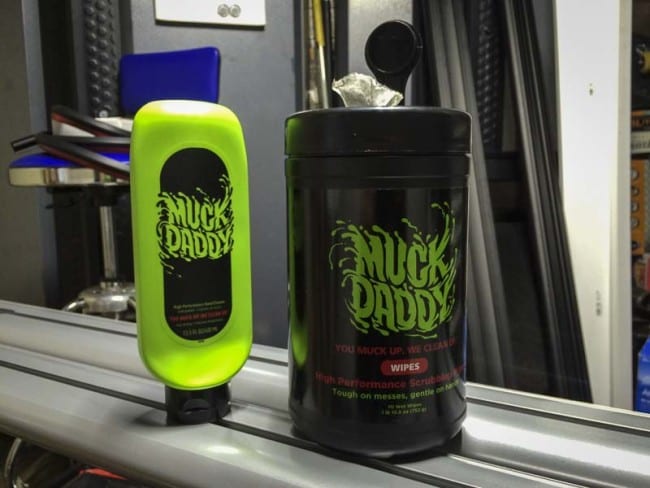
The Muck Daddy formula combines the Myralene solvent with a suite of other ingredients that address the practical requirements of an industrial hand cleaner. Pumice—finely ground volcanic rock—is added to provide a mechanical abrasive that helps to scrub stubborn, embedded grime from the pores and creases of the skin. A moisturizer and conditioner, derived from squalane—a hydrocarbon that is naturally present in human sebum and that is also produced through the Amyris fermentation process—is incorporated to counteract the drying effects of the solvent and to leave the hands feeling soft and conditioned after use. The scent is fresh and clean, closer to a citrus‑based cleaner than to a solvent, and it dissipates quickly, leaving no lingering chemical odor. The product is available in several formats. The 13.5‑ounce squeeze bottle contains the gel formula with pumice, suitable for use at a sink or a hose bib where water is available for rinsing. The gallon container provides an economical bulk option for workshops and garages that consume a significant quantity of hand cleaner. The 70‑count wipes container provides a portable, water‑optional solution for cleaning hands in the field, at the job site, or anywhere that a sink is not within reach. A smooth version of the gel, without pumice, is available for lighter cleaning tasks or for users who prefer not to use an abrasive. The wipes, in particular, represent a significant convenience upgrade over the traditional hand cleaner format. A mechanic who has just finished a brake job, whose hands are coated in brake dust and grease, can simply pull a wipe from the container, clean their hands thoroughly, and dispose of the wipe—no water, no towel, no mess. The wipes are large, durable, and saturated with enough cleaning solution to handle a full set of dirty hands. They are the preferred solution for the mobile professional who moves between job sites and who does not always have access to a wash station.
The performance of Muck Daddy, in direct comparison with the petroleum‑based hand cleaners that have dominated the market for decades, is the critical question. A product that is derived from sugarcane and that is marketed as eco‑friendly will generate skepticism among professionals who have learned, through hard experience, that the words "green" and "effective" do not always go together. The testing we conducted—cleaning hands after automotive brake work, after handling greasy engine components, after working with hydraulic fluid, and after a day of general construction that left hands coated in a mixture of dirt, concrete dust, and sweat—demonstrated that Muck Daddy cleans as well as the leading solvent‑based products. The Myralene solvent cuts through grease and oil quickly, the pumice provides a satisfying scrubbing action that lifts embedded grime from the skin, and the rinsing process leaves hands feeling clean and smooth, not dry and stripped. The absence of the lingering solvent smell is a genuine quality‑of‑life improvement. After using Muck Daddy, hands smell neutral—they smell clean, without any chemical residue. For the professional who interacts with clients, who shares a vehicle with a spouse or a coworker, or who simply does not want to carry the smell of a refinery into their home, this is a meaningful benefit. The skin conditioning is not a marketing claim; it is objectively noticeable. After a week of using Muck Daddy exclusively, my hands were in visibly better condition than after a comparable week of using a petroleum‑based cleaner. The skin was less dry, the cuticles less cracked, and the overall feel was healthier. For the professional who washes their hands multiple times a day, every day, the cumulative effect of switching from a harsh solvent to a conditioning cleaner can be significant over the course of a career.
The environmental and health arguments for Muck Daddy are compelling, but they are not the only reasons to consider it. The product is simply pleasant to use, in a way that a solvent‑based cleaner is not. The fresh scent, the smooth feel, the absence of the burning sensation that sometimes accompanies the application of a strong solvent to broken skin—these are subjective qualities, but they are qualities that affect how a person feels about the task of cleaning their hands, and a person who does not dread the cleaning process is more likely to clean their hands thoroughly and frequently. The convenience of the wipes format, for the professional who works in the field, is a genuine productivity enhancement that eliminates the need to find a water source before eating lunch, before getting into the truck, or before handling clean materials. The gallon jug and the squeeze bottles are economical and practical for the workshop, and the availability of a smooth version expands the product's appeal to users who do not need or want an abrasive. At prices that are competitive with the leading solvent‑based hand cleaners—the 13.5‑ounce bottle retails for $8.99, the gallon for $39.99, the wipes for $24.99—Muck Daddy does not ask the user to pay a premium for its environmental credentials. It is priced to compete on performance, and it delivers.
For the professional mechanic, the construction worker, the maintenance technician, the machinist, or anyone whose hands bear the daily evidence of their labor, Muck Daddy industrial hand cleaner represents a rare convergence of effectiveness, safety, and sustainability. It is a product that was developed by scientists, not marketers, and the ten‑year development timeline speaks to the difficulty of the challenge and the rigor of the solution. It cleans as well as the old, petroleum‑based products. It conditions the skin instead of damaging it. It smells fresh instead of harsh. And it is derived from a renewable resource, produced through a fermentation process that points the way toward a future in which the chemicals we use every day are grown, not drilled. In a world where every product claims to be revolutionary, Muck Daddy is one of the few that genuinely is. It is a hand cleaner that represents not merely an incremental improvement over the status quo, but a fundamental rethinking of what a hand cleaner can be—and what it should be.
Muck Daddy Industrial Hand Cleaner
Comments 0
Leave a Comment