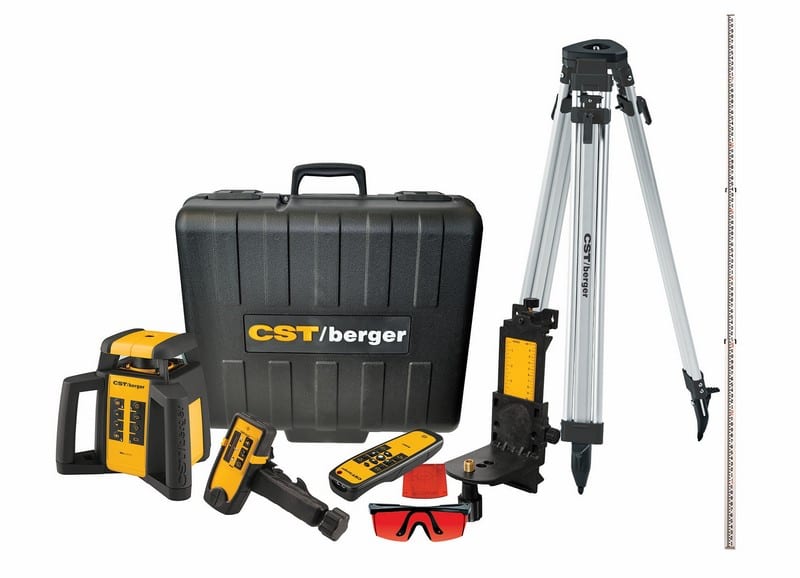
CST/berger, a brand that has quietly built a reputation for no-nonsense precision instruments that don't inflate the invoice with marketing fluff, decided to draw a line in the dirt. The RL50HVCK Horizontal/Vertical Rotary Laser Kit lands on your doorstep - rod, tripod, detector, remote control, magnetic target, laser glasses, batteries, and a hard carrying case included - for $799. That's not a typo. When the press release hit, the first reaction from anyone who understands construction laser pricing was a raised eyebrow followed by the same question : What's the catch?
We dug into the specifications, tested the feature list against jobsite reality, and talked to contractors who've put the RL50HVCK through its paces. What we found is a laser that makes deliberate, intelligent tradeoffs in areas most users will never care about, while absolutely refusing to compromise on range, accuracy, and the kind of rugged reliability that keeps a tool out of the repair shop and on the job. This isn't a stripped-down budget laser masquerading as a pro tool. It's a carefully engineered value proposition that forces the rest of the market to answer an uncomfortable question : if CST/berger can deliver all this for $799, what exactly are you paying for when you spend $500 more?
Unboxing the RL50HVCK : What “Complete Kit” Actually Means
One of the quiet frustrations of buying a rotary laser is the moment you open the box and realize you can't use it. The laser is there, a detector might be included if you're lucky, but the tripod is sold separately, the grade rod is an afterthought, and you're staring at a $1,200 purchase that still needs another $200 in accessories before you can check a single elevation. CST/berger sidesteps that entire headache. The RL50HVCK kit is genuinely a ready-to-work package.
Inside the rugged carrying case, you'll find:
- CST/berger RL50HVCK Rotary Laser - the main unit, self-leveling, horizontal and vertical capable
- RD5 Laser Detector - with dual front-and-back displays and a convenient memory function
- Remote Control - adjust rotation speed, scan angle, and more without walking back to the laser
- Adjustable Wall Mount - for quick interior plumb and layout applications
- Aluminum Tripod - sturdy, lightweight, and ready to set up right out of the box
- Leveling Rod - the accessory that most manufacturers leave out, costing you an extra trip to the store
- Laser Glasses - red beam enhancement for those early morning or late evening shots
- Magnetic Target - perfect for steel beam layout and aligning to metal surfaces
- Batteries - 3 D-cell batteries included, giving you up to 55 hours of runtime from day one
- Hard Carrying Case - custom-molded to keep every component secure when bouncing down a dirt access road
Removing the tripod, rod, and wall mount from your shopping list doesn't just save money; it saves the wasted morning of discovering you're one component short. For the small-to-mid-size contractor who runs a tight calendar, that readiness translates directly into billable hours.
The $799 Question : Where CST/berger Made the Smart Tradeoffs
When a rotary laser kit drops below the psychological $1,000 barrier, seasoned pros start looking for the corners that got cut. It's a healthy instinct. The rotary laser market splits roughly into two tiers : premium units in the $1,200–$1,800 range that boast green beams, lithium-ion rechargeable batteries, and dual-slope capability, and budget units under $600 that compromise heavily on range, durability, and accuracy. The RL50HVCK at $799 doesn't fit neatly into either bucket. CST/berger found a middle path by making three conscious tradeoffs that trim cost without gutting performance.
Tradeoff 1 : Red Beam Instead of Green
The easiest and most effective way to reduce laser cost is to use a red diode instead of green. Red laser diodes are less expensive to manufacture, draw less power, and are available in mature, reliable supply chains. Green lasers are objectively brighter to the human eye - about four times more visible under the same output power - but that advantage matters most for indoor applications where you're working without a detector. Outdoors, in the sunlight, even the brightest green beam gets washed out beyond a few dozen feet. That's why virtually every outdoor rotary laser user relies on a detector, regardless of beam color. With the RD5 detector clipped to your grade rod, the color of the beam becomes irrelevant; you're chasing the beep and the display indicator, not the dot itself. CST/berger made the right call here : go red, keep the price down, and pour the savings into the detector and the accessories. Most excavation and concrete crews won't miss the green one bit.Tradeoff 2 : D-Cell Batteries Over Lithium-Ion
Pop open the battery compartment on the RL50HVCK and you'll find space for three D-cell alkaline batteries, not a proprietary lithium-ion pack. This decision cuts manufacturing cost significantly and eliminates the need for an onboard charging circuit and a custom charger. In return, you get up to 55 hours of continuous runtime - enough to cover a full work week of heavy use without swapping cells, and when you do need fresh batteries, you can grab them at any gas station, hardware store, or convenience store in the country. The downside? Over the course of a year, you'll spend more on disposable batteries than you would on electricity to charge a lithium pack, and you'll generate more waste. However, for a tool that might sit idle for weeks between projects, D-cells never self-discharge into a brick. Keep a spare set in the case and you're never waiting for a recharge. It's an old-school power strategy that prioritizes uptime and accessibility over modern convenience.Tradeoff 3 : Single-Axis Slope Instead of Dual
The RL50HVCK offers single-axis slope control. That means you can set a grade on one axis - essential for driveways, drainage, and foundation footings - but you can't independently slope both the X and Y axes simultaneously for complex contours. Dual-slope lasers command a premium because they allow compound plane creation in a single setup. For the vast majority of residential and light commercial work, single-axis slope covers the application : set the fall for a trench drain, pitch a patio away from the house, establish a uniform slope on a concrete slab. If your scope regularly includes intricate site grading with independent slopes in two directions, you probably already own a dual-slope laser and the RL50HVCK serves as a second unit or a backup. For everyone else, this is a tradeoff you won't feel on a daily basis, but it keeps $300–$400 off the sticker price.What CST/berger Refused to Sacrifice
Here's where the deal gets compelling. Despite those three areas of cost-saving, the RL50HVCK stands toe-to-toe with lasers costing 50% more on the metrics that determine whether a job passes inspection:Range: 2,000-foot diameter working range with the RD5 detector. That's full-size lot capability. You can shoot foundations across a commercial pad without moving the laser.
Accuracy: ±1/16 of an inch at 100 feet. That's the same tolerance you'll find on the DeWalt 20V Max Tough Green Laser ($1,299) and within a whisker of the most expensive Topcon units. At 100 feet, 1/16 inch is about 0.0052% deviation - more than enough for concrete, grading, and formwork.
Durability: IP56 rating against dust and water contamination, a glass-enclosed top housing that shields the rotating prism from direct impact, and over-molded housing in all the impact-critical areas. This laser expects to get rained on, covered in concrete splatter, and knocked over by a wind gust without missing a beat.
Self-Leveling: The motorized self-leveling system brings the beam to plumb and level within seconds of setup, and the Anti-Drift System (ADS) continuously monitors and corrects for any temperature or vibration-induced movement throughout the day. You don't have to keep checking back; the laser self-corrects before the error accumulates.
Feature Deep Dive : What the RL50HVCK Offers That Budget Lasers Can't Touch
Beyond the headline specs, CST/berger packed the RL50HVCK with a suite of features that elevate it above the bargain-bin alternatives and into serious professional territory. Let's walk through each one and translate what it means when you're standing in a muddy excavation, mud caked on your boots, trying to get a reading before the concrete truck arrives.
Variable Rotation Speeds : 0, 150, 300, 600 RPM
The laser head spins at different speeds depending on the application. At 600 RPM, the beam appears as a solid line to the naked eye - great for quick visual alignment indoors or in low light. At 150 RPM, the beam pulses more slowly, maximizing the detector's ability to lock onto the signal at long range and in bright outdoor conditions. The 0 RPM setting stops the rotation entirely, allowing you to manually position a stationary dot for single-point elevation transfer, plumb alignment, or 90° corner layout. Being able to switch speeds from the remote control without jogging back to the tripod saves dozens of small time sinks that add up over a long day.Variable Scan Angles : 10°, 25°, 50°
Scan mode restricts the beam to a specific arc rather than a full 360° circle. Why does this matter? Two reasons : first, concentrating the laser's energy into a smaller angle dramatically increases the visible brightness of the beam, making it easier to see without a detector indoors. Second, it prevents the beam from striking unintended targets - like cars driving down the street or that neighbor's window you'd rather not illuminate. The 10° scan is perfect for a single work area, the 25° for a broader room, and the 50° for a large interior layout. The remote control toggles through these modes instantly.Vertical Beam Mode for 90° Corners and Plumb
Tilt the RL50HVCK into its vertical orientation and you gain a perfectly plumb vertical laser line that projects up a wall, across a ceiling, and down the opposite side. This is how you square a foundation, align column forms, or transfer a point from the floor to the ceiling for pipe penetrations. Combined with the variable scan angles, you can shoot a vertical line that climbs exactly where you need it without flooding the whole jobsite with stray laser light. The included adjustable wall mount makes vertical setup a one-person task, even on uneven surfaces.Anti-Drift System (ADS)
Temperature swings, a passing heavy truck vibrating the ground, a crew member bumping the tripod - any of these can nudge a laser out of calibration. The Anti-Drift System constantly monitors the self-leveling pendulum and activates a correction motor if it detects even the slightest drift. The alternative is the “head tilt” shutdown common on cheaper units, where the laser simply stops spinning and blinks an error light, forcing you to walk back and reset. ADS keeps you working uninterrupted, which is exactly what you need when the concrete pump is already on site.RD5 Laser Detector with Dual Displays and Memory
The included RD5 detector isn't an afterthought. It features large, easy-read LCD displays on both the front and back faces, so whether you're standing behind the rod or in front of it, you get a clear visual indication of “too high,” “too low,” or “on grade.” The memory function remembers the last on-grade setting even after you power the detector off - handy when you take lunch break and come back without needing to re-reference. The audio tones are loud and distinct, cutting through jobsite noise. The rugged, over-molded housing survives drops onto packed dirt, which it will inevitably experience.IP56 Rating : The Truth About Weather and Dust Resistance
An IP56 rating means the laser is protected against powerful water jets - think driving rain or the splash-back from a power washer - and it's nearly dust-tight. You can leave the RL50HVCK on the tripod during a sudden downpour without sprinting across the site to throw a bucket over it. The glass-enclosed top housing adds an extra layer of defense for the rotating prism assembly, the most mechanically sensitive part of the laser. For crews that work in the Pacific Northwest, the Gulf Coast, or anywhere that weather changes on a dime, this rating isn't a luxury; it's the difference between finishing the day's layout and losing an hour to calibration checks.Temperature Tolerance : 14°F to 122°F
From winter footing pours in New England to mid-August slab work in Arizona, the RL50HVCK is rated to operate across a 108-degree temperature spread. The internal compensation and self-leveling mechanism are tested to maintain accuracy within this range, so you can trust your elevations whether the ground is frozen or baking.Specifications at a Glance : The CST/berger RL50HVCK by the Numbers
When you're comparing lasers across brands, the spec sheet tells the story quickly. Here's the RL50HVCK laid out in an easy-to-scan reference table.
| Specification | CST/berger RL50HVCK |
|---|---|
| Model Number | RL50HVCK |
| Working Range (with detector) | 2,000-foot diameter (600 m) |
| Accuracy | ±1/16 inch at 100 feet (±1.5 mm at 30 m) |
| Self-Leveling | Motorized, horizontal and vertical |
| Slope Control | Single-axis |
| Anti-Drift System (ADS) | Yes |
| Rotation Speeds | 0, 150, 300, 600 RPM |
| Scan Angles | 10°, 25°, 50° |
| Vertical Beam | Yes, for 90° corners and plumb |
| Beam Color | Red |
| Power Source | 3 × D-cell alkaline batteries (included) |
| Battery Life | Up to 55 hours |
| IP Rating | IP56 (dust and powerful water jet protection) |
| Housing | Glass-enclosed top, over-molded impact zones |
| Detector | RD5 with dual displays, memory, audible tones |
| Remote Control | Yes |
| Kit Includes | Tripod, leveling rod, wall mount, glasses, target, case |
| Dimensions (bare tool) | 7.3″ L × 8.6″ H |
| Bare Tool Weight | 5.08 lbs (2.3 kg) |
| Operating Temperature | 14°F to 122°F (−10°C to 50°C) |
| Price | $799.00 |
Where the RL50HVCK Outperforms : Real-World Applications
Specifications are sterile until you map them onto the actual work that pays your invoices. The RL50HVCK finds its strongest footing in five core trades. Here's how each one wrings value out of this kit's feature set.
Concrete Flatwork and Form Setting
Pouring a garage slab, basement floor, or commercial apron demands elevation control across a wide area. Set the RL50HVCK on its tripod at the center of the pad, switch it to 600 RPM for a solid visual line, and walk the perimeter with the RD5 detector on the grade rod. Every form stake, every screed pin gets set to the same precise reference in minutes. The single-axis slope capability lets you dial in the required pitch - 1/8 inch per foot for drainage, for example - without complex setup. After the pour, you can verify the finished surface by simply walking the slab with the detector, identifying high spots before the concrete sets. The IP56 rating proves its worth when the crew splashes water and slurry around without babying the tool.Excavation and Site Grading
Digging a foundation to grade requires constant elevation checks. Traditionally, this means a dedicated rod man and an operator on the transit, communicating by hand signals or shouting over equipment noise. With the RL50HVCK set up at a safe distance, the excavator operator can mount the RD5 detector directly to the machine's arm or bucket (using an appropriate magnetic or clamp mount, not included) and see real-time elevation readouts on the dual display. The 2,000-foot diameter range means you can dig a full basement, a long trench, or a swimming pool without relocating the laser. The memory function on the RD5 remembers the desired depth, allowing the operator to dig aggressively until the detector signals “on grade.” This one-person workflow cuts labor cost in half on grading days.Footings and Foundations
Accuracy on footings is non-negotiable; a 1/4-inch error at the footing translates to a visible rack in the framing above. The RL50HVCK's ±1/16-inch-at-100-feet accuracy gives the concrete crew the confidence to place anchor bolts, step forms, and pier pads within tolerance. The vertical beam mode allows you to plumb from the footing up to the sill plate layout, ensuring the foundation wall is square to the top plate. Using the 10° scan angle, you can project a crisp vertical reference onto a framing square or a corner form without the beam spilling into the adjacent property.Septic and Drainage Installation
Installing a septic tank, leach field, or storm drain line requires precise slope over a long run. Single-axis slope control handles this perfectly. Set the laser at the high end of the run, dial in the required fall (say, 2% over 100 feet), and the beam automatically tilts to the correct plane. Walk the trench with the rod and detector to confirm the bottom is consistently graded. The remote control allows you to adjust the slope incrementally from the trench itself, eliminating the frustrating back-and-forth that eats time when you're working alone.Framing and Interior Layout
When you move indoors for metal stud framing, drywall, or dropped ceiling installation, the RL50HVCK shifts roles. The 600-RPM setting creates a bright, continuous horizontal reference line around the entire room. The 50° scan concentrates the beam on the wall you're actively working on, making it visible without glasses in most lighting conditions. Vertical mode, combined with the adjustable wall mount, lets you plumb wall lines, locate light fixture centers, and square door openings to the floor layout. The fact that you can do all of this with the same tool you used to level the foundation outside is a logistical triumph for contractors who run lean.What the Trades Are Saying About the RL50HVCK
We reached out to contractors who integrated the CST/berger RL50HVCK into their daily workflow. Their feedback cuts through the spec-sheet noise and speaks to how the tool performs when the pressure is on.
“I was skeptical about the price. I've been running a competitor's green laser that cost me almost $1,400 with the detector. Bought the CST as a backup, and within a week it became the primary. The red beam doesn't matter - I always use the detector outside anyway. The fact that it came with the rod and a tripod that didn't feel like a toy? That's what sold me. I ordered a second kit for the other crew.”
– Luis V., Concrete & Flatwork Contractor, Houston TX
“I run a one-man excavation business. Every minute I spend climbing in and out of the mini-excavator to check elevation is a minute I'm not moving dirt. The remote control on the CST let me adjust the laser from the cab. The memory function on the detector meant I could stop for lunch, come back, and immediately pick up right where I left off. All that for eight hundred bucks. I can't figure out why anyone pays more.”
– Evan K., Owner, K&G Excavation Services, Scranton PA
“We do a lot of rural septic installs where the ground can be frozen in the morning and muddy by afternoon. The RL50HVCK has been rained on, splattered with mud, and dropped once off the tripod when a gust caught it. No calibration drift, no fuss. The D-cells last long enough that I'm only swapping them once every couple of months. For our volume of work, it's the right tool at the right price.”
– Joel H., Septic System Installer, Bozeman MT
Kit Comparison : What You Get vs. What You'd Normally Buy Separately
The true value of the RL50HVCK kit crystallizes when you tally up the cost of acquiring an equivalent setup piece by piece. Here's a realistic breakdown of what each component typically commands in the open market.
| Component | Typical Separate Purchase Price |
|---|---|
| Rotary laser (self-leveling, similar specs) | $600 – $900 |
| Laser detector (dual display, memory) | $150 – $250 |
| Aluminum tripod (medium duty) | $60 – $100 |
| Grade rod (fiberglass, 16-foot) | $50 – $80 |
| Adjustable wall mount | $30 – $50 |
| Remote control | $40 – $70 |
| Laser glasses | $15 – $25 |
| Magnetic target | $10 – $20 |
| Hard carrying case | $40 – $80 |
| Total Estimated À La Carte Cost | $995 – $1,575 |
| RL50HVCK Kit Price | $799 |
The math speaks for itself. Even at the low end of the à la carte range, you're saving nearly $200 by buying the bundle. At the high end, the kit effectively delivers $700+ in value. CST/berger's decision to include every accessory as standard isn't a marketing gimmick; it's a direct assault on the nickel-and-dime strategy that has irritated contractors for years. You open the case, you go to work. No second order, no shipping delay, no foreman calling you to ask where the rod is.
D-Cell Power Strategy : The Case for Disposable Batteries on a Profesional Tool
The lithium-ion revolution has conditioned us to expect rechargeable packs in every cordless tool. A rotary laser that runs on D-cells feels almost anachronistic. But the jobsite reality for many construction laser applications doesn't align with the daily-use, quick-recharge model of a cordless drill. Here's why CST/berger's power choice makes practical sense for the contractor who does two or three large layout days per month, then the laser sits for weeks.
Shelf Life and Storage: Lithium-ion batteries self-discharge slowly but steadily. A laser stored in the gang box for three weeks between projects may have a dead or critically low pack when you finally pull it out on a frosty 6:00 AM start. Alkaline D-cells, stored in their packaging, hold charge for years. You keep a spare set in the case and forget about them until you actually need them.
Universal Availability: If your lithium pack dies on a remote job site 60 miles from the nearest hardware store, you're done for the day. D-cells are sold at every gas station, convenience mart, and grocery store in North America. This ubiquity counts for a lot when the job is on a deadline and the nearest big-box store closes at 8:00 PM.
55-Hour Runtime: Fifty-five hours of continuous use on three D-cells is remarkable. For a typical concrete or excavation crew, that translates to roughly two to three weeks of actual work. At a battery cost of roughly $5–$8 per set, the annual operating expense is minimal compared to the time saved by never waiting for a recharge.
No Charger, No Downtime: A missing proprietary charger can sideline a lithium-powered laser for days while a replacement ships. D-cell power eliminates that single point of failure. There is no charger to lose, break, or forget in the hotel room.
The environmental tradeoff is real : disposable batteries generate more waste. For high-volume users who run the laser 40+ hours every week, a lithium-ion alternative might pay for itself over a year and reduce landfill contribution. CST/berger isn't hiding from that calculus; they're simply betting that the majority of their buyers will prefer the convenience and low upfront cost of alkaline power. For the contractor who fits that usage pattern, it's a win.
The Red Beam Reality Check : When Color Matters - And When It Doesn't
A quick physics lesson explains why green lasers command a premium. The human eye's peak photopic sensitivity sits at roughly 555 nanometers - a vivid green. Red laser light, typically around 635–650 nm, lands on a less sensitive region of the eye's response curve. Under the same power output, a green beam appears four to five times brighter to a person standing next to the laser. Indoors, this difference is dramatic; a green rotary laser can often be used without a detector for drywall layout, acoustic ceiling grid installation, or cabinet leveling, simply by sighting the visible line on the wall.
The moment you step outside into daylight, however, that advantage evaporates. The sun's broad-spectrum radiation overwhelms the contrast of any visible laser beam, red or green, beyond a short distance. Even the brightest green lasers wash out within 30–50 feet under full sun. For outdoor excavation, concrete, and grading work, you're using a detector 95% of the time regardless of beam color. The detector reads the laser's modulated signal, not its visible brightness, and it works identically with red or green.
The RL50HVCK's red beam, combined with the 600-RPM rotation speed, still produces a visible horizontal line indoors that's adequate for many tasks. Add the included laser glasses, which filter ambient light and enhance the red band, and interior visibility improves further. For the all-outdoor contractor, beam color is a non-issue. For the mixed indoor-outdoor professional, the cost savings of red easily outweigh the occasional convenience of green. At $799, you're not paying the green-beam premium - and you're not missing it where it counts.
Setting Up the RL50HVCK : A Quick Start Guide for Optimized Performance
Even a self-leveling laser rewards proper setup. Follow these steps to ensure the accuracy the spec sheet promises shows up in your work.
- Choose Solid Ground: Set the tripod on firm, stable soil or a concrete surface. If the ground is soft or muddy, push the tripod feet in firmly and consider weighting the center column. The self-leveling mechanism can compensate for slight out-of-level conditions, but a tripod that sinks during the day will introduce error.
- Rough-Level the Head: Use the tripod's bubble level to get the laser platform approximately level. The RL50HVCK's self-leveling range handles about ±5° of tilt. If you exceed that, the laser will flash a warning. A rough leveling takes 15 seconds and prevents startup delays.
- Power On and Let It Self-Level: Switch the laser on and watch the head stabilize. The beam will flash while self-leveling and then transition to a solid rotation once locked. If the Anti-Drift System detects movement later, it will silently correct without interrupting the beam.
- Select Rotation Speed and Scan Angle: For outdoor detector work, 150 or 300 RPM provides the most stable reading. For indoor visual work, 600 RPM creates a solid line. Use the smallest scan angle that covers your work zone to maximize visible brightness and extend battery life.
- Set Slope (If Needed): Enable single-axis slope control and adjust the grade using the remote control. Always verify the slope by shooting a known elevation at both ends of the run before digging or pouring.
- Verify with the Detector: Before trusting the beam for layout, walk a short distance with the RD5 detector to confirm the beam is striking the correct elevation. This habit catches setup errors before they manifest as material mistakes.
- Power Down and Wipe Clean After Use: Remove mud, dust, and moisture from the laser housing and the tripod threads before storing. Dirt in the threads makes the next setup frustrating. The IP56 rating protects the internals, but exterior grime invites corrosion over time.
Frequently Asked Questions About the CST/berger RL50HVCK
Q : Can I use the laser without the detector indoors?
A : Yes. At 600 RPM, the red beam is visible up to about 30–50 feet in moderate indoor lighting. The included laser glasses enhance visibility. For longer distances or brightly lit rooms, the detector eliminates guesswork.
Q : Is the tripod included sturdy enough for daily professional use?
A : The included aluminum tripod is a mid-grade unit suitable for the weight of the RL50HVCK. It handles typical jobsite conditions well. Crews that operate in high winds or on extremely uneven ground may eventually upgrade to a heavy-duty fiberglass or carbon-fiber tripod, but the stock tripod is perfectly serviceable for the vast majority of applications.
Q : Can I recharge the D-cell batteries, or must I use alkaline only?
A : You can use rechargeable NiMH D-cells, though the voltage per cell is slightly lower (1.2V vs. 1.5V alkaline). This may reduce the runtime from 55 hours to approximately 40–45 hours. The laser will function correctly, but CST/berger's official rating is based on alkaline cells. If you choose rechargeable, keep a spare charged set on hand.
Q : What happens if the laser gets rained on mid-job?
A : The IP56 rating means it's designed to withstand powerful water jets and heavy rain. No immediate action is required beyond wiping off standing water before it enters the battery compartment when you open it. The glass-enclosed top housing protects the critical rotating prism. Many contractors operate the RL50HVCK in steady rain without issues.
Q : Is the slope control fully manual or motorized?
A : The slope is electronically set and motorized. You use the remote control or the on-unit buttons to dial in the desired slope percentage. The laser then tilts the beam accordingly. The ADS continues to monitor and correct the level axis independently of the sloped axis.
Q : Will this laser work with a different brand's detector?
A : It will work with most universal rotary laser detectors that read the same modulation frequency. However, the RD5 is optimized for the RL50HVCK and provides the best range and response time. Using a third-party detector may reduce the effective working range and forfeit features like the memory function.
Q : How does the warranty compare to other brands?
A : CST/berger provides a standard limited warranty covering defects in materials and workmanship. Specific term lengths vary by region. Check with your dealer for exact coverage. The brand's reputation for robust build quality tends to make warranty claims rare, but having a local dealer relationship is always advisable for service and calibration checks.
When the RL50HVCK Might Not Be the Right Fit
No tool is universal. The RL50HVCK's deliberate tradeoffs mean there are scenarios where a different laser would serve you better. Recognizing these before you buy saves buyer's remorse and ensures your $799 lands on a tool that matches your workload.
You work primarily indoors with no detector: If your bread-and-butter is interior framing, drywall, acoustic ceilings, or metal stud layout in brightly lit spaces, a green-beam rotary laser or a multi-line green cross-line laser will be significantly more visible without a detector. The RL50HVCK can do indoor work, but it's optimized for outdoor detector-based applications.
You require dual-slope capability: Complex site grading with independent slopes in two axes calls for a dual-slope laser. The single-axis slope of the RL50HVCK handles the vast majority of residential and light commercial work, but heavy civil, large commercial pad work, or intricate landscape contouring may exceed its capability.
You use the laser 50+ hours every single week: At that level of usage, the battery cost and waste of D-cells will add up meaningfully over a year. A lithium-ion powered laser may have a higher upfront cost but lower ongoing operational expense for ultra-high-volume users. The RL50HVCK still works for this scenario, but the economics shift.
You need an internal digital grade readout: Some high-end lasers display the exact slope percentage on an LED screen. The RL50HVCK sets slope incrementally via remote control, relying on a scale and the user's verification. Precision-obsessed contractors may prefer a direct digital readout, but this adds significant cost.
If none of these apply to your daily workflow, the odds are high that the RL50HVCK will exceed your expectations and leave a few hundred dollars in your business checking account that would have otherwise gone to features you'd rarely engage.
The CST/berger Heritage : Why Brand Matters on a Precision Tool
CST/berger may not command the flashy marketing presence of some larger tool corporations, but its pedigree runs deep in the survey and construction instrument world. The brand's DNA traces back to the merger of C.S.T. (Chicago Steel Tape) and Berger Instruments, two companies with roots stretching back to the late 19th century. Berger produced the first practical builder's transit in the United States. This isn't a startup slapping a logo on a generic factory design; it's a manufacturer that understands optical and laser precision at an engineering level.
For the professional buyer, this matters because the calibration, after-sales service, and parts availability network is in place. A rotary laser is a long-term investment. You want to know that in three years, when the unit needs a calibration check, you can send it to a service center that actually stocks the necessary jigs and replacement vials. CST/berger has that infrastructure, and it's built into the $799 price without an extra “brand tax.”
Final Verdict : The RL50HVCK Resets Expectations for What a Sub-$1,000 Kit Can Deliver
CST/berger didn't attempt to out-green the green lasers or out-battery the lithium-ion crowd. They made sober, practical engineering choices that preserve the three non-negotiables of any outdoor rotary laser - range, accuracy, and durability - while stripping away the cost-inflating features that a large portion of the market simply doesn't need. The result is a kit that, at $799, includes every accessory required to go from unboxing to on-grade in under ten minutes.
The red beam is a red herring for outdoor crews; the detector is the real interface. The D-cell power system prioritizes field replaceability and uptime over modern charging convenience. The single-axis slope handles the grade demands of footings, slabs, driveways, and drainage trenches with room to spare. And the build quality - IP56, glass-enclosed top, over-molded impact zones, Anti-Drift System - is what you'd expect from a tool that costs several hundred dollars more.
For the concrete finisher who needs a reliable reference on every pour, the excavator who wants to run dirt solo, the septic installer grading trenches in variable weather, or the general contractor who oscillates between foundation work and interior layout, the CST/berger RL50HVCK is a rare alignment of price and capability. It's not the laser you settle for because the budget is tight. It's the laser you choose because it does exactly what you need and refuses to charge you for what you don't.
The kit is available now through professional tool dealers and online retailers. If you're still hauling a transit and a rod man to your job sites out of habit or budget fear, the RL50HVCK makes an undeniable case that the upgrade to a self-leveling rotary laser no longer requires a five-figure contract to justify. It's quite possibly the most sensible $799 a dirt-moving, concrete-pouring, foundation-setting professional can spend this year.
Comments 0
Leave a Comment