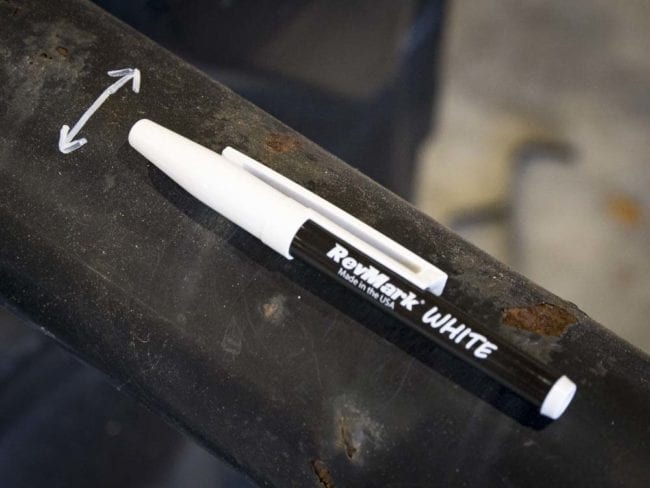
RevMark, the company behind the original dark‑ink industrial pens that clipped to your belt tip‑down, looked at this daily aggravation and asked : what if we just made white ink that flows like a pen, needs no shaking, and writes on the same dark, oily, rough materials that normally require a paint marker? The answer is the RevMark white ink marker—a deceptively simple tool that promises to replace the paint marker in your pouch, eliminate the shaking, and survive in your pocket or on your belt with a clever inverted‑clip design that’s either genius or fussy, depending on where you carry it. At $5.99 for a two‑pack, it’s priced like an experiment. We ran the experiment on metal, wood, concrete, and cast iron. Here’s what happened when we put pen to everything dark.
The Inverted Clip Design : Pull and Write, or Fumble and Wedge ?
The RevMark family’s signature feature is its upside‑down clip. Instead of the standard pen‑clip shape that slides over a pocket and leaves the tip facing upward, the RevMark clip is designed so the pen hangs tip‑downward on your belt, pocket, or shirt placket. The logic is straightforward : when you need to write, you grab the marker body, pull upward, and the cap stays clipped to your clothing. The marking tip is exposed in a single motion, already oriented correctly in your hand. No uncapping, no holding the cap in your teeth, no setting the cap down on a dusty surface where it fills with grit. In theory, it’s faster and cleaner than any pen you’ve ever used on a job site.
In practice, the experience depends largely on where you clip it. On a tool belt—especially the thick leather or webbing waistband of a professional pouch—the RevMark works exactly as advertised. The clip grips securely, the cap holds fast, and you can pull the marker upward with a satisfying pop. It’s a one‑handed operation that lets you mark a pipe, measure, and resheathe the marker without breaking your rhythm. On a jeans pocket, the results are slightly less bulletproof. The fabric is softer and thinner, and the clip occasionally lacks the clamping force to hold the cap securely. When you pull the marker upward, the cap can come with it, turning what was supposed to be a one‑handed flourish into a two‑handed annoyance. In a shirt pocket, the cap extraction issue is even more pronounced—the fabric flexes, the clip slips, and you end up fishing the cap out of the pocket with your thumb.
For users who already keep a pen on their belt, the RevMark is a revelation. For those who prefer to keep their marking tools inside a pocket or tucked into a shirt, it’s a slightly fussy design that asks you to change a habit. RevMark doesn’t hide this—the product is called a “belt‑mounted” marker in the marketing—but if you’re not willing to clip it to your belt, you’ll be wrestling with the cap more than you’ll be admiring the white ink. The good news is that the clip is robust and doesn’t snap off under lateral pressure, and the cap seals tightly enough that the ink doesn’t dry out even if you leave the marker unused for weeks. That alone is a major upgrade over paint marker caps that seem engineered to vanish into the ether.
White Ink, Not Paint : What’s Actually in This Thing ?
The RevMark white ink marker is not a paint marker in a different package. It’s a true ink—a fluid formulation that flows through a porous tip without the need for a pressurized barrel or a mixing ball. There’s no valve to prime, no shaking required, and no solvent stench that hangs in the air after use. The white pigment is densely opaque, which is the whole point : it needs to show up on dark, often glossy surfaces like black iron, cast iron, dark plastics, and oil‑stained metal. In our testing, the opacity was impressive. A single stroke laid down a bright, legible line that could be read from several feet away. On rough surfaces, the ink penetrated the texture and left a mark that was difficult to remove with a dry rag. On glossy surfaces, it required a bit more patience—more on that in a moment—but the initial readability was excellent.
The ink formulation is also notable for what it doesn’t do. It doesn’t have the acrid chemical smell that accompanies many industrial paint markers. It doesn’t dry out inside the tip if left uncapped for a minute between marks. It doesn’t require you to press the tip against a hard surface to start flow; it writes immediately on contact, much like a gel pen. For anyone who’s ever watched a paint marker’s tip slowly turn from a crisp point into a frayed stump after a few dozen marks on rough steel, the RevMark’s consistency feels luxurious. The tip is durable enough to write on textured surfaces without disintegrating, though wood—especially rough‑sawn lumber—was noticeably more abrasive than metal or concrete. After a dozen long marks on construction‑grade pine, the tip showed minor wear but continued to write cleanly. If your work involves marking primarily on lumber, a traditional lumber crayon or a soapstone might still be more economical, but the RevMark handles occasional wood marking without complaint.
Surface‑by‑Surface Performance : Where the White Ink Shines, and Where It Smudges
We tested the RevMark white ink marker on five common industrial and construction materials : smooth steel, rough cast iron, concrete block, kiln‑dried wood, and black ABS plastic. The results were consistent enough to draw clear guidelines for use.
Smooth steel and sheet metal: The ink lays down thick and glossy, with excellent opacity. However, because the surface is non‑porous, the ink doesn’t absorb. It sits on top like a thin film of paint and takes approximately 60 to 90 seconds to dry to the touch. Rushing to handle the marked piece or running a glove over the line within the first minute will smudge the mark. Once dry, the mark is fairly durable—it resists light abrasion but can be removed with a solvent wipe or vigorous rubbing. For layout lines that need to survive the rigors of fabrication, follow with a scribe or punch mark. For temporary identification, the RevMark is perfect.
Rough cast iron and textured metal: This is where the RevMark truly earns its place on the tool belt. The ink flows into the micro‑recesses of the rough surface, drying quickly and resisting smear. Even immediately after marking, the ink was difficult to remove with a dry finger. A wet rag removed some of the surface pigment, but a ghost line remained in the texture. For labeling tools, marking pipe lengths, or writing identification numbers on cast fittings, this performance is ideal.
Concrete and masonry: The ink writes well on smooth concrete, cinder block, and brick. The mark is bright white against the gray or red background, making it useful for layout and identification. On very dusty concrete, the tip can pick up some grit, but a quick wipe on a clean rag restores flow. The permanence is moderate : foot traffic will eventually fade the mark, but it won’t rub off with casual contact.
Wood (pine and oak): Wood is the RevMark’s weakest medium. The fibrous texture drags on the tip and can clog it with sawdust. The ink also tends to spread slightly along the grain, reducing line crispness. A heavy mark on a rough‑sawn surface is legible, but a fine line on a smooth planed board can be harder to achieve than with a sharp pencil. For general carpentry marking, a dark graphite pencil remains the superior tool. Use the RevMark on wood only when you specifically need a white mark for visibility on a dark species like walnut or wenge.
Black ABS and PVC plastic: The ink writes smoothly, much like on steel. Drying time is slightly longer than on porous surfaces, but within a minute it’s smudge‑resistant. The brightness of the white against black plastic is striking, making it an excellent choice for marking plumbing waste lines, electrical conduit, and ABS drain components.
Drying Time and Smudge Resistance : The One Critical Habit You’ll Need to Adopt
If there’s one user‑behavior adjustment that makes or breaks the RevMark experience, it’s learning to wait for the ink to dry on glossy materials. The ink flows generously—thicker than a ballpoint, closer to a gel pen in volume. On non‑porous surfaces, that means the mark is wet for up to a minute and a half. If you’re used to paint markers that dry almost instantly because the solvent flashes off, this delay will catch you off guard the first few times. The benefit is that the ink remains workable for those 60‑90 seconds, allowing you to smudge‑erase and remark if you make an error. The drawback is that if you immediately grab the marked pipe to cut it, you’ll transfer ink to your glove and blur the line.
Our recommended workflow : mark your line, set the marker back in its cap (just slide it downward into the belt‑clipped cap), and then reach for your saw, wrench, or drill. By the time you’ve positioned the tool and are ready to cut, the ink will be dry enough to handle. On rough, porous materials, you can work almost immediately without smudging. Developing this slight pause becomes second nature after a day of use, and it’s a small price to pay for eliminating the shaking and priming routine of paint markers.
RevMark White Ink vs. Traditional Paint Markers : A Head‑to‑Head Comparison
To contextualize where the RevMark fits in the industrial marking landscape, let’s compare it directly to the paint marker that has dominated this niche for decades.
| Feature | RevMark White Ink Marker | Traditional Paint Marker |
|---|---|---|
| Priming/Shaking | None; writes immediately | Requires shaking and tip‑priming |
| Noise | Silent | Loud rattling during shaking |
| Drying Time (Glossy) | 60‑90 seconds | 10‑30 seconds (solvent evaporation) |
| Drying Time (Porous) | <30 seconds | Instant to 15 seconds |
| Tip Durability | Good; wears on rough wood | Varies; can fray on rough metal |
| Cap Design | Inverted clip; belt‑mounted, tip‑down | Standard screw‑on cap |
| One‑Handed Use | Yes (on belt) | Rarely; cap needs two hands to remove |
| Storage Life | Long; tip doesn’t dry out if capped | Medium; cap loss or loose cap ruins marker |
| Price (per marker) | ~$3.00 (2‑pack at $5.99) | $3.00 – $5.00 |
| Made in USA | Yes | Varies by brand |
As the table illustrates, the RevMark trades a slightly longer drying time on glossy surfaces for a vastly more convenient user experience. If you mark primarily on rough, porous materials like cast iron and concrete, the RevMark is unquestionably the faster tool from pocket to mark. If you work almost exclusively on smooth, painted steel and need the ink to dry nearly instantly, a paint marker’s solvent‑based formula still has an edge—but only if you can tolerate the shaking and priming ritual.
Pricing and Packaging : $5.99 for Two, or $32.99 for a Dozen
RevMark offers the white ink marker in two purchase configurations. A two‑pack retails for $5.99 direct from RevMark, which brings the per‑marker cost to roughly $3.00. A twelve‑pack is available for $32.99, dropping the per‑unit cost to about $2.75. This pricing positions the RevMark squarely in the same ballpark as name‑brand paint markers (Markal, Dykem, Sakura) while undercutting some specialty metal markers that run $5 to $8 each. For a shop that outfits multiple crew members or a contractor who loses markers to the jobsite void with some regularity, the twelve‑pack makes economic sense. For the individual Pro wanting to test the waters, the two‑pack is a low‑risk entry. Either way, you’re not paying a premium for the novel clip design; you’re paying a competitive market rate for a domestically manufactured industrial marker with a unique convenience feature.
Specifications at a Glance
| Specification | Detail |
|---|---|
| Product Name | RevMark White Ink Industrial Marker |
| Ink Type | White pigment ink (non‑paint, no shaking required) |
| Tip Type | Durable porous tip (similar to felt, but reinforced) |
| Clip Design | Inverted clip for tip‑down carry; cap stays on belt or pocket |
| Drying Time (Glossy) | 60‑90 seconds |
| Drying Time (Porous) | Under 30 seconds |
| Best Surfaces | Cast iron, steel, concrete, black ABS, textured metal, dark plastics |
| Adequate Surfaces | Wood, painted surfaces (use with care) |
| Made in USA | Yes |
| Packaging Options | 2‑pack ($5.99), 12‑pack ($32.99) |
| Ordering | Direct from RevMark |
Who Should Buy the RevMark White Ink Marker ?
The RevMark white ink marker is an ideal upgrade for professionals who mark dark, rough, or oily surfaces regularly and who are willing to carry a marker on their belt rather than in a pocket. Specific trades that benefit most include:
- Plumbers and pipefitters: Marking black iron, galvanized, and cast iron pipe; labeling ABS and PVC drain assemblies. The one‑handed belt operation means you can hold a pipe in one hand and mark it with the other, a common scenario when fitting dry.
- Metal fabricators and welders: Layout on dark steel plate, marking cut lines, labeling fabricated assemblies. The ink is bright enough to remain visible through welding haze, and the marker won’t clog with metal dust as quickly as a paint marker.
- Ironworkers and steel erectors: Beam identification, bolt‑hole numbering, torque‑value marking. The belt clip keeps the marker ready when you’re climbing.
- Concrete contractors: Marking layout on slabs and formwork, labeling anchor bolts. The white shows up clearly on gray concrete.
- Electricians: Panel labeling, marking conduit runs on dark backgrounds, writing circuit numbers on black enclosures.
- Any Pro tired of shaking paint markers: If the noise, the priming, and the dried‑out tips have worn you down, the RevMark is a silent, ready‑to‑write alternative that works for 80% of the marks you’d make with white paint.
Who might stick with paint markers ? If you work primarily on glossy, smooth surfaces where instant drying is critical—such as marking automotive glass, finished metal panels in direct customer view, or high‑speed production lines—the RevMark’s drying delay could be a bottleneck. In those cases, a solvent‑based paint marker still has the edge on drying speed, even if it costs you the shaking ritual. Also, if you absolutely refuse to clip anything to your belt and insist on pocket carry, the RevMark’s cap extraction issue may frustrate you enough to outweigh the ink benefits.
The Bottom Line : A Simple Tool That Removes a Daily Annoyance
The RevMark white ink industrial marker is not a revolutionary piece of technology in the way a laser measure or a digital level might be. It’s something arguably more valuable : a thoughtful refinement of a tool that millions of tradespeople use daily, aimed at making that use just a little bit faster, quieter, and more reliable. The white ink flows beautifully on the dark materials that other markers struggle with. The cap‑on‑belt design, once you embrace it, genuinely streamlines the mark‑check‑cut workflow. And the price is so reasonable that you can buy a two‑pack on a whim and discover within a single pipe‑fitting job whether it suits your style.
The drying time on glossy surfaces is the only consistent criticism, and it’s a manageable one. Mark first, work second—a slight shift in sequence is all it takes. In exchange, you get a marker that never needs shaking, never loses its cap, and writes on rough, oily cast iron as if the surface were paper. For the plumber, fabricator, ironworker, or concrete guy who has been fighting with paint markers for years, the RevMark white ink marker is the quiet, belt‑clipped solution that makes a small part of the day significantly less annoying. And sometimes, the removal of a small daily friction is the most productive upgrade you can make.
Order the RevMark white ink industrial marker direct from RevMark in a 2‑pack for $5.99 or a 12‑pack for $32.99. At that price, you could outfit your entire crew and still spend less than a single premium box level. For anyone who marks on the dark side, it’s worth a try.
Comments 0
Leave a Comment