How the FC‑Cutters Work: A Blade That Follows the Pipe
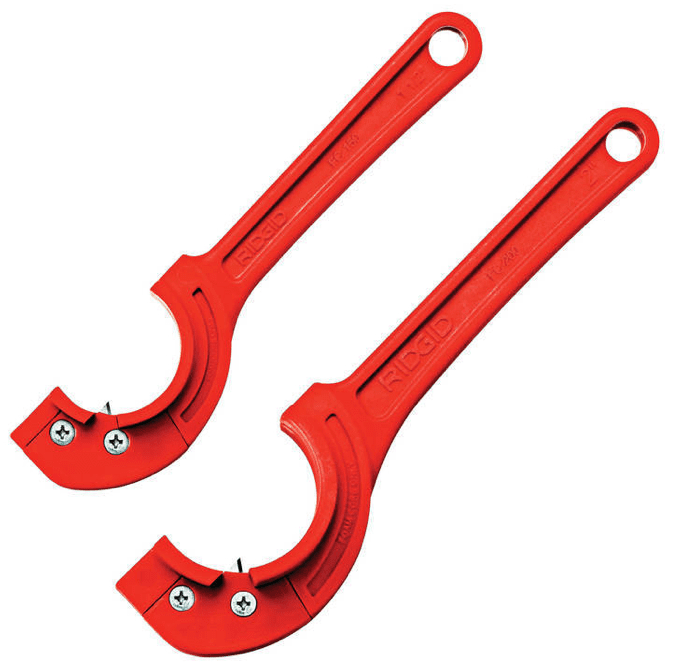
The FC‑Cutters are essentially a spring‑loaded guide with an internal cutting wheel. The tool body is made of a durable polymer, shaped like a C‑clamp that wraps slightly more than halfway around the pipe. A sharp steel cutting wheel is mounted inside the body, positioned to contact the outer wall of the pipe at a precise angle. To use the tool, you simply snap it onto the pipe—the C‑shaped opening flexes slightly, allowing the pipe to seat fully inside the guide channel, and then the polymer body springs back, holding the tool in place with gentle tension. Once the tool is seated, you rotate it once around the circumference of the pipe. As the tool rotates, the cutting wheel traces a continuous, deepening groove around the pipe wall. Because the tool body maintains consistent alignment with the pipe, the cut is perfectly perpendicular to the pipe axis—no wandering, no spiraling, no angled ends that would create a gap at the fitting shoulder. After one full rotation, the pipe is cut through. You lift the tool off, and the severed end falls away, leaving a clean, square edge with no burrs.
The key to the FC‑Cutters' effectiveness is the sharpness of the cutting wheel and the rigidity of the tool body. Unlike a saw, which removes material by abrasion—tearing tiny chips from the pipe wall and inevitably leaving a rough edge—the cutting wheel slices through the plastic by concentrating force into a very narrow line. This slicing action cleanly severs the polymer chains at the cut line without tearing or stretching the surrounding material. The result is a cut surface that is nearly as smooth as the extruded surface of the pipe itself. For ABS and foam core PVC, both of which are relatively soft and amenable to this type of cutting action, the result is a joint‑ready pipe end that requires no additional preparation beyond a quick wipe with primer.
The Two Models: FC‑150 and FC‑200
Ridgid offers two sizes of FC‑Cutter, each designed for a specific pipe diameter. The FC‑150 handles 1‑1/2‑inch pipe and weighs a mere 0.225 pounds—lighter than most pocket knives. The FC‑200 steps up to 2‑inch pipe, the most common size for residential drain, waste, and vent (DWV) applications, and weighs just 0.364 pounds. Both tools are small enough to fit in a tool pouch, a pocket, or the bottom of a toolbox, making them ideal for service plumbers who need to carry a compact kit. The long handle on each tool provides ample leverage for rotating the cutter around the pipe, even in tight spaces where a full 360‑degree swing might be obstructed by joists, studs, or adjacent pipes. In those situations, you can work the cutter back and forth in a ratcheting motion, advancing the cut incrementally without needing a full rotation.
Each cutter ships with an extra blade installed in a storage compartment in the handle, and replacement blades are available in packs of four for a very modest cost. The blades are reversible, effectively doubling their service life. When one side of the cutting wheel becomes dull, you simply flip it over and use the other side. Replacement is tool‑free: the blade is held in place by a thumb screw that can be loosened by hand. This ease of maintenance means a single FC‑Cutter can serve a plumber for years, with the only recurring cost being the occasional blade replacement.
When to Use an FC‑Cutter vs. a Saw or Ratcheting Cutter
The FC‑Cutters are not a universal pipe cutting solution. They are specifically designed for ABS and foam core PVC, two materials that are commonly used in residential DWV systems. ABS is a rigid black plastic with good impact resistance and a relatively low softening temperature; foam core PVC is a lightweight variant of PVC with a cellular inner layer that reduces weight and cost. Both materials respond well to the scoring‑and‑breaking action of the FC‑Cutters because they are brittle enough to fracture cleanly along the score line. For solid‑wall PVC, particularly the pressure‑rated Schedule 40 and Schedule 80 varieties used in water supply and industrial applications, a different tool is required. Solid PVC is tougher and more ductile than its foam‑core counterpart; it resists the scoring‑and‑breaking action and is better cut with a ratcheting shear or a saw. Ridgid offers other tools for those applications, and the FC‑Cutters are intended to complement, not replace, those tools. For the plumber who works primarily with DWV systems, however, the FC‑Cutters cover the vast majority of daily cutting tasks. The 1‑1/2‑inch and 2‑inch sizes correspond to the most common branch and stack sizes in residential plumbing, and the speed and cleanliness of the FC‑Cutter cuts can significantly accelerate the pace of rough‑in and trim work.
Ridgid FC‑Cutter Specifications
| Part Number | Model | Pipe Size | Weight (lbs) |
|---|---|---|---|
| 41703 | FC‑150 | 1‑1/2 inches | 0.225 |
| 40938 | FC‑200 | 2 inches | 0.364 |
| 41768 | Blade Pack (4) | All Models | 0.011 |
Conclusion: A Niche Tool That Earns Its Keep
The Ridgid FC‑Cutters are not flashy. They do not have batteries, lasers, or Bluetooth connectivity. They are simple, mechanical tools that do one job—cut ABS and foam core PVC pipe—and they do it faster and cleaner than any alternative short of a powered saw. For the residential plumber who spends days assembling DWV systems, they are a genuine productivity tool. The time saved by eliminating the deburring step, multiplied across hundreds of cuts on a rough‑in, is substantial. The compact size and light weight mean they are always in the pouch, ready for the next cut. The replaceable, reversible blades mean they can be maintained at minimal cost. And the Ridgid name carries a warranty and a reputation for durability that inspires confidence. At their modest price point, the FC‑Cutters are an easy recommendation for any plumber who has ever wished for a faster, cleaner way to cut plastic pipe, and they are a valuable addition to the toolkit of anyone who works with ABS or foam core PVC.
Comments 0
Leave a Comment