Two Sizes, Same DNA: The Large Wrinkle (SE74) and Small Wrinkle (SE67)
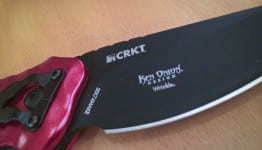
Snap‑on released the Wrinkle in two distinct sizes, both sharing the same fundamental design language. The larger SE74 features a 3.25‑inch blade and a handle that accommodates a full four‑finger grip. The smaller SE67 scales down the blade to approximately 2.75 inches and shrinks the handle proportionally, making it a more pocket‑friendly option for those who prefer a discreet carry. Both knives are built around an IKBS pivot system housed in cold‑forged 6061‑T6 aluminum handles. Both deploy via a flipper tab that doubles as a finger guard when the blade is open. Both lock up solidly with a liner lock that engages with an authoritative click. The larger version is available in four color options, while the smaller is offered in eight, giving buyers an unusual degree of aesthetic choice for a production knife. I received the larger Wrinkle in red and the smaller in black, and both looked striking—the red handle a bold, glossy statement piece, the black handle a more subdued, tactical‑adjacent look.
The naming of the knife—"Wrinkle"—is a Ken Onion signature. He has a penchant for evocative, slightly whimsical names that hint at the knife's personality without taking themselves too seriously. The Wrinkle's personality, as I discovered over weeks of daily carry, is that of a capable, fast‑deploying cutting tool that wants to be used, not merely admired. The full‑belly blade profile, the downward angle of the handle relative to the blade, and the lightweight aluminum construction all point toward a knife designed for slicing efficiency and pocket comfort. This is not a tactical knife, despite its aggressive styling; it is an everyday workhorse dressed in a tailored suit.
Blade Steel and Geometry: AUS‑8, Full Belly, and the Ken Onion Curve
Both sizes of the Wrinkle feature a blade forged from AUS‑8 stainless steel, the same Japanese alloy that has served as the backbone of countless mid‑range production knives. AUS‑8 is not a steel that will win spec‑sheet debates against S30V or 154CM. Its carbon content, around 0.75%, is modest by modern standards, and its edge retention, while perfectly adequate for daily tasks, does not rival the powder‑metallurgy super‑steels. But AUS‑8 has several virtues that make it an excellent choice for a knife at this price point. It is exceptionally easy to sharpen—a few minutes on a ceramic rod or a pocket stone will bring back a hair‑popping edge. It is tough, resisting chipping and rolling even when encountering unexpected hard materials like staples or wire. It takes a very fine edge, allowing the knife to deliver razor‑sharp cutting performance straight out of the box. And it is corrosion‑resistant enough to survive pocket carry in a humid climate without developing rust spots, provided it is given a minimal amount of care.
The blade profile is where Ken Onion's design philosophy becomes most apparent. The Wrinkle employs what Onion calls a “full‑belly” blade—a deeply curved cutting edge that provides an enormous amount of slicing surface relative to the blade length. This profile is ideal for the kind of tasks an everyday carry knife encounters: opening packages, breaking down cardboard, slicing rope, cutting zip ties. The generous belly allows long, smooth draw cuts that engage the maximum amount of blade edge with each stroke. The blade also features a slight downward angle relative to the handle axis—a design element that Onion has used on many of his knives—which positions the cutting edge at a more ergonomic angle for pull cuts and reduces wrist strain during extended use. The spine of the blade is unadorned, with no jimping, and the tip is a fine, acute point suitable for piercing and detail work. A matte black corrosion‑resistant coating covers the blade on both models, giving the knife a cohesive, low‑reflectance appearance that pairs well with the colorful handles.
The IKBS Flipper: Why Opening This Knife Is Genuinely Addictive
The deployment mechanism is the Wrinkle's party piece. The IKBS bearing system, the same technology found in CRKT's higher‑end knives like the Fossil and the Hootenanny, gives the Wrinkle an action that is remarkably smooth for a knife at this price. To deploy the blade, you press rearward on the flipper tab. There is an initial resistance as you overcome the detent, and then—with no spring assist, no torsion bar—the blade glides through its arc on a bed of tiny steel bearings and locks open with a satisfying report. The action is fast, fluid, and deeply satisfying. It is the kind of deployment that makes you want to open and close the knife repeatedly, just to enjoy the mechanical precision of it. I found myself flipping the Wrinkle open during idle moments—while on phone calls, while waiting for coffee to brew—because the action is that enjoyable.
The flipper is a crucial safety feature. When the blade is fully open, the flipper tab extends downward from the tang, creating a substantial finger guard that prevents the index finger from sliding forward onto the cutting edge during use. This is a design element that many flipper knives incorporate, and it is executed well here. The tab is large enough to provide a positive stop for the finger, even when the knife is used forcefully or in awkward positions. The tab is also textured with slight ridges that provide grip for the finger, though the texture is not aggressive enough to become uncomfortable during casual handling.
Closing the knife is a one‑handed operation courtesy of the liner lock. The lock bar is positioned on the right side of the handle (when holding the knife in the right hand) and is easily disengaged with the thumb. As the lock bar is pressed inward, the blade can be pushed forward with the index finger, and the IKBS bearings allow it to swing closed smoothly. The lock bar engages the blade tang fully, with no tendency to slip or walk under pressure. After weeks of use, the lockup remains solid, with no blade play in any direction.
The Aluminum Handle: Lightweight, Strong, and a Slippery Slope
The handles of both Wrinkle models are constructed from cold‑forged 6061‑T6 aluminum, a material that offers an excellent strength‑to‑weight ratio. The handles are significantly lighter than steel or titanium would be, contributing to the knife's overall featherweight feel—the larger Wrinkle weighs just over 4 ounces, and the smaller is even lighter. The aluminum is anodized in the chosen color, producing a vivid, durable finish that resists scratching and corrosion. The handle slabs are machined with a series of longitudinal ridges that create a visually striking tiger‑stripe pattern. These ridges are intended to provide grip, and they do, to a point. But here is the crux of my criticism: the aluminum, even with the ridges, is slick. Not dangerously slick in the sense that the knife will fly out of your hand during normal cutting tasks, but slick enough that a sweaty palm—and I live in Florida, where sweat is a way of life—can feel less secure than it should.
The slickness of the handle is exacerbated by the knife's lightweight construction. A heavier knife, even with a smooth handle, can feel more secure due to its mass; the Wrinkle, being so light, relies almost entirely on grip friction to stay put in the hand. The ridges help, but they are not a substitute for a more textured surface or a rubberized inlay. For indoor use, in an air‑conditioned office or workshop, the grip is perfectly adequate. For outdoor use, in the humidity and heat of a Florida summer, the handle can become something you have to actively think about—and that is a distraction you do not want when using a sharp blade. This is a solvable problem; a light stippling or a matte finish would likely provide the additional texture needed without sacrificing the knife's aesthetic appeal. As it stands, the handle is the Wrinkle's single greatest weakness.
Carry, Ergonomics, and the Ken Onion Angle
The Wrinkle carries easily thanks to its light weight and slim profile. The pocket clip is a single‑position, tip‑down design. This will suit some users and frustrate others; tip‑down carry is the more traditional approach, and it positions the knife for a rapid deployment by pulling the knife from the pocket and rotating it into the palm in a single motion. The clip is reversible for left‑side carry, accommodating both right‑ and left‑handed users. The clip tension is firm, holding the knife securely during activity but not making it difficult to remove.
In the hand, the Wrinkle feels comfortable and natural. The slight downward angle of the handle relative to the blade creates an ergonomic advantage that is most noticeable during extended cutting sessions. When slicing through cardboard, for example, the knife feels like it is naturally oriented to the material, requiring less wrist flexion than a straight‑handled knife. The finger grooves along the handle are generously sized and accommodate a variety of hand sizes. The balance point is slightly blade‑heavy, which aids in cutting strokes by providing momentum that the user can direct. The knife is not designed for heavy‑duty tasks like batoning or prying; it is a slicing tool, and in that role it excels.
Snap‑on Wrinkle Knife Specifications (Large SE74)
| Specification | Detail |
|---|---|
| Model | SE74 (large) / SE67 (small) |
| Blade Steel | AUS‑8 |
| Blade Length | 3.25 inches (large) |
| Blade Finish | Matte black corrosion‑resistant coating |
| Handle Material | Cold‑forged 6061‑T6 aluminum |
| Lock | Liner lock |
| Deployment | IKBS bearing flipper |
| Clip | Single‑position, tip‑down, reversible |
| Weight | 4.0 ounces (large approximate) |
| Designer | Ken Onion, manufactured by CRKT for Snap‑on |
Who Should Carry the Snap‑on Wrinkle?
The Wrinkle is ideal for the Snap‑on enthusiast who wants a matching pocket knife to complement their tool collection. It is a natural gift for the mechanic, the automotive technician, or the Snap‑on franchisee who already owns the tool chest, the ratchet, and the coffee mug. Beyond brand loyalty, the Wrinkle appeals to knife buyers who value deployment speed and smoothness over absolute grip security—those who work primarily indoors, in controlled environments. It is also an excellent choice for the user who appreciates Ken Onion's design language and wants to experience the IKBS bearing system without paying the premium that custom knives command. For outdoor use, for sweaty environments, or for tasks that demand a no‑slip grip, the Wrinkle should be supplemented with a knife that features a more textured handle material. The Wrinkle is the sports car of the folding knife world—fast, stylish, and a joy to operate, but not the vehicle you choose for off‑roading.
Conclusion: A Fast, Fun, and Flawed Gem That Earns Its Place
The Snap‑on Wrinkle is a knife that does not try to be everything to everyone. It is unapologetically a Ken Onion design, with all the curves, the emphasis on slicing geometry, and the addictive flipper action that entails. It is a collaboration that makes sense—Snap‑on brings the brand recognition and the heavy‑duty aesthetic, CRKT brings the manufacturing expertise and the IKBS pivot, and Ken Onion brings the vision. The result is a knife that is fast, fun, and functional, marred primarily by a handle that is too slick for its own good. For indoor everyday carry, for automotive work, for the collector's display case, the Wrinkle is a worthwhile addition. For the outdoorsman, the construction worker, or anyone who demands a lock‑tight grip, look for a knife with more texture. In the end, the Wrinkle does what Snap‑on tools have always done: it does its job with style, precision, and a satisfying mechanical click that makes you want to use it again.
Comments 0
Leave a Comment