Let me be clear about something from the outset: I am not a fan of sissy knives. I have no interest in carrying a blade that feels fragile, that wobbles at the pivot, that requires two hands and a prayer to open. The Twitch II, despite its modest proportions and warm wood inlays, is emphatically not a sissy knife. It is a compact predator dressed in evening wear—a tool that understands discretion is sometimes the better part of capability. The 2.65‑inch blade, forged from AUS‑8 stainless steel and ground into a drop point profile, tapers into a tip that is far more acute than its gentle curves suggest. The SOG Assisted Technology mechanism flings the blade open with a snap that never fails to surprise first‑time users. And the rosewood inlays, set into a stainless steel frame, provide a tactile warmth and visual sophistication that make the knife feel less like a weapon and more like a fine writing instrument. Over the past several weeks, I have put this little knife through a battery of tests that would make most office‑appropriate blades weep for mercy. It has emerged not merely unscathed, but genuinely impressive.
First Impressions: Rosewood, Steel, and the Allure of the Lock‑Bar
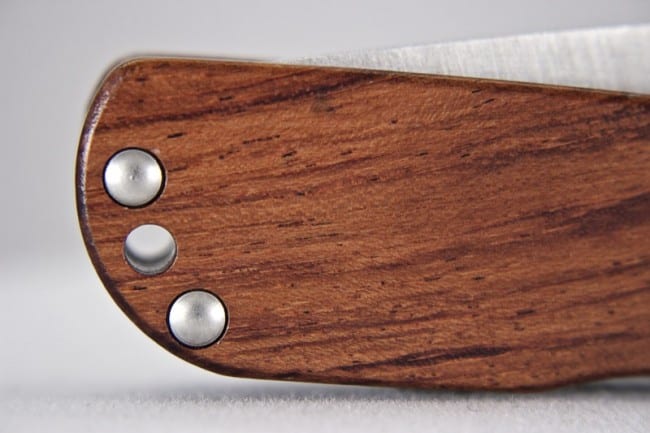
The moment the Twitch II Rosewood emerges from its packaging, the star of the show is immediately apparent. The rosewood inlays—rich, dark, cross‑grained—provide a visual warmth that synthetic materials like G‑10, carbon fiber, or aluminum simply cannot replicate. Rosewood has been prized for centuries in fine furniture, musical instrument fretboards, and high‑end tool handles. It possesses a natural oiliness that gives it a subtle lustre and a smooth, almost waxy feel under the thumb. The inlays on the Twitch II are bookmatched on both sides, meaning the wood grain patterns mirror each other across the handle, a detail that signals attention to aesthetics well beyond the knife's modest price point. The wood is flush with the steel frame, with no gaps or uneven transitions, and the edges are softly radiused so that nothing catches on a pocket seam or a bare palm.
The handle itself is a lesson in old‑school knife construction executed with modern precision. Rather than employing the ubiquitous liner lock or frame lock, the Twitch II uses a lock‑back mechanism—a design that dates back to the classic Buck 110 and remains beloved for its reliability and symmetry. A lock‑back knife does not favor left‑handed or right‑handed use because the release is centered on the spine of the handle, not on one side. For a knife intended to be inoffensive in any setting, this ambidextrous character is a significant asset. The lock bar is a slim steel lever positioned at the rear of the handle, textured with subtle ridges for positive engagement. Depressing it releases the blade and allows one‑handed closing with a flick of the wrist, though most users will probably close the Twitch II against their thigh or a table edge, a technique that becomes second nature after a day of carry.
The fit and finish on the Twitch II Rosewood exceed what I expected at its price point. The blade is perfectly centered between the handle scales when closed. The pivot is tight enough to eliminate side‑to‑side play but smooth enough to allow the S.A.T. mechanism to do its work without hesitation. The steel frame is satin‑finished on the flats and polished along the edges, creating a subtle contrast that catches light without being flashy. The overall impression is one of restrained quality—a knife that does not demand attention but rewards it when given.
Blade Steel and Geometry: AUS‑8 at Its Best
The cutting edge of the Twitch II is formed from AUS‑8 stainless steel, a Japanese alloy that has been a staple of mid‑range production knives for decades. AUS‑8 contains roughly 0.75% carbon, 14% chromium, and small additions of molybdenum and vanadium. It is not a super‑steel in the vein of S30V or M390; it will not hold an edge for months of heavy use without maintenance. What AUS‑8 offers instead is a combination of attributes that makes it exceptionally user‑friendly: it takes a razor‑sharp edge with minimal effort, it resists chipping due to its relatively high toughness, and it sharpens readily on a wide range of abrasives from Arkansas stones to ceramic rods to diamond plates. For a knife that may be sharpened at a kitchen counter with a pocket stone rather than at a dedicated bench with a guided system, AUS‑8 is a pragmatic choice that prioritizes accessibility over absolute performance.
SOG heat‑treats the AUS‑8 to a hardness range of RC 57‑58, which positions the steel in the sweet spot for a balance of edge retention and toughness. At this hardness, the blade is hard enough to resist rolling when cutting abrasive materials like cardboard, yet not so hard that it becomes brittle and prone to micro‑chipping when encountering a staple or a hard knot in wood. The full‑flat grind runs from the spine to the cutting edge without a secondary bevel until the very apex, which is finished with a crisp 16‑degree edge angle per side. The result is a blade that slices with very little resistance, gliding through paper, plastic, and even leather with an ease that belies its compact size. The drop point profile features a gently curved belly that provides ample slicing surface for a blade this small, while the spine sweeps downward in a subtle arc to meet the tip at a point that is sharp enough for piercing tasks like opening clamshell packaging or starting a cut in drywall.
The satin finish on the blade is cleanly executed, with an even scratch pattern running longitudinally from the spine to the edge. It resists corrosion reasonably well; after carrying the knife in the humid Florida summer, including several days when it rode in a pocket damp with perspiration, no rust spots or discoloration appeared. AUS‑8 is not fully stainless in the manner of some high‑chromium powder steels, but it withstands the demands of everyday pocket carry without demanding the vigilance required by high‑carbon tool steels. A periodic wipe with a lightly oiled cloth is sufficient to maintain its appearance indefinitely.
SOG Assisted Technology: The Kick That Launches a Thousand Smiles
The deployment mechanism on the Twitch II is SOG's proprietary S.A.T. (SOG Assisted Technology), and it operates through a cleverly concealed "kick"—a small protrusion at the base of the blade tang that acts as both the flipper and the engagement point for the torsion spring. When the blade is closed, the kick sits flush with the back of the handle, visually unobtrusive but readily accessible to the thumb or forefinger. A firm press on the kick overcomes the detent tension, and the torsion spring immediately takes over, driving the blade through its arc and snapping it into the locked position with an audible click. The action is fast, crisp, and deeply satisfying—the kind of mechanical feedback that makes you want to open and close the knife repeatedly just for the sheer pleasure of feeling it work.
The S.A.T. system is distinct from the SpeedSafe mechanism found on Kershaw knives. Where SpeedSafe uses a bar that travels through a channel in the handle, the S.O.G. system employs a coiled torsion spring that wraps around the pivot pin. Both achieve the same end—rapid, one‑handed deployment—but the feel is slightly different. The Twitch II's action has a lighter initial resistance followed by a forceful snap, whereas some SpeedSafe knives require more thumb pressure before the spring engages. The Twitch II is balanced such that a user with average hand strength can open the knife easily and consistently, while the detent remains firm enough to prevent accidental opening in the pocket. After hundreds of cycles, the action on my sample has not loosened perceptibly nor developed any grittiness.
The lock‑back mechanism that secures the blade is an old‑school design executed with modern precision. Unlike a liner lock, which relies on a thin leaf of steel pressing against the blade tang, a lock‑back uses a robust steel bar that drops into a notch machined into the tang. The geometry of this interface is inherently strong because the forces are oriented vertically, parallel to the handle, rather than laterally. There is zero blade movement when the lock is engaged; the Twitch II feels like a fixed blade in the hand, with no hint of the slight wiggle that plagues some liner‑lock folders at their price point. Disengaging the lock requires pressing the exposed lever on the spine of the handle, which pivots the lock bar upward and releases the tang. It is a deliberate motion that is difficult to perform accidentally, adding a layer of safety that makes the knife appropriate for users who are not knife‑obsessives steeped in the nuances of lock mechanics.
The Rosewood Inlays: Where Craftsmanship Meets Daily Carry
Let us spend a moment on the rosewood itself, because the material is so central to the Twitch II's identity. Rosewood—typically from species in the Dalbergia genus—has been used in fine woodworking for centuries due to its density, stability, and rich coloration. It is a heavy, oily wood that resists moisture and dimensional changes better than most domestic hardwoods. On a knife handle, rosewood offers a combination of aesthetic warmth and tactile comfort that synthetic materials struggle to match. It does not feel cold in the hand the way aluminum or titanium can on a winter morning. It does not abrade the skin like aggressive G‑10 texturing. It simply feels... pleasant, in a way that is difficult to articulate but immediately apparent when you pick up the knife.
My personal connection to woodworking runs deep. My grandfather was an accomplished wood carving sculptor who could transform a block of basswood into an intricate bird in flight using nothing more than a bench knife and sandpaper. My father is a self‑taught carpenter who built the house I grew up in with his own hands. Their reverence for wood—for its grain, its warmth, its living character—transferred to me at a young age. When I hold the Twitch II Rosewood, I think of them. The knife becomes more than a tool; it becomes a small, functional piece of the craft tradition that shaped my family. This is not something that a spec sheet can capture, but it is, I suspect, a significant part of why the rosewood variant resonates with so many buyers. It connects the modern pocket knife to an older, slower tradition of craftsmanship that values beauty alongside utility.
The rosewood inlays are not thick slabs that add bulk to the handle; they are precisely fitted scales that sit within recessed pockets in the steel liners. The inlay thickness is perhaps 2 millimeters, enough to provide a meaningful tactile difference from bare steel but not so much that the handle becomes chunky. The wood is finished with a light sealant that protects against moisture and skin oils without making the surface glossy or slippery. Over time, the oils from the user's hand will deepen the wood's color and develop a patina that personalizes the knife. It is a material that ages gracefully, recording the history of its use in a way that titanium and carbon fiber cannot.
Real‑World Testing: From Credit Cards to Cardboard, This Little Blade Delivers
I subjected the Twitch II Rosewood to a testing regimen that was, I will admit, not entirely fair. A knife designed for office‑appropriate carry typically encounters envelopes, packing tape, loose threads, and the occasional apple. I, however, decided to see what the little SOG could really handle. The first victim was an expired credit card—a thick slab of PVC plastic that had been sitting in my wallet for months awaiting destruction. The shredder was across the hall, and I am constitutionally incapable of passing up a testing opportunity. I pressed the kick, deployed the blade, and drew the edge across the credit card with steady pressure. The AUS‑8 steel bit into the plastic and tracked through it with a satisfying, zippering sound. After three passes, the card was in four pieces. The edge showed no visible dulling, no rolling, no micro‑chipping. A credit card is surprisingly abrasive, and a lesser edge would have blunted noticeably after such a cut. The Twitch II shrugged it off.
Next came a stack of corrugated cardboard—the universal test medium for any knife that claims to be a useful everyday tool. I broke down twenty boxes of varying thickness, from single‑wall shipping cartons to double‑wall appliance packaging. The full‑flat grind made its presence felt here; the blade sliced through the corrugations with significantly less resistance than a hollow‑grind or saber‑grind blade of comparable size. The drop point profile allowed both long draw cuts and precise corner work, and the thin tip made initiating a cut in the middle of a panel effortless. After the marathon cardboard session, the blade was still capable of slicing printer paper cleanly, though it had lost the ability to push‑cut newsprint. A few minutes on a ceramic rod restored the edge to shaving sharpness. AUS‑8's reputation for easy maintenance proved entirely justified.
The knife also tackled plastic clamshell packaging—the bane of modern consumer existence—with aplomb. The fine tip pierced the rigid plastic cleanly, and the sharp edge tracked through it without catching or skating. Zip ties, that other ubiquitous modern nuisance, parted with a single snip when the edge was placed at the tie and pressed with a firm push. Nylon paracord, both 550 and smaller accessory cord, yielded cleanly to the blade's slicing action. Throughout all of these tests, the lock‑back mechanism remained rigid and secure, the handle stayed comfortable in my hand, and the rosewood inlays provided just enough traction to prevent my fingers from sliding forward. The only limitation I encountered was blade length: at 2.65 inches, there is simply not enough edge to make long, sweeping cuts through thick foam or carpet. But that is not a flaw; it is the nature of a compact folder, and the Twitch II makes no pretensions about being more than it is.
Carry Comfort and the Office Environment
The Twitch II shines brightest when evaluated in the context for which it was designed: daily carry in a setting where discretion is paramount. Closed, the knife measures a mere 3.55 inches, shorter than a standard ballpoint pen. It rides in the pocket via a low‑carry stainless steel clip that positions the knife tip‑down, with only the top quarter‑inch of the handle visible above the pocket seam. The clip is not a deep‑carry design that would hide the knife entirely, but it is sufficiently discreet that only someone actively looking for a pocket knife would likely notice it. The clip tension is firm enough to prevent the knife from dislodging during typical daily activities—walking, sitting, climbing stairs—but not so tight that it resists being removed from the pocket. The low‑carry position also means that the knife does not jab into the hip when seated, a common complaint with larger folders carried tip‑up.
The weight of the Twitch II is a remarkable 2.6 ounces. To put that in perspective, it is lighter than a standard AA battery, lighter than most car key fobs, and roughly equivalent to two tablespoons of water. In the pocket, it effectively disappears. I have carried the Twitch II alongside a smartphone, keys, and loose change without ever feeling that my pocket was overloaded or that the knife was competing for space. For the office worker who wants a cutting tool but does not want to rearrange their wardrobe to accommodate one, the Twitch II is an ideal solution.
When deployed, the knife projects an image that is decidedly non‑threatening. The rosewood inlays soften its appearance considerably compared to an all‑black or all‑metal design. The 2.65‑inch blade is well below the threshold that tends to alarm non‑knife‑people; it looks more like a high‑end folding fruit knife than a tactical folder. When I have used the Twitch II to open packages or trim labels in front of colleagues, the reaction has typically been curiosity about the wood handle rather than concern about the blade. That is precisely the balance a discreet EDC should strike: fully capable, visually approachable.
The Lock‑Back: A Dependable Classic That Prioritizes Symmetry and Safety
I want to elaborate on the lock‑back mechanism because it is increasingly rare on modern folders, which have largely migrated toward liner locks, frame locks, and compression locks. The lock‑back, sometimes called a rocker lock or a mid‑lock, operates on a simple principle: a spring‑loaded bar pivots on a pin in the center of the handle. The front of the bar engages a notch in the blade tang when the blade opens; the rear of the bar extends to form the release lever. Pressing the rear lever lifts the front of the bar out of the tang notch, freeing the blade to close. It is a system that has been proven over decades of use on knives that have seen hard service in the field.
The advantages of the lock‑back are several. It is inherently ambidextrous because the release is on the spine, not on one side of the handle. It is strong, with the locking bar typically as thick as the blade stock. It does not rely on the user's grip to maintain lock engagement, as a liner lock does; the spring holds the bar in the tang notch regardless of whether the hand is squeezing the handle. And it positions the release lever far from the blade path, so that closing the knife does not require placing a fingertip in the path of the edge. The drawbacks are that one‑handed closing requires a specific technique and that the lock‑back typically cannot achieve the glass‑smooth "drop shut" action of a well‑tuned liner lock. For the intended audience of the Twitch II—users who value safety, simplicity, and symmetry—these tradeoffs are entirely acceptable.
Maintenance, Long‑Term Durability, and the Wood Care Factor
AUS‑8 steel is straightforward to maintain. After heavy use, a few passes on a fine ceramic rod or a leather strop loaded with compound will restore a working edge. For a full re‑sharpening, a medium diamond stone followed by a fine stone and a strop will bring the edge back to arm‑hair‑shaving sharpness within ten minutes. The flat‑ground blade is easy to sharpen because the entire bevel face registers against the stone, providing a natural angle guide. Users who are new to sharpening will find the Twitch II forgiving and unintimidating.
The rosewood inlays require minimal care but benefit from occasional attention. If the knife is used in wet conditions or exposed to excessive sweat, the wood can be wiped down with a dry cloth. Every few months, a tiny drop of mineral oil or a dedicated wood conditioner can be applied to the inlays to maintain their luster and prevent drying. The wood is sealed, so casual moisture exposure will not cause swelling or warping, but prolonged submersion should be avoided. The pivot can be lubricated with a drop of light machine oil to maintain smooth action. The lock‑back mechanism is largely self‑contained; the spring is not user‑serviceable, and the pivot of the lock bar is not externally accessible. Under normal use, the mechanism should function without attention for the life of the knife.
SOG Twitch II Rosewood Handle Knife Specifications
| Specification | Detail |
|---|---|
| Type | Assisted Folder |
| Blade Finish | Satin |
| Blade Style | Drop Point |
| Edge | Straight |
| Blade Steel | AUS‑8 |
| Blade Thickness | 0.1 inches |
| Hardness | RC 57‑58 |
| Handle | Rosewood inlays on stainless steel |
| Belt Clip | Low carry |
| Length (Open) | 6.2 inches |
| Length (Closed) | 3.55 inches |
| Length (Blade) | 2.65 inches |
| Weight | 2.6 ounces |
Final Thoughts: The Sophisticated Gentleman's Answer to Everyday Cutting Needs
The SOG Twitch II Rosewood occupies a niche that is surprisingly underserved in the modern knife market. It is a genuinely capable cutting tool dressed in materials that evoke craftsmanship and tradition rather than aggression and tactical posturing. The AUS‑8 steel, while not exotic, is perfectly matched to the knife's intended role: it sharpens easily, resists corrosion adequately, and holds an edge long enough for the kind of light to moderate cutting tasks that fill most people's days. The S.A.T. assisted opening is fast, reliable, and—crucially—fun to use, adding a mechanical delight to the simple act of deploying a blade. The lock‑back mechanism provides solid, ambidextrous security that inspires confidence without demanding expertise. And the rosewood inlays elevate the entire package from mere tool to personal accessory, something you look forward to carrying and using, not just something you tolerate because it is practical.
For the office worker who wants a knife that will not alarm coworkers, the Twitch II is nearly perfect. For the knife enthusiast who already owns a collection of tactical folders and wants something that can accompany a suit or dress slacks, it fills a gap that G‑10 and titanium cannot bridge. For the person who simply appreciates wood as a material and wants to carry a small piece of craftsmanship in their pocket every day, the rosewood inlays are a constant, quiet pleasure. It is not the knife for a survival situation, nor for heavy construction work, nor for defensive carry. But it was never meant to be those things. It is exactly what it set out to be: a compact, elegant, capable everyday carry knife that bridges the gap between the utilitarian and the refined, between the job site and the boardroom, between the tradition of woodworking and the precision of modern manufacturing. SOG has delivered a knife that honors the past while serving the present, and for under fifty dollars, it stands as one of the best values in the gentleman's carry category.
Comments 0
Leave a Comment