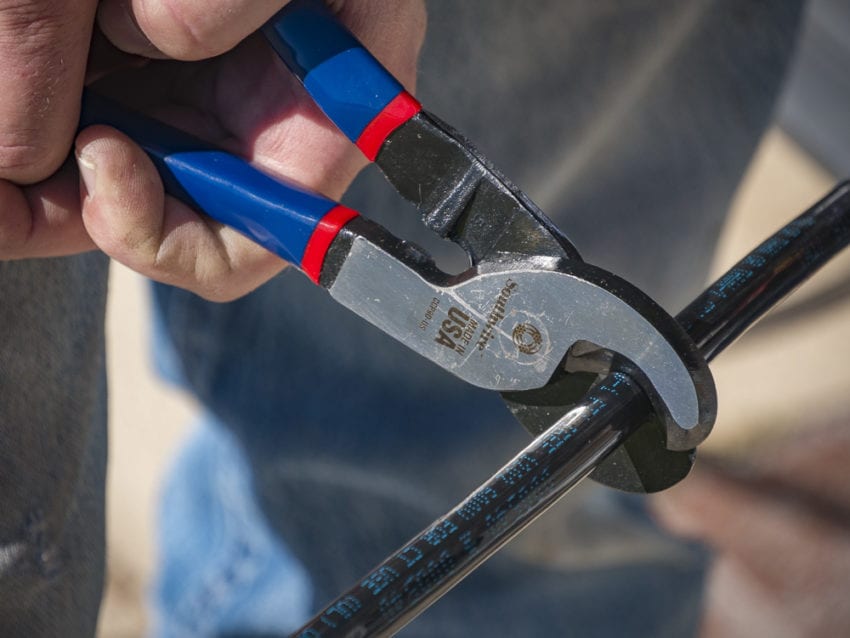
What distinguishes one pair of cable cutters from another is not obvious to the casual observer. Cable cutters, from a distance, look more or less identical: two crossed pieces of steel with insulated handles and a set of cutting blades near the pivot. The differences that matter are in the details that cannot be seen at arm's length but that become immediately apparent the moment the tool is put to use. The quality of the steel—whether it was forged from a billet that was free of voids and inclusions, whether its grain structure was properly aligned by the forging process, whether its carbon content and alloying elements were carefully controlled—determines how well the blades will hold an edge and how much force the tool can withstand without bending or breaking. The quality of the heat treatment—whether the blades were hardened to the correct depth and hardness, whether the transition between the hardened edge and the tough core was properly managed—determines whether the blades will chip when they encounter a hard spot in a conductor or roll when they are asked to cut a material near the limit of their capacity. The quality of the pivot—whether it was hot‑riveted, cold‑riveted, or assembled with a nut and bolt—determines how smoothly the tool opens and closes and whether it will develop the maddening looseness that allows the blades to separate under load. The quality of the edge geometry—whether the blades were hand‑filed to the correct angle, whether the bevel is symmetrical, whether the cutting edges meet evenly across their full length—determines whether the tool cuts cleanly or crushes, whether it requires one hand or two, and whether it leaves a cable end that is ready for termination or one that requires additional cleanup with a knife. The Southwire CCP9D‑US, by all indications, excels in each of these categories.
Drop‑Forged Steel: The Foundation of Durability
The raw material for the CCP9D‑US begins as American‑sourced steel, which is heated to a plastic state and then hammered into shape in a drop forge. This process is ancient in concept but remarkably sophisticated in execution. Under the repeated blows of the forge hammer, the steel's internal grain structure flows along the contours of the tool, like the grain in a piece of wood. A properly forged tool has a continuous, uninterrupted grain that follows the curve of the handles, the shoulders, and the jaws, providing maximum strength in the directions where the tool will experience stress. A cast tool, by contrast, has a random, unstructured grain that is riddled with microscopic discontinuities—the internal equivalent of knots in wood—that can act as starting points for cracks. A stamped tool, cut from a flat sheet of steel, has its grain running in a single direction, regardless of the tool's geometry, which means that some parts of the tool will be strong while others will be inherently weak. The forging process eliminates the fissures, air bubbles, and inclusions that would otherwise compromise the steel's integrity. The result is a pair of cable cutter halves that are dense, homogeneous, and ready to be machined into their final form.
Once forged, the steel goes through a series of machining operations that shape the jaws, the cutting blades, the pivot bore, and the handle tangs. The pivot bore is drilled and reamed to a precise diameter, ensuring that the hot rivet will fit tightly and that the two halves will align perfectly. The cutting blades are rough‑ground to approximate their final shape, then sent through the induction hardening process. Induction hardening is a selective heat treatment that uses an electromagnetic field to heat only the cutting edge region. The rest of the tool remains relatively cool, retaining its original toughness and ductility. The heated edge is then quenched, transforming its microstructure into hard, wear‑resistant martensite. The result is a tool that is hard at the edge—where hardness is needed to retain sharpness—and tough everywhere else—where toughness is needed to resist bending and breaking. This is the ideal combination for a cutting tool, and it is achieved through precise control of the induction heating parameters. Once hardened, the blades are hand‑filed to their final edge angle. A skilled file operator can feel the development of the edge through the file, sensing when a burr has been removed and when the bevel is symmetrical. The hand‑filing process ensures that each pair of cutters leaves the factory with a sharp, precise, uniform edge.
The Hot Rivet: A Joint That Improves With Age
The pivot joint on the CCP9D‑US is hot‑riveted, a process that involves heating a steel rivet until it glows, inserting it through the aligned pivot bores, and then hammering or pressing it into shape while it is still hot. As the rivet cools, it contracts, pulling the two plier halves together with a precise, uniform tension that is distributed across the full area of the joint. The cooled rivet is flush with the surface of the steel, leaving no protruding nut, bolt head, or rivet tail to snag on wires or scratch finished surfaces. The hot‑riveted joint is inherently self‑adjusting; as the pliers wear over decades of use, the rivet maintains its tension through the simple physics of thermal expansion and contraction. A cold‑riveted joint, by contrast, relies on the deformation of a room‑temperature rivet, which never achieves the same degree of tightness or uniformity. A nut‑and‑bolt joint, while convenient for disassembly and repair, inevitably loosens over time unless it is secured with thread‑locking compound—and even then, the constant cycling of the handles works against it. The hot rivet is the mark of a premium tool, and its presence on the CCP9D‑US signals Southwire's commitment to building cutters that will last.
The smoothness of the action is immediately apparent when you first pick up the CCP9D‑US. The handles open and close with a fluid, hydraulic motion, with no trace of the gritty, notchy feel that characterizes a poorly fitted joint. This smoothness is not merely a tactile pleasure; it has a practical benefit. When you are cutting cable, especially large cable that requires significant force, you want the entire closing motion to be transmitted into the cutting edges, not absorbed by friction in the pivot. A smooth pivot means that more of your hand force reaches the workpiece, and less is wasted overcoming internal resistance. It also means that the tool is easier to control, which is important when you are making a critical cut that must be positioned precisely—trimming the end of a conductor to length before terminating it, for example, or cutting a bundle of communication cables without nicking the inner conductors.
Cutting Capacity and Edge Performance
The CCP9D‑US is rated to cut up to 4/0 AWG aluminum, 2/0 AWG copper, and 100‑pair 24 AWG communications cable. These are substantial capacities that cover the vast majority of cables an electrician encounters in residential, commercial, and light industrial work. 4/0 aluminum is a large conductor—the kind used for service entrance cable feeding a 200‑amp residential panel. 2/0 copper is similarly heavy, used for large feeders and sub‑panels. The 100‑pair telecom rating means the cutters can handle the thick, multi‑conductor bundles found in telephone and data installations. For the electrician who works on a mix of power distribution and low‑voltage systems, the CCP9D‑US provides a single tool that can handle both ends of the spectrum. The cutting edges are shaped with a slight curve, which helps to grip the cable and prevent it from sliding forward as the blades close. This geometry is particularly effective on large, round conductors, which can otherwise roll out of flat‑bladed cutters. The blades meet evenly across their full length, with no gap at any point. This is critical for a clean cut; if the blades do not meet, the cable is not fully severed and must be torn apart, leaving a ragged end. The CCP9D‑US cuts cleanly, leaving a conductor end that is ready for termination with no additional trimming required. The handles are dipped in a thick, rubbery coating that provides grip and comfort. The dip is chemically resistant, so it will not degrade from contact with the oils, solvents, and general grime of an active jobsite. The handles are long enough to provide good leverage, and they are shaped symmetrically to accommodate the standard grip and the reversed grip equally well. The overall weight of the tool—substantial enough to feel durable, light enough to use overhead without fatigue—strikes a good balance. There is a tether hole at the end of one handle for users who work at height and need to secure their tools.
Quality Control: The Final Inspection
Each pair of CCP9D‑US cutters undergoes a thorough evaluation before leaving the factory. This is not a batch inspection, where a sample of tools from a production run is tested and the rest are assumed to be acceptable. Southwire individually inspects each pair of cutters. The inspector checks the alignment of the blades, the smoothness of the pivot, the uniformity of the cutting edges under magnification, and the overall fit and finish. This level of quality control is more commonly associated with premium hand‑tool brands like Klein and Knipex than with a brand that was primarily known, until recently, for wire and cable. It is a statement of intent. Southwire is not merely stamping its name on a generic offshore tool and calling it a day. The company is building professional‑grade hand tools in the United States, to a standard that holds up against the established giants of the industry.
Southwire Made in America Cable Cutting Plier Specifications
| Specification | Detail |
|---|---|
| Model Number | Southwire CCP9D‑US |
| Material | American forged steel |
| Pivot | Hot‑riveted |
| Cutting Edges | Induction hardened, hand‑filed |
| Cutting Capacity | Up to 4/0 AWG aluminum, 2/0 AWG copper, 100‑pair 24 AWG communications cable |
| Handle | Dipped grips |
| Warranty | Hassle‑free lifetime |
| Country of Origin | USA |
| Retail Price | ~$37 |
Conclusion: An American Cable Cutter That Earns Its Price
At around $37, the Southwire CCP9D‑US is not the cheapest cable cutter on the shelf, and it does not try to be. It is a premium tool built to a premium standard, and its price reflects the American labor, the American materials, and the individual attention that go into its manufacture. For the electrician who uses cable cutters as a primary tool—who reaches for them dozens of times a day, who relies on them to make clean, accurate cuts in conductors that will carry power for decades—the investment in a quality tool is not an extravagance. It is a practical necessity. The CCP9D‑US cuts cleanly, operates smoothly, and withstands the rigors of daily professional use. It is backed by a hassle‑free lifetime warranty, which means that if it ever fails due to a manufacturing defect, Southwire will replace it. The "Made in the USA" stamp on the steel is not just a patriotic flourish; it is a representation that the tool was built by workers who were paid American wages, in a factory subject to American environmental and safety regulations, from steel that was melted and poured in an American mill. For many professionals, that matters. For all professionals, the performance of the tool matters, and on that front, the CCP9D‑US delivers. It is a worthy addition to any electrician's tool bag, and a strong entry from a company that is clearly committed to competing in the premium hand‑tool space.
Comments 0
Leave a Comment