Understanding D2: The Steel That Punches Above Its Weight
D2 has a long and storied history in the tool and die industry, where it has been used for decades to make blanking dies, forming rolls, and shear blades—applications that demand exceptional wear resistance. Its carbon content is high, typically 1.5%, and it contains approximately 12% chromium, which places it just below the threshold for being classified as fully stainless (most stainless steels require at least 13% chromium). This means D2 offers better corrosion resistance than high‑carbon non‑stainless steels like 1095, but it will develop a patina or surface rust if neglected in wet environments. In terms of edge retention, D2 significantly outperforms mid‑grade steels like 8Cr13MoV and AUS‑8, and it approaches the performance of S30V in some categories, though it is generally less tough and slightly more brittle. The trade‑off is that D2 is more difficult to sharpen than simpler steels, requiring diamond or ceramic abrasives to efficiently cut its hard chromium carbides. For the knife user who values a long‑lasting working edge and is willing to invest a bit more effort in maintenance, D2 is an outstanding choice. For the user who wants to quickly touch up an edge on a pocket stone between tasks, D2 may feel stubborn. Southwire's decision to use D2 across the EdgeForce line signals that these knives are intended for people who understand and appreciate steel, who are willing to trade a bit of sharpening convenience for a blade that stays sharp through days of heavy use.
The Three Models: Tanto, Drop Point, and Sheepsfoot—Each With Its Own Character
The EdgeForce lineup is not a series of minor variations on a single theme. Each of the three models is distinctly different in size, blade style, and intended use, and each carries its own model number and pricing tier.
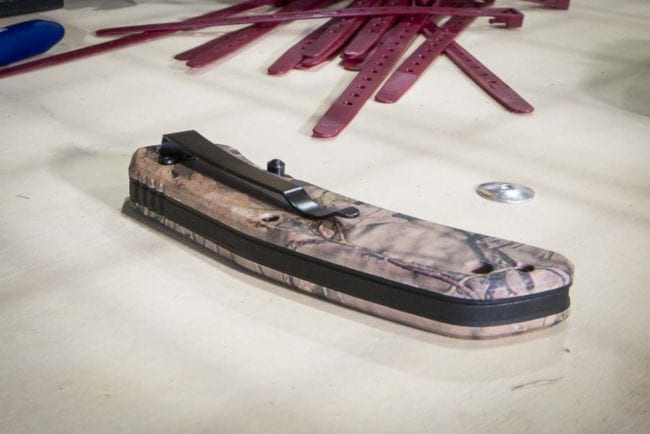
The TBKND2‑CAMO is the largest and most expensive of the trio, with an overall open length of 8.18 inches and a 3.45‑inch blade. It features a partially serrated tanto profile, a blade style that originated in Japanese sword design and was adapted for tactical knives due to its strong, reinforced tip. The tanto point resists snapping under lateral stress, and the partially serrated edge provides a sawing capability that is useful for cutting rope, strapping, and fibrous materials. The handle is decorated in Mossy Oak camouflage, appealing to hunters and outdoor enthusiasts, and the blade carries a stonewash finish that hides scratches and wear. This model has an MSRP of $30.32.
The DPKD2 is the middle child, with a 7.91‑inch open length and a 3.26‑inch plain‑edge drop‑point blade. The drop point is the most versatile and widely recommended blade shape for general everyday carry, offering a balanced combination of tip strength, belly for slicing, and ease of sharpening. The plain edge is straightforward to maintain and excels at clean push cuts. The handle is black, without camouflage, giving the knife a more subdued, professional appearance suitable for a work environment. The MSRP is $22.98, making it the middle option in price as well as size.
The CSPKD2 is the smallest and most affordable, with a 6.44‑inch open length and a 2.58‑inch sheepsfoot blade. The sheepsfoot profile is characterized by a straight cutting edge and a spine that curves downward to meet it, resulting in a blade with no acute piercing tip. This makes it exceptionally safe for use in environments where an accidental puncture could be dangerous—around livestock, on a boat deck, or in a crowded workspace—and it excels at slicing cuts where a tip is not needed. The plain edge and compact size make it a convenient pocket knife for light daily tasks. The MSRP is $19.98, positioning it as an impulse‑friendly entry point into D2 steel.
Handle Design, Ergonomics, and the Deployment Gap
All three EdgeForce knives feature handles with a contoured shape that fits comfortably in the palm, and each handle incorporates a rubber overmold panel that enhances grip security. The overmold is positioned on the primary grip area, providing a soft, high‑friction surface that resists slipping even when the hand is wet or gloved. I wish the overmold wrapped further around the handle to cover more contact points when the knife is held in a forward grip, but the coverage is adequate for most cutting tasks. The pocket clips are functional, though the clip on the sheepsfoot model is noticeably weaker than the clips on the larger two knives. Both the drop‑point and sheepsfoot models allow for tip‑up or tip‑down carry, though the clip is not reversible for left‑hand use. The camo tanto model has a single‑position tip‑up clip.
Deployment is the area where the EdgeForce knives diverge most significantly from the assisted‑opening and bearing‑equipped competition. These knives use a manual thumb‑stud opening with no spring assist and no ball‑bearing pivot. The resistance is noticeable—you must apply deliberate pressure to the thumb stud and follow through with a wrist flick to fully deploy the blade. It is not the buttery‑smooth, one‑finger deployment that enthusiasts have come to expect from brands like Kershaw and CRKT. This is the trade‑off for the D2 steel at this price point: the money went into the blade material, not into a refined pivot mechanism. For the working professional who deploys a knife a few times an hour to cut something and then puts it away, the manual opening is entirely acceptable. For the enthusiast who fidgets with their knife during meetings and values deployment speed as a primary criterion, the Southwire EdgeForce knives will feel unpolished.
Southwire EdgeForce D2 Pocket Knife Specifications
| Model | Blade Style | Blade Length | Open Length | Steel | Clip | MSRP |
|---|---|---|---|---|---|---|
| TBKND2‑CAMO | Partially Serrated Tanto | 3.45 in. | 8.18 in. | D2 | Tip‑Up | $30.32 |
| DPKD2 | Drop Point | 3.26 in. | 7.91 in. | D2 | Tip‑Up/Down | $22.98 |
| CSPKD2 | Sheepsfoot | 2.58 in. | 6.44 in. | D2 | Tip‑Up/Down | $19.98 |
The Bottom Line: D2 for the Masses, With a Few Rough Edges
The Southwire EdgeForce pocket knife lineup is a bold move by a company that is still establishing its credentials in the knife market. By offering D2 steel at prices that undercut virtually every other D2‑equipped knife on the market, Southwire has created a compelling value proposition for budget‑conscious buyers who prioritize edge retention above deployment refinement. The knives are well‑built, with comfortable handles, secure liner locks, and functional pocket clips. The blade grinds are even, and the edges are sharp out of the box. The manual thumb‑stud deployment is the most significant compromise, and it will be a dealbreaker for some users. But for the electrician, the plumber, the HVAC installer, or the weekend DIYer who wants a knife that will hold an edge through a long day of cutting and can be replaced without financial pain if lost or damaged, the EdgeForce series delivers genuine performance at a price that feels like an error. Southwire may not yet be a household name in knives, but with products like these, it is well on its way.
Comments 0
Leave a Comment