The Principle Behind the Cut: A Rotating Blade That Never Touches Conductor
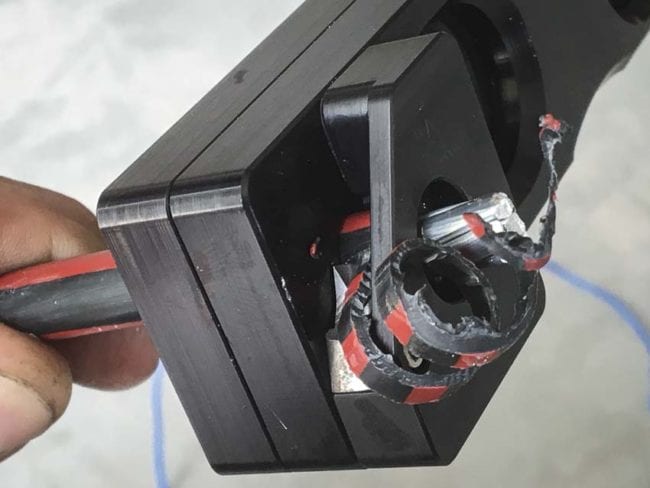
To appreciate why the Southwire XT Mini Stripper is such an effective tool, it helps to understand the fundamental challenge it solves. Traditional methods of stripping heavy‑gauge wire—ringing the jacket with a utility knife and then peeling it back, or using a pair of cable cutters to score the insulation—are inherently imprecise. The depth of the cut is entirely dependent on the user's hand pressure and angle, and the margin between "deep enough to separate the jacket" and "deep enough to gouge the copper" is vanishingly small. The XT‑02 solves this problem with a replaceable, concave blade that is pre‑tensioned to a specific depth. The blade is curved inward, matching the circumference of the wire, and it is mounted in a spring‑loaded clamp that applies consistent, controlled pressure. When you close the tool around the wire and begin rotating it, the blade bites into the insulation at exactly the right depth—deep enough to sever the jacket cleanly, but shallow enough that the underlying copper is never touched.
The mechanism operates via a cam‑action clamp that is actuated by squeezing the hinged handles together. The middle finger hole is the one you use to initiate the cut; by closing your hand, you open the jaws of the stripper, which allows you to place the wire into the cutting channel. When you release pressure, the spring‑loaded clamp closes around the wire, and the blade engages the insulation. Then you simply rotate the tool around the wire in a clockwise direction. As you rotate, the blade traces a perfect spiral around the circumference of the jacket. Because the tool is applying angular pressure into the cut—you are not just rotating, but pressing lightly into the workpiece as you turn—the blade wallows into the insulation and carves a clean, beveled channel. When you have completed one or two full rotations, you simply stop applying angular pressure, and the blade disengages. The jacket is now cut through along a spiral path, and you can pull the XTS‑02 off the wire while simultaneously sliding the severed insulation away. The result is a cleanly stripped section of wire with an edge that tapers smoothly—no jagged cuts, no knife marks on the copper, no strands of jacket material clinging stubbornly to the conductor.
Build Quality and Ergonomics: Aluminum, Spring Steel, and a Single‑Hand Operation
The XTS‑02 is built around an aluminum frame that strikes a satisfying balance between weight and portability. It is heavy enough to feel substantial in the hand—you know you are holding a serious tool, not a toy—but light enough that using it overhead or in awkward positions does not induce immediate fatigue. The handles are contoured to fit the palm, and the spring‑loaded clamp mechanism requires only moderate hand strength to operate. The blade is a replaceable precision‑curved steel insert, held in place by a small set screw, and Southwire sells replacement blades inexpensively. This is a significant long‑term value consideration; rather than buying a new stripper when the blade dulls, you simply swap in a fresh blade and keep working. The blade's concave geometry is the secret to its effectiveness on round cable. A flat blade would bite into the insulation at two points, creating a V‑shaped cut that risks nicking the conductor at the deepest point. The concave blade matches the curve of the wire, distributing the cutting force evenly around the circumference and ensuring a consistent depth of cut.
Real‑World Testing: Stripping 1/0 Underground Feeder Cable
Our test case was a 100‑foot run of 2‑phase 1/0 aluminum underground feeder cable, buried in conduit and pulled into a sub‑panel at the shop. Stripping the ends of this cable is not a trivial task. The jacket is thick, tough, and designed to resist abrasion, moisture, and direct burial conditions. Using a utility knife would have required carefully scoring the jacket around the circumference—a process that is both slow and prone to error—or making a longitudinal cut and peeling the jacket like a banana, which often leaves ragged edges and can still nick the wire if the blade penetrates too deeply. The XTS‑02 made short work of it. We placed the wire into the open jaws, released the clamp, and began rotating. The first rotation was slightly stiff, as the blade bit into the tough outer jacket, but subsequent rotations smoothed out as the blade tracked in its own spiral cut. After two complete rotations, we stopped applying angular pressure and pulled the tool off. The jacket separated cleanly, leaving a perfectly stripped section of wire ready for termination. There was no damage to the conductor, no ragged edges, and the stripped length was exactly what we needed.
Capacity and Compatibility: #6 AWG Through 1/0, THHN, XHHW, and More
The XTS‑02 is compatible with a range of common insulation types, including THHN, XHHW, RHH, RHW, and USE jackets. This means it can handle the thermoplastic and thermoset insulations found on everything from branch circuit wiring to service entrance cable. The capacity range of #6 AWG through 1/0 covers the vast majority of residential and light commercial applications. For larger cable—up to 1000 MCM or outside diameter sizes from 0.33 inches to 1.284 inches—Southwire offers the XTS‑01, which operates on the same principle but in a larger, heavier package. For the electrician who works primarily on residential services, sub‑panels, and light commercial feeders, the XTS‑02 is the right size. It lives in a tool bag without consuming excessive space, and it is always ready for the next pull.
Comparison to Other Stripping Methods: Why the Southwire XT Series Wins
I have used a variety of cable strippers over the years. Some are end‑cut designs, where you place the tool on the end of the cable and crank it around with brute wrist strength, stripping off a ring of insulation at the very end. These work, but they are slow, they require significant hand strength for larger cables, and they often leave a rough edge. Others use a rotational handle for better ergonomics, allowing you to spin the tool around the cable with a crank rather than your wrist. These are faster, but they typically only make a single ring cut, after which you must manually pull the jacket off—a task that can be surprisingly difficult with cold, stiff insulation on a winter morning. The Southwire XT series combines the best of both worlds. The rotational action is smooth and requires minimal effort, thanks to the pre‑tensioned blade and the cam‑action clamp. The spiral cut means the jacket is severed along its length as well as around its circumference, so it slides off the wire with a gentle tug rather than requiring a wrestling match. And because the blade never touches the conductor, there is zero risk of creating a stress riser or a hot spot in the copper. For the professional electrician, this is not a luxury—it is a fundamental requirement for safe, code‑compliant work.
Price and Value: $124 for a Lifetime of Clean Strips
The XTS‑02 is not an impulse purchase. At a retail price around $124, it is a tool that demands a justification. For the homeowner or the occasional DIYer who strips heavy‑gauge wire once every few years, it is probably overkill; a sharp utility knife and a careful hand will suffice. But for the professional electrician who terminates dozens or hundreds of cables per year, the XT Mini Stripper pays for itself rapidly in time saved and mistakes avoided. Consider the cumulative minutes spent carefully scoring and peeling each cable with a knife, multiplied across a year's worth of jobs. Then consider the cost—in both dollars and reputation—of a single nicked conductor that fails an inspection, causes a callback, or, worst of all, creates a latent safety hazard that does not manifest until years later. In that context, $124 is a modest investment. The replaceable blade system further extends the value; a single tool, properly maintained, can last a career.
Conclusion: A Specialist Tool That Redefines Efficiency
The Southwire XT Mini Stripper XTS‑02 is the kind of tool that, once used, makes you wonder how you ever managed without it. It transforms a task that was traditionally a finicky, high‑risk operation into a quick, repeatable, nearly mindless process. The spiral cutting action, the pre‑tensioned concave blade, and the spring‑loaded clamp all work together to deliver a clean, damage‑free strip every time. The tool is built to professional standards, with an aluminum frame and replaceable blades that ensure longevity. It is not cheap, and it is not intended for casual users. But for the electrician who pulls and terminates heavy‑gauge wire regularly, it is one of those rare purchases that actually makes the workday shorter, safer, and more satisfying. We used it to strip the 1/0 feeders that power our shop, and it performed flawlessly. It will be in our tool bag for every sub‑panel and service upgrade from now on.
Comments 0
Leave a Comment