The Math of 120 Teeth: Why More Teeth Means Less Swing
The geometry of a ratchet is determined by a single variable: the number of teeth on the gear. The arc swing required to engage the pawl is calculated by dividing 360 degrees—the full circle—by the number of teeth. For a 60‑tooth ratchet, 360 divided by 60 equals 6 degrees. For a 120‑tooth ratchet, 360 divided by 120 equals 3 degrees. It really is that simple, and the practical implications are enormous. In a tight space where the ratchet handle can only move through a 5‑degree arc before it hits an obstruction, a 60‑tooth ratchet is useless. The handle cannot swing far enough to engage the next tooth, so the fastener cannot be turned. You are stuck. With a 120‑tooth ratchet, that same 5‑degree arc is more than enough to engage the pawl and advance the fastener. The reduced swing arc transforms an impossible task into a slow but possible one. The user can work the ratchet in tiny increments, each 3‑degree swing advancing the fastener by a fraction of a turn, until it is loose enough to remove by hand or tight enough to finish with a torque wrench. This is not a theoretical advantage. Anyone who has worked on a modern vehicle—or on any piece of machinery where packaging is tight and access is an afterthought—has encountered fasteners that are located in positions that seem to have been designed by someone who had never held a wrench. The 120‑tooth ratchet is the tool you reach for in those situations, and the difference between 6 degrees and 3 degrees is the difference between continuing the job and walking away in frustration.
Stanley achieves the 120‑tooth specification using a dual‑pawl mechanism. Instead of a single pawl engaging the gear, two pawls are arranged so that one is always in contact with the gear teeth. As the handle is swung, one pawl ratchets over the teeth while the other is positioned to engage immediately when the direction is reversed. This dual‑pawl design distributes the load across two contact points, reducing wear on the individual pawls and increasing the overall strength of the mechanism. The gear and pawls are manufactured from hardened steel, with precise tooth profiles that ensure smooth, positive engagement. The ratchet operation is smooth and quiet, with a fine, rapid clicking sound that is audibly distinct from the slower, coarser sound of a 60‑tooth ratchet. The feel is light and precise, with minimal back‑drag—the resistance that the mechanism creates when ratcheting in the reverse direction. Low back‑drag is critical for working in tight spaces, because it means the ratchet does not require significant effort to swing through its return arc. You can work the tool with your fingertips, making tiny adjustments without losing control.
The Low‑Profile Switch Lever and Black Chrome Finish: Thoughtful Details
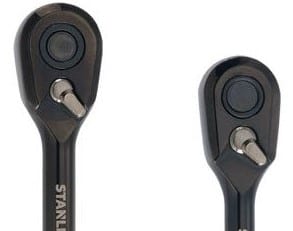
The direction switch on the Stanley 120‑Tooth Ratchet is a low‑profile lever positioned on the back of the ratchet head, just above the handle. The lever is designed to be operated with the thumb of the hand that is holding the ratchet, allowing for true one‑handed operation. The low profile is more than an ergonomic preference; it is a deliberate feature that prevents accidental switching. There are few things more frustrating than ratcheting a fastener through a long, tight swing arc, only to have the direction lever catch on an adjacent component or your own glove and reverse itself, undoing the progress you just made. The low‑profile lever minimizes the surface area that can be snagged, and it requires a deliberate, positive motion to switch directions. It is not going to flip on its own, no matter how contorted the workspace. The lever is marked with directional indicators that are easy to read in low light, and the switching action is crisp and definitive.
The finish on the ratchet is black chrome, a plating process that deposits a thin layer of chromium over a black nickel undercoat. The result is a finish that is both attractive and functional. It resists rust and corrosion far better than bare steel or standard chrome plating, which is particularly important for a tool that will be exposed to oil, grease, brake fluid, and the other corrosive substances that populate an engine bay or a machinery shop. The black chrome also has a slightly textured appearance that hides fingerprints and minor scratches better than a bright chrome finish. The handle is contoured with a series of grooves that provide a secure, comfortable grip, and the overall length of the tool provides adequate leverage for most fastening tasks. A large quick‑release button on the back of the ratchet head allows sockets to be removed easily, even when they are coated in oil or when the user's hands are gloved. The button is recessed to prevent accidental activation while working.
The Extended Handle and Available Sizes
The Stanley 120‑Tooth Ratchet is available in two drive sizes: 3/8‑inch and 1/2‑inch. Both models feature extended handles compared to standard ratchets in their respective classes. The extended handle provides greater leverage, which means the user can apply more torque to a stubborn fastener without switching to a breaker bar or a longer ratchet. For the 3/8‑inch model, the extended handle is particularly valuable because 3/8‑inch drive ratchets are often used for mid‑range fasteners that can be surprisingly tight—brake caliper bolts, suspension fasteners, engine mounts—and the extra length provides the mechanical advantage needed to break them loose. The 1/2‑inch model, with its larger drive anvil, is suitable for higher‑torque applications, and the extended handle further amplifies the user's input force. The trade‑off for the extended handle is that the ratchet is slightly longer and heavier than a standard‑length model, which can be a liability in extremely tight spaces where overall length is the limiting factor. However, for the vast majority of applications, the additional leverage is a benefit that outweighs any minor increase in size. Stanley prices the ratchets between $14.99 and $24.99, depending on the drive size and the retailer. At that price, the 120‑tooth ratchet is positioned as a value‑oriented alternative to premium ratchets from brands like Snap‑on, Matco, and Mac Tools, which can cost ten times as much. It is not a professional‑grade tool in the sense of being designed for daily use in a production shop where the ratchet will see hundreds of cycles per day, year after year. But for the automotive enthusiast, the weekend mechanic, the maintenance technician, or the tradesperson who uses a ratchet as part of a broader tool kit, the Stanley 120‑Tooth Ratchet offers a level of performance and precision that far exceeds its price point.
Stanley 120‑Tooth Ratchet Specifications
| Specification | Detail |
|---|---|
| Tooth Count | 120 teeth |
| Arc Swing | 3 degrees |
| Mechanism | Dual‑pawl, quick‑release |
| Drive Sizes | 3/8‑inch and 1/2‑inch |
| Handle | Extended length, contoured with grooves |
| Finish | Black chrome |
| Direction Switch | Low‑profile, thumb‑operated |
| Price Range | $14.99 – $24.99 |
Conclusion: A Budget‑Friendly Ratchet That Thinks It's a Premium Tool
The Stanley 120‑Tooth Ratchet is a compelling argument that high tooth count is not a luxury reserved for expensive professional tools. By packing 120 teeth into an affordable, well‑finished ratchet, Stanley has made the benefits of a fine‑tooth mechanism—the reduced arc swing, the smooth operation, the ability to work in impossibly tight spaces—accessible to the home mechanic, the automotive enthusiast, and the value‑conscious professional. The dual‑pawl design provides the necessary strength for the mechanism, and the extended handle offers the leverage needed to break loose stubborn fasteners. The low‑profile switch lever, the black chrome finish, and the quick‑release button are thoughtful details that enhance the user experience. At under $25 for either drive size, the Stanley 120‑Tooth Ratchet is an exceptional value. It is not going to displace a Snap‑on ratchet from the toolbox of a professional mechanic who uses the tool twelve hours a day, but for the rest of us—the weekend wrenchers, the DIYers, the tradespeople who need a reliable ratchet that can handle tight spaces—it is an easy recommendation. It proves that, even in a category as old and well‑established as the ratchet, there is still room for improvement, and that improvement does not have to come with a premium price tag.
Comments 0
Leave a Comment