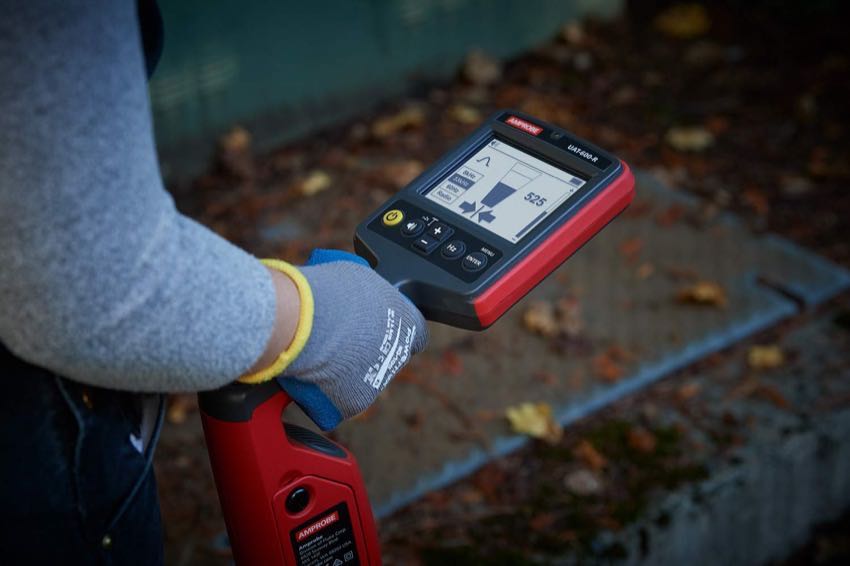
The Three Modes of Operation: Passive Power, Passive Radio, and Active Tracing
The UAT‑620 can locate buried utilities using three different methods, each of which is suited to a different set of circumstances. The two passive modes—passive power and passive radio—do not require the use of the transmitter. The receiver alone, when tuned to the appropriate frequency, can detect the electromagnetic fields that naturally surround energized electrical cables (50 or 60 Hz, depending on the local power grid) or the fields from distant radio transmissions that are re‑radiated by long, buried metallic objects acting as antennas. Passive power mode is the quickest method for locating an energized electrical cable: simply turn on the receiver, select the 50/60 Hz mode, and walk over the area to be scanned. The receiver will indicate the presence and the approximate location of any buried cable that is carrying current. Passive radio mode works on a similar principle but uses radio frequencies—typically from distant AM broadcast stations—that are picked up and re‑radiated by buried metallic objects, including pipes and cables that are not energized. Passive radio mode can detect metallic utilities that would be invisible to passive power mode, but it is less precise and does not allow the user to identify the specific utility that is being detected. For precise, unambiguous locating of a specific line, the active mode is used. The transmitter is connected to the utility line that is to be traced—either directly, via test leads, or inductively, via a clamp that is placed around the line without making electrical contact. The transmitter injects a signal of a known frequency—8 kHz or 33 kHz, selectable by the user—into the line. The receiver, tuned to the same frequency, can then trace the precise path of that specific line, even when it is surrounded by other utilities that are carrying different signals or no signal at all. The active mode is also used to measure the depth of the buried line. By placing the receiver on the ground directly above the line and activating the depth measurement function, the user can read the depth on the receiver's display. The depth measurement is accurate to within 3% for depths from 4 inches to 10 feet, and within 5% for depths from 10 feet to 20 feet. The ability to connect the transmitter directly to an energized line up to 600V in a CAT IV environment is what sets the UAT‑600 series apart from many competing underground locators. With other tools, if you needed to trace an energized electrical cable by injecting a signal into it, you first had to de‑energize the cable—a process that involves coordinating with the utility, shutting off power to customers, and performing lockout‑tagout procedures. The UAT‑620 can be connected directly to the energized line, safely and legally, without interrupting service. This capability saves time, reduces disruption, and simplifies the locating process for electrical contractors and utility workers.
The Transmitter, the Receiver, and the A‑Frame Accessory
The UAT‑620 kit includes the transmitter, the receiver, a test lead kit, a signal clamp, batteries, fuses, and a duffel bag for transport. The transmitter is a rugged, portable unit that can be powered by its internal batteries or, for extended use, by an external AC adapter. It can inject a signal directly into a line, or it can use its internal induction antenna to radiate a signal into the ground around it, which is useful when direct connection or clamping is not possible. The receiver is a lightweight, handheld unit with a large, backlit display that shows the signal strength, the depth measurement, and the selected mode and frequency. The receiver uses both a peak mode and a null mode to help the user zero in on the exact position of the buried line. In peak mode, the receiver indicates the point of maximum signal strength—directly above the line. In null mode, the receiver indicates the point of minimum signal strength—also directly above the line, but with a sharper, more precise indication that is useful for fine‑tuning the location. The receiver also includes an automatic backlight that adjusts to the ambient lighting conditions, and a battery status indicator. The optional AF‑600 A‑frame accessory can be used to locate ground faults on buried cables. The A‑frame consists of two probes that are inserted into the ground, and it measures the voltage gradient between them. By moving the A‑frame along the path of the cable and observing the direction of the voltage gradient, the user can pinpoint the location where the cable's insulation has failed and current is leaking into the earth.
Amprobe UAT‑620 Specifications
| Specification | Detail |
|---|---|
| Model | UAT‑620 |
| Measurement Category | CAT IV 600 V |
| Active Tracing Frequencies | 33 kHz and 8 kHz |
| Passive Tracing | 50/60 Hz and radio |
| Locating Modes | Peak and null |
| Depth Accuracy (4 in. to 10 ft) | ±3% |
| Depth Accuracy (10 ft to 20 ft) | ±5% |
| Power Supply (Receiver) | 6 × AA batteries |
| Power Supply (Transmitter) | 8 × D‑cell batteries |
| Weight (Receiver) | 4.2 lbs |
| Weight (Transmitter) | 7 lbs |
| Price | ~$3,870 |
Conclusion: The Tool That Sees What Lies Beneath
The Amprobe UAT‑620 is not a tool for the casual user. Its price, its complexity, and its intended application place it firmly in the professional category. For the contractor, the utility worker, the electrical fault locator, or the site engineer who is responsible for ensuring that excavation proceeds safely and without incident, the UAT‑620 is an essential piece of equipment that pays for itself many times over in avoided damage, avoided downtime, and avoided liability. It is a tool that takes the guesswork out of underground locating, replacing the approximate, "somewhere in this area" markings of 811 with a precise, traceable, and measurable location. In a world where the ground beneath our feet is increasingly crowded with buried infrastructure, the ability to see what lies beneath before breaking ground is not a luxury—it is a necessity.
Comments 0
Leave a Comment