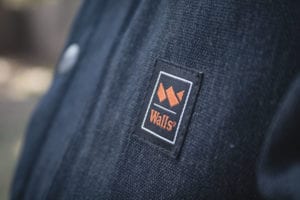
A bulletproof vest is likely the first image that comes to mind when you hear the word Kevlar, but the high‑tensile‑strength synthetic fiber has many applications. The 10‑ounce brushed duck fiber blend of the Walls Workwear Jack‑Shirt is 5 percent Kevlar with DWR—Durable Water Repellent—20 percent polyester, and 75 percent cotton. It certainly gives the impression of being rugged while appearing stylish enough to pass for something other than workwear. You could wear this around town without giving away that you just came from the job site. The Jack‑Shirt features double‑needle diamond‑quilt construction, large silver snaps, an adjustable cuff, an interior media loop, and a Realtree AP lining that will be unmistakable to outdoorsmen. All great elements, to be sure, but two others really stand out: the two pockets with dual entry and the bi‑swing back. Dual entry pockets mean that there is a large pouch design that opens at the top as well as a traditional pocket entry for your hands in the same area. The pockets do not connect, of course, but it gives you ample room for storage as well as a place to warm your hands. Greater still is the bi‑swing back, whose design is readily apparent just below the yoke. It is meant to give the wearer a large range of mobility and comfort.
Comfort and Movement: The Bi‑Swing Back and Polyester Blend in Action
My company, Quality Maintenance and Building Services, has many projects in process from cleaning ponds to landscaping to building homes. I am constantly on the move performing the work, supervising the work, or jumping in and out of the truck to do some of both. I even did a little mechanic work during the review. Any apparel that restrains movement or is not constructed well just will not last long. But right from the start, I found the Walls Workwear Jack‑Shirt with Kevlar extremely comfortable. I could stretch my arms without the slightest restriction, thanks to the bi‑swing back and polyester in the blend. The bi‑swing back is an ingenious piece of garment engineering that dates back to the early days of outdoor workwear. Traditional jacket backs are a single piece of fabric, sewn flat, which means that when the wearer extends their arms forward or upward, the back of the jacket pulls tight across the shoulder blades, restricting movement and causing the jacket to ride up. A bi‑swing back solves this problem by incorporating two overlapping pleats—essentially, folds of fabric that lie flat when the arms are at rest but that expand outward when the arms are extended. The pleats open up, providing additional fabric where it is needed, and the wearer experiences none of the binding or restriction that a traditional back would cause. It is a feature that is commonly found on premium hunting and outdoor jackets, and its inclusion on a work‑wear garment at this price point is a testament to Walls' commitment to functional design.
The Jack‑Shirt is warm but not overly so. In fact, I worked in it from the mid‑50s to just about 80 degrees as the mornings warmed. I found it to provide enough comfort while allowing a little airflow since it is not tight‑fitting. I might run a little colder than the other guys, but I found just opening the front kept me comfortable as temps rose. From a movement standpoint, I could even wear my tool belt and move around freely wearing the Jack‑Shirt zipped up. The design did not interfere with the tools, and if I unzipped it, I could easily reach my tools. Overall, the Walls were more roomy and comfortable than my other work jackets from those big name manufacturers. I think that is because Walls does not taper the Jack‑Shirt down to the waist while others do. That lack of taper, combined with the bi‑swing back and the polyester content, creates a garment that moves with the wearer rather than against them. For the professional who spends their day bending, reaching, lifting, and carrying, the mobility that the Jack‑Shirt provides is not merely a comfort feature—it is a productivity tool that reduces the fatigue and frustration of working against one's own clothing.
Pockets, Construction, and the Kevlar Difference
The dual‑entry pockets are perfectly placed and easy to reach, as were both pockets on the inside. It might seem like a small thing, but having pockets that make you raise your elbow too high or reach too far inside when you are working can really be cumbersome. The pockets are also quite large. I kept portions of the building plans, permits, and my phone in the inside pockets, which was really convenient. I really like the material. It is soft but very tough, thanks to the stitching and Kevlar blend. The seams appear to be very strong. I even pulled at all the joints and the threads held fast. I scraped the jacket against a lot of abrasive stuff while I worked—rusty trailer, nails, concrete—and there is not a mark on it. Quite often I have to get in the cabinet under a kitchen sink to inspect or plumb, so I did just that. Once again, the Jack‑Shirt did not restrict my movement in the confined space.
Walls does not bill the Jack‑Shirt as waterproof, but the Kevlar's DWR coating repels water. You can see it clearly working as water beads up on the fabric. I would not use it as a raincoat, of course, but it is nice to know that in temperatures that require a jacket, you will not have to suffer through being wet, too. Just to be sure I was not missing anything, I lent the Jack‑Shirt to one of my carpenters while he erected some walls. He also found it to be exceedingly comfortable in 60‑to‑65‑degree weather, offering a full range of movement without restriction. He, too, wore his full tool belt while using a nail gun and was able to easily hang and access the gun from under the jacket. I had to ask for the Jack‑Shirt back a couple of times—that is how much he liked it.
The Kevlar content in the fabric is worth a closer examination. Kevlar, developed by DuPont in the 1960s, is a para‑aramid synthetic fiber with a tensile strength that is five times that of steel on an equal‑weight basis. It is best known for its use in ballistic body armor, but it has found applications in everything from aerospace composites to cut‑resistant gloves to high‑performance sporting goods. In a fabric blend like the one used in the Jack‑Shirt, the Kevlar fibers provide a dramatic increase in abrasion resistance and tear strength compared to a conventional cotton‑polyester blend. The 5 percent Kevlar content is not enough to make the garment bulletproof—that would require a much higher concentration of the fiber, arranged in a much denser weave—but it is enough to make the fabric significantly more resistant to the kind of rough, abrasive contact that characterizes construction and mechanical work. A shoulder scraped against a concrete wall, a sleeve dragged across a rusty trailer hitch, an elbow rubbed against a rough‑sawn stud—these are the daily insults that, over time, wear holes in conventional work shirts and jackets. The Kevlar in the Jack‑Shirt resists that wear, extending the life of the garment and maintaining its appearance even after months of hard use. The DWR treatment on the Kevlar fibers adds water repellency to the blend, and the overall combination of materials creates a garment that is greater than the sum of its parts—a shirt that is as durable as a heavy jacket but as comfortable and mobile as a lightweight flannel.
At a list price of $101.99, the Walls Workwear Jack‑Shirt with Kevlar is an investment in workwear that will outlast and outperform multiple cheaper alternatives. Online pricing frequently dips well below that figure, making it an even more compelling value. For the professional who needs a warm, durable, and mobile layer for cool‑weather work, who values pockets that are large and accessible, and who wants a garment that can survive the daily abuse of the job site and still look presentable enough to wear to the hardware store or the diner at the end of the day, the Jack‑Shirt is a standout product in a crowded category. It is a hybrid—a shirt that thinks it is a jacket, or perhaps a jacket that thinks it is a shirt—and it is a hybrid that works. The bi‑swing back, the Kevlar‑reinforced fabric, the dual‑entry pockets, and the thoughtful, generous fit combine to create a garment that does exactly what workwear is supposed to do: it protects the wearer, it organizes their tools, it moves with them, and it lasts. The Walls Workwear Jack‑Shirt with Kevlar is a tool, in the truest sense of the word, and it is a tool that belongs in the closet of every professional who works in the cool seasons of the year.
Walls Workwear Jack‑Shirt Specifications
| Specification | Detail |
|---|---|
| Item Number | Walls YJ337 |
| Fabric | 10‑oz brushed duck: 75% Cotton, 20% Polyester, 5% Kevlar with DWR |
| Lining | Realtree AP with 6‑oz insulation |
| Stitching | Double‑needle diamond‑quilt |
| Pockets | 2 dual‑entry exterior, 2 interior |
| Back Design | Bi‑swing for unrestricted movement |
| Cuffs | Adjustable with sleeve placket |
| Closure | Large silver snaps |
| MSRP | $101.99 |
Comments 0
Leave a Comment