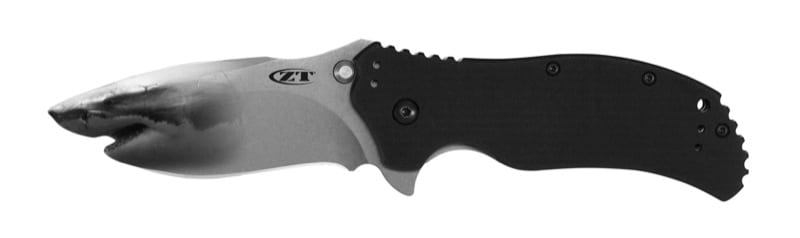
Zero Tolerance is a division of KAI USA Ltd., the same company that owns the widely‑respected Kershaw brand based in Tualatin, Oregon. While Kershaw targets a broad audience of enthusiasts and everyday carriers, ZT was conceived with a narrower mission: to produce hard‑use, tactical‑grade knives for military personnel, law enforcement officers, and first responders who demand unyielding reliability. The 0350SW, designed by Ken Onion, distills that mission into a 7.75‑inch package that manages to feel both massive and perfectly balanced. It is a knife that wears its capability openly, from the deep hollow‑grind belly of its S30V blade to the textured G‑10 scales that grip the palm like a handshake from a lifelong friend.
The S30V Blade: A Masterclass in Edge Retention and Cutting Geometry
The heart of any folding knife is its blade, and the 0350SW is equipped with Crucible Industries’ S30V stainless steel—a powder‑metallurgy alloy that for many years represented the gold standard of premium production‑knife steels. S30V contains a carefully engineered balance of carbon, vanadium, chromium, and molybdenum that yields a steel with exceptional wear resistance, high hardness, and sufficient corrosion resistance to shrug off humidity, sweat, and incidental contact with acidic materials. The vanadium‑rich carbide structure enables the steel to take an extremely fine edge and hold it through prolonged use, often requiring only a stropping to return to hair‑popping sharpness after weeks of moderate cutting tasks. It is not the easiest steel to sharpen freehand on a pocket stone; the same wear resistance that preserves the edge also resists the abrasive action of a sharpening rod. But once dialed in on a quality guided system or diamond plate, S30V rewards the user with a working edge that lasts measurably longer than the mid‑grade steels found on most sub‑$100 folders.
On the 0350SW, that S30V blade is shaped into a drop‑point profile that gracefully curves upward toward a fine, penetrating tip while maintaining a generous, sweeping belly ideal for slicing. The blade is not heavily recurved—a design choice that makes field sharpening far more straightforward than a hawkbill or a pronounced recurve would permit. The hollow grind removes material from the blade flats, reducing drag when cutting through thick material like cardboard, leather, or nylon webbing. The stonewashed finish—hence the “SW” in the model designation—replaces the DLC coating found on earlier iterations, giving the blade a softer, more organic appearance that hides scratches exceptionally well. A stonewashed blade does not show wear the way a satin or bead‑blast finish does; each new scratch simply blends into the pre‑existing pattern, allowing the knife to age gracefully and honestly, like a good pair of jeans.
The spine of the blade features a modified swedge, a shallow bevel that runs from roughly the midpoint of the blade toward the tip. A swedge adds no cutting capability—it is purely cosmetic—but it dramatically refines the visual profile, giving the 0350SW the sleek, hydrodynamic look of a great white shark. It also subtly reduces tip weight, contributing to the knife’s overall balance. The swedge is not sharpened, so there is no risk of cutting oneself when pressing down on the spine for controlled cutting tasks. Below the swedge, the blade spine is interrupted by a thumb ramp with aggressive jimping that locks the thumb securely in place when using a forward grip. The jimping is not so sharp that it causes pain during prolonged use, but it provides enough texture to prevent slippage even with wet or gloved hands.
Deployment: SpeedSafe and the Flipper‑and‑Thumb‑Stud Tango
Zero Tolerance equips the 0350SW with Kershaw’s SpeedSafe assisted‑opening mechanism, a torsion‑bar system that completes the blade’s travel once the user overcomes a relatively strong detent. The primary deployment method is the ambidextrous flipper tab, which protrudes from the spine when the knife is closed. A firm press of the index finger is all that is required to overcome the detent and launch the blade toward its open position with a satisfying, authoritative thwack. The spring is robust enough that the blade locks open reliably even if the wrist is not flicked, making one‑handed opening straightforward regardless of hand size or glove thickness.
The knife also includes dual thumb studs, a concession to users who prefer a stud‑actuated deployment. However, in practice, the left‑hand thumb stud is positioned so close to the handle scale that it becomes functionally useless for a left‑handed opener. The right‑hand stud works, but it requires considerably more force than the flipper; the detent resistance on this knife is tuned for the leverage advantage of the flipper tab. Most users will quickly learn to rely on the flipper exclusively, which doubles as a substantial finger guard when the blade is open. The flipper extends far enough below the handle to prevent the index finger from sliding forward onto the cutting edge during a thrust, a safety feature that becomes instinctive after only a few days of carry. The assisted opening is robust and consistent across thousands of cycles, though like all assisted mechanisms, it benefits from an occasional drop of lubricant at the pivot to maintain peak smoothness.
The G‑10 Handle: Texture, Ergonomics, and a Pocket Clip That Does Not Intrude
The handle of the 0350SW is composed of two slabs of textured black G‑10, a glass‑fabric‑reinforced epoxy laminate prized for its strength, stability, and resistance to chemicals and moisture. G‑10 is essentially a high‑performance composite that originated in the electronics industry as a substrate for printed circuit boards. Its use in knife handles provides a material that is lighter than steel or titanium, impervious to rot, and capable of accepting aggressive three‑dimensional texturing without compromising structural integrity. The 0350SW’s G‑10 scales are milled with a pattern that strikes a careful balance between traction and comfort—it is rough enough to prevent the knife from squirming in a sweat‑slick palm during hard cutting, but not so aggressive that it abrades bare skin or chews through the corner of a pocket.
The handle profile is a masterpiece of ergonomic design. The spine is gently arched, filling the palm naturally when the knife is held in a standard hammer grip. There are no sharp corners or abrupt edges; every surface that touches the hand has been radiused thoughtfully. The forward choil, formed by the flipper tab and a deep index‑finger notch, provides a secure purchase for choking up on the blade for detail work. The overall length of the handle is generous—4.5 inches when closed—accommodating a full four‑finger grip on the scales alone, with no need to pinch the butt or press the pinky against the rear corner. This is a knife that truly fits the hand, regardless of glove size.
One of the most impressive aspects of the handle design is the manner in which the pocket clip integrates into the grip. The 0350SW offers four possible clip positions: tip‑up or tip‑down on the right side, and the same on the left side. In each of the four orientations, the clip does not create a hot spot or pressure point against the palm. This is a rare achievement. Many knives, when reconfigured to a different clip position, place the clip across a location where it digs into the hand during use. The 0350SW manages to recess the clip into the G‑10 scale or position it along a flat of the frame such that it becomes virtually unnoticeable. The clip itself is a deep‑carry design that conceals the knife fully in the pocket, leaving only a small ZT logo visible above the seam. It holds with sufficient tension to prevent accidental loss, yet slides on and off the pocket smoothly without snagging or tearing the fabric.
The Liner Lock: A Beefy Steel Gate That Inspires Confidence
Flipping the knife over reveals the liner lock, a thick slab of stainless steel that engages the blade tang with a solid, authoritative click. Liner locks on cheaper knives can often be thin and prone to flexing under heavy load, but the 0350SW’s liner lock is noticeably robust—measuring over 0.05 inches in thickness by visual estimation—and cut from the same quality steel as the handle’s internal frame. The lock bar contacts the blade tang at full engagement, with no tendency to slip or walk under spine pressure. Disengaging the lock is smooth and predictable; the thumb can easily press the lock bar inward while the index finger starts the blade forward, allowing one‑handed closing without a moment of anxiety. The lock bar is also positioned far enough from the pivot to provide excellent mechanical advantage, making it easy to unlock even with cold or tired fingers. The lock’s geometry includes a slight over‑travel stop that prevents the bar from moving past its optimal position and becoming stuck, a detail that speaks to Ken Onion’s deep understanding of lock mechanics.
Weight, Carry Comfort, and the iPhone Analogy
At 5.8 ounces, the 0350SW is not a lightweight knife by the standards of modern carbon‑fiber‑framed gent’s folders. But weight, when properly distributed, conveys presence rather than bulk. The knife balances precisely at the forward index‑finger groove when open, giving the blade a lively, responsive feel in the hand despite its substantial size. In the pocket, the 0350SW carries surprisingly well. The key is not its absolute weight, but how it occupies space: the wide, flat profile distributes the knife’s mass across a broad area, preventing the concentrated pressure point that a narrow, heavy knife creates. The experience is analogous to carrying a modern smartphone in a front pocket. An iPhone, for example, is not light, yet most people do not find it obtrusive because its broad face lies flat against the thigh. The 0350SW behaves the same way, settling unobtrusively into the pocket and often being forgotten until needed. I have carried both my phone and this knife in the same pocket on many occasions without issue. For those who find the weight initially daunting, a week of daily carry is usually sufficient to acclimate, after which lighter knives may begin to feel insubstantial by comparison.
Edge Retention, Sharpening, and the Real‑World Cutting Experience
Over the course of a month of daily use, the 0350SW’s S30V blade was subjected to a predictable but rigorous diet of materials: double‑wall corrugated cardboard, heavy‑duty zip ties, nylon paracord, plastic strapping, rubber hose, leather, and the occasional inadvertent encounter with a staple. Out of the box, the factory edge was sharp enough to push‑cut newsprint with minimal effort. After the first week, that initial hair‑whittling sharpness gave way to a solid working edge that still cleanly sliced receipt paper but no longer treetopped arm hair. The edge then plateaued, holding a useful level of sharpness for another two weeks of intermittent use before requiring a touch‑up. Sharpening S30V is a deliberate process best performed with diamond abrasives or high‑quality ceramic stones; inexpensive aluminum oxide stones will struggle to cut the vanadium carbides efficiently. However, once the correct abrasives are employed, the steel responds willingly, taking a fine polish that returns the edge to near‑factory keenness. The hollow grind reduces the cross‑sectional area behind the edge, meaning less steel must be removed to restore geometry, which offsets some of the difficulty inherent in the steel’s wear resistance.
The blade’s generous belly makes it an exceptional slicer, allowing long, fluid draw cuts through materials like leather and rope. The tip is fine enough for detail work, such as piercing plastic packaging or scribing lines in wood, but thick enough behind the swedge to withstand reasonable side‑pressure without snapping. The knife is not a dedicated pry bar, and no folding knife should be used as such, but the 0350SW’s tip can handle the occasional light prying task without immediate failure—a testament to the balance Onion struck between piercing ability and durability.
One Nitpick: The Jimping’s Aggressive Edge
If the 0350SW has a flaw that bears mentioning, it is the aggressiveness of the jimping on the spine of the G‑10 handle. When using the flipper to deploy the blade, the fingertip naturally drags across this jimping as the index finger follows through the flipping motion. The jimping is sharply machined and can abrade the skin after repeated firings, particularly if one’s hands are not heavily calloused. This effect is amplified for those who fidget with their knives, opening and closing the blade repeatedly during idle moments. Over time, the fingertip develops a slight callus that mitigates the discomfort, and it is possible to adjust technique to minimize contact. Nevertheless, a slightly softer peak on the jimping teeth would have improved the out‑of‑the‑box experience without sacrificing traction. It is a minor criticism in the context of an otherwise superbly executed design, but it warrants mention for buyers with sensitive hands.
Who Should Carry the Zero Tolerance 0350SW?
The 0350SW is not a “gentleman’s pocket knife” in the traditional sense; it will not seamlessly blend into a pair of dress slacks, nor will it go unnoticed in a conservative office environment. It is a tool for those who ask more from their everyday carry than opening envelopes and trimming stray threads. Military personnel, law enforcement officers, paramedics, construction professionals, and serious outdoor enthusiasts will find in the 0350SW a reliable, hard‑use folder that does not flinch when confronted with demanding cutting tasks. The S30V steel and robust locking mechanism imbue the knife with a margin of safety and performance that lesser knives cannot provide. For the knife enthusiast who appreciates American craftsmanship—Zero Tolerance manufactures the 0350SW in the USA—and who values an heirloom‑quality tool that can be passed down to the next generation, the 0350SW stands as an iconic choice. It is a knife that feels, from the first moment it fills the hand, like it will outlast its owner.
Zero Tolerance 0350SW Specifications
| Specification | Detail |
|---|---|
| Overall Length | 7.75 inches |
| Blade Length | 3.25 inches |
| Blade Thickness | 0.12 inches |
| Blade Steel | S30V Stainless |
| Handle Material | Textured Black G‑10 |
| Closed Length | 4.50 inches |
| Handle Thickness | 0.494 inches |
| Weight | 5.8 oz. |
| Warranty | Limited lifetime |
| Price | $140 |
Final Verdict
The Zero Tolerance 0350SW continues to occupy a special place in the landscape of production folding knives, even years after its initial release. Its combination of premium S30V steel, ergonomically sculpted G‑10 handle, reliable SpeedSafe deployment, and a stonewashed finish that hides the scars of honest use makes it a compelling choice for anyone who needs a knife that works as hard as they do. It appeals on a visceral level—the heft, the solid lock‑up, the authoritative sound of the blade snapping into place—but it also rewards rational scrutiny with its thoughtful ergonomics and material quality. Whether carried as a duty knife, an outdoor tool, or a trusted EDC companion, the 0350SW lives up to the ZT promise of “No‑nonsense performance.” It is, in the truest sense of the phrase, a knife that would make Mick Dundee pause and nod in respectful approval.
Comments 0
Leave a Comment